


Analysis Region: Gyeonggi-
do Key Regions: Southern Gyeonggi High-tech Industrial Axis and Data Center Location Areas including Yongin, Icheon, Pyeongtaek, and Hwaseong
Agenda: Electricity, Water, Transmission Networks, and Local Acceptance Responding to the Growth Rate of Semiconductors, AI, and Data Centers Readiness
Golden Time Type: Critical + Opportunity
Reference Date: August 28, 2026
Version: Regional AX Golden Time Intelligence v3.1
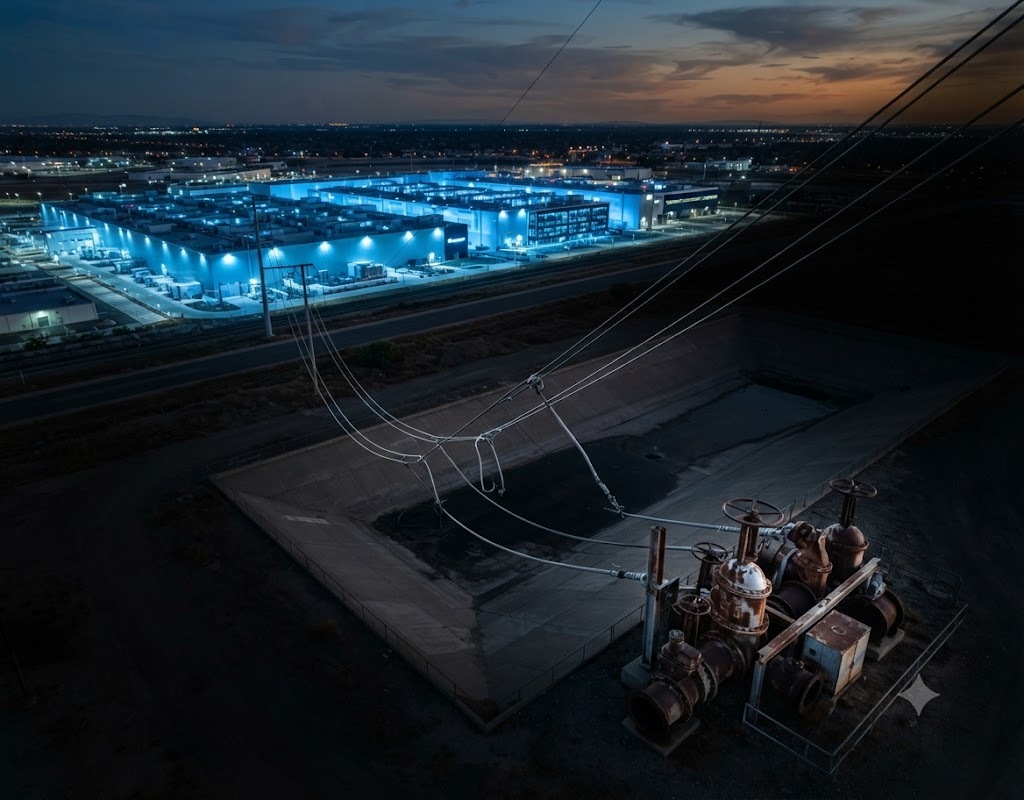
In Gyeonggi Province's competition for high-tech industries, the resources most likely to become scarce in the future are not companies or industrial complexes, but electricity and water .
Looking solely at the Yongin Semiconductor Cluster, the Ministry of Trade, Industry and Energy is formulating a plan to secure a power supply capacity of over 10 GW in the long term . The 11th Basic Plan for Electricity Supply and Demand proposes a structure in which an initial 3 GW LNG power generation capacity is connected to the Yongin National Industrial Complex via a mid-to-long-term long-distance transmission network, while initial substations and interconnection lines are constructed for general industrial complexes, followed by the supply of power from the East Coast after 2039. The very fact that the government has separately reflected the power needs of the semiconductor cluster in the national long-term power plan implies a level of electricity demand distinct from that of general industrial complexes. ( Ministry of Trade, Industry and Energy )
The scale of water supply is also substantial. The Yongin Semiconductor Industrial Complex Integrated Water Supply Project, promoted by the Ministry of Environment and the Korea Water Resources Corporation, aims to supply 1,072,000 cubic meters per day by 2034 with an investment of approximately 2.2 trillion won . In Phase 1, a 46.9 km pipeline will be constructed from Paldang Dam to Yongin to supply 310,000 cubic meters per day starting in 2031, with plans to expand to Phase 2 thereafter. ( Ministry of Environment )
However, these figures should not be interpreted as meaning that electricity and water have been secured. A significant portion of the electricity supply requires the construction of power plants, substations, and transmission lines in the future, and as of 2026, the first phase of basic and detailed design for water is still underway. Supply plan ≠ supply completion .
Bottlenecks in the power sector have already become a reality. The Yongin General Industrial Complex, centered around SK Hynix, faced a mid-to-long-term power shortage of an additional 3GW , so Gyeonggi Province and Korea Electric Power Corporation (KEPCO) devised a plan to jointly construct a power grid in the underground space of Provincial Road 318 between Yongin and Icheon by January 2026. A working-level consultative body was even launched in May 2026. ( Gyeonggi News Portal )
At the same time, power demand from AI data centers is also increasing rapidly. The 11th Basic Plan for Electricity Supply and Demand projects domestic data center power demand to reach 6.2 GW by 2038 , reflecting an additional demand of 4.4 GW that exceeds existing trends. Globally, the IEA forecasts that data center power consumption will more than double from approximately 415 TWh in 2024 to approximately 945 TWh in 2030. ( Ministry of Trade, Industry and Energy )
Therefore, the problem of Gyeonggi-do is simple.
The pace of investment in semiconductors, AI, and data centers is fast, but the construction speed of power plants, transmission networks, and water pipelines is much slower.
If the industrial investment schedule and the construction schedule for power and water infrastructure are not connected into a single runtime within the next two to three years, an infrastructure gap may occur where factories cannot operate even after companies are attracted.
The core axis of Gyeonggi Province's high-tech industries has already been established in southern Gyeonggi. Semiconductor production facilities are concentrated around Yongin, Icheon, Hwaseong, and Pyeongtaek, while AI and software companies are densely clustered in Seongnam and Pangyo.
The semiconductor industry is particularly dependent on electricity and water compared to other industries. Advanced fabs can be significantly affected by production processes and yields even from a momentary interruption in power supply, and a stable supply of raw water is required for ultrapure water production.
The government’s projection of 15.4 GW of domestic semiconductor power demand by 2038 in the 11th Basic Plan for Electricity Supply and Demand also illustrates this structure. Of this, 1.4 GW represents additional demand exceeding existing demand trends. Data center demand is projected at 6.2 GW at the same time. ( Ministry of Trade, Industry and Energy )
From Gyeonggi Province's perspective, it is important that these two industries grow simultaneously.
The semiconductor industry requires large-scale power centered around Yongin, Pyeongtaek, and Icheon, and the expansion of the AI industry further increases power demand through data centers.
In industrial policy, the two industries have a synergistic relationship, but in the power system, they can become a large-scale load that competitively demands the same scarce infrastructure .
Therefore, Gyeonggi Province's high-tech industrial policy is moving toward a stage where Power & Water Carrying Capacity must be checked first, rather than the area of industrial complexes or the amount of investment attracted.
In investment announcements for high-tech industries, electricity and water are often treated as secondary infrastructure. However, in the semiconductor and data center sectors, infrastructure is the operating condition of the industry itself.
Therefore, the following distinction is necessary.
- Power supply plan ≠ Power supply
- Transmission network agreement ≠ Completion of transmission network
- Water supply project approval ≠ actual water supply
- Securing power generation facilities ≠ Grid connection
- Data center construction permit ≠ power connection possible
The power issue at the Yongin Semiconductor Industrial Complex is a prime example. Gyeonggi Province has agreed with KEPCO on a plan to construct a power grid underground for approximately 27 km along the Yongin-Icheon section of Provincial Road 318 to supply the additional 3 GW required for the SK Hynix-centered industrial complex by January 2026. ( Gyeonggi News Portal )
Gyeonggi Province estimated that this method could shorten the construction period by approximately five years and reduce project costs by about 30% compared to constructing roads and power grids separately. However, this is an estimated effect , and the actual reduction in construction time and cost savings must be verified after completion. ( Gyeonggi News Portal )
In other words, finding a solution to the power problem and actually stably supplying 3GW are two different stages.
The same applies to water supply. The schedule for the Phase 1 dedicated pipeline involves design work by November 2026, construction by 2030, and supply beginning in 2031. Currently, it is the infrastructure construction phase, not the supply performance phase. ( Ministry of Environment )
The standards for industrial location are changing.
In the past, highways, ports, industrial land, and labor force were the primary location requirements. In the era of AI and semiconductors, power grids, power quality, water supply, data networks, and carbon intensity are added as key conditions.
In particular, the rate of increase in electricity demand for data centers is very rapid. According to the IEA, global electricity consumption by data centers was approximately 415 TWh in 2024, accounting for about 1.5% of total global electricity consumption, and is projected to more than double to approximately 945 TWh by 2030. The IEA also points out as a key bottleneck that while data centers themselves can become operational within two to three years, the power grid requires a much longer period for planning, permitting, and construction. ( IEA )
In 2025, global power demand for data centers increased by 17% year-over-year , with AI-centric data centers growing even faster. The IEA projects that by 2030, total data center power consumption will double again, while power usage by AI-centric data centers will increase by approximately three times. ( IEA )
These changes have direct implications for Gyeonggi-do.
Semiconductor fabs and data centers both require large-scale , stable 24-hour power . Therefore, as the concentration of high-tech industries in southern Gyeonggi Province grows, there is a possibility that regional power grid bottlenecks will also increase simultaneously.
The Golden Time of industry and the Golden Time of infrastructure are now becoming the same issue.
The largest national plan in terms of electricity is the 11th Basic Plan for Electricity Supply and Demand.
The government has proposed a structure to secure over 10 GW of power for the Yongin Semiconductor Cluster . National industrial complexes will utilize 3 GW of on-site LNG power generation starting in the initial 2030s, and in the mid-to-long term, transmit power generated in the Honam and East Coast regions over long distances. General industrial complexes plan to first construct substations and interconnection lines after 2027, and supply power from the East Coast in the mid-to-long term. ( Ministry of Trade, Industry and Energy )
A problem-solving structure is also being established at the Gyeonggi-do provincial level. As of April 2026, Gyeonggi-do is operating the Semiconductor All-Care Task Force, involving 17 cities and counties, research institutions, KEPCO, and the Semiconductor Industry Association , to manage electricity and water supply issues as major priorities. ( Gyeonggi-do News Portal )
In the water sector, the Ministry of Environment and the Korea Water Resources Corporation are promoting the Integrated Water Supply Project. This is a long-term plan to invest approximately 2.2 trillion won by 2034 and establish a supply capacity of 1,072,000 cubic meters per day. ( Ministry of Environment )
In the power grid sector, Gyeonggi Province and KEPCO established a new model for simultaneous construction of roads and power grids. In May 2026, a working group was launched to begin discussions on detailed implementation plans for the route connecting to Provincial Road 318. ( Gyeonggi News Portal )
Policy is in motion.
However, the core of all these policies is whether they are completed on time as planned .
Korea's power issues are structurally more complex than those of other countries.
The IEA points out that Korea's power system is an isolated grid , not connected to the power grids of neighboring countries . As power demand from semiconductors and data centers increases, securing a stable power grid, storage devices, and new power sources is becoming increasingly important. ( IEA )
Conversely, power demand for AI data centers is increasing faster than expected globally. In the U.S., China, and Europe, shortages of transmission networks, transformers, and gas turbines required to connect to data centers are emerging as a new bottleneck. ( IEA )
Gyeonggi Province is highly likely to experience this global problem in a compressed manner.
This is because the world's largest semiconductor megacluster and AI demand in the metropolitan area are concentrated in the same space.
Another important factor is the carbon quality of the electricity . As global semiconductor and IT companies expand carbon reduction in their supply chains and the use of renewable energy, it becomes important not only whether electricity is available but also what kind of electricity it is.
Therefore, Gyeonggi-do's long-term competitiveness must simultaneously satisfy power generation capacity + stability + grid connection speed + carbon intensity .
Connecting the numbers makes the scale of the challenges facing Gyeonggi Province clear.
The Yongin Semiconductor Cluster is structured to require over 10 GW of electricity in the long term. According to the 11th Basic Plan for Electricity Supply and Demand, the nationwide electricity demand for semiconductors is projected to reach 15.4 GW by 2038. This means that the specific industrial region of Yongin will occupy a very significant share of the overall national electricity supply and demand policy. ( Ministry of Trade, Industry and Energy )
An additional 6.2GW of nationwide data center power demand is added to this.
The two figures cannot be simply added together to represent the demand for Gyeonggi Province. 6.2GW is the nationwide forecast for data centers, and 15.4GW is also the nationwide forecast for semiconductors. However, the national structure in which the demand for high-tech industries and data centers is growing rapidly simultaneously is clear.
The water supply plan is 1,072,000 cubic meters per day. This is divided into Phase 1 (310,000 cubic meters/day) and Phase 2 (762,000 cubic meters/day). ( Ministry of Environment )
In the power sector, the issue of supplying an additional 3GW to general industrial complexes has already emerged as a separate challenge, and a new method involving transmission networks beneath roads has even been introduced. ( Gyeonggi-do News Portal )
Connecting the numbers leads to one conclusion.
Gyeonggi Province's competition in high-tech industries is highly likely to shift from a competition to attract companies to a competition in the speed of infrastructure supply.
The first is the gap between the speed of industrial investment and the speed of power grid construction . While investment decision-making for fabs and data centers is rapid, transmission networks take a long time due to site selection, environmental factors, public acceptance, and construction.
The second is the gap between power supply and grid connection . Even if the total national power generation is sufficient, it cannot be used if there is no transmission network to deliver power to the relevant industrial complex.
The third point is the gap between the water plan and the actual supply timing . The actual supply for Phase 1 of the Yongin Integrated Water Supply is scheduled for 2031. The operation schedule of the new fab and the pipeline completion schedule must be managed in conjunction. ( Ministry of Environment )
Fourth is the time lag between industrial policy and energy policy . While the creation of industrial sites and corporate investment are determined by industrial policy, power generation, transmission, and water supply involve multiple ministries and public enterprises.
The fifth is the acceptance gap between large-scale industries and local residents . If community concerns regarding the noise, heat, and environmental impacts of transmission towers, ultra-high voltage lines, and data centers grow, infrastructure construction may be delayed.
In the case of the data center in Goyang City as well, residents raised issues such as distance from apartments and schools, noise and the urban heat island, ultra-high voltage power lines, and green space, and the city treated these as subjects for separate review. ( Goyang City Hall )
Power plants are not the only important thing in power infrastructure.
The entire chain of power generation → transmission → substation → distribution → industrial facilities must be completed simultaneously.
In particular, for semiconductor and AI data centers, not only simple supply capacity but also power quality and grid stability capable of handling instantaneous power fluctuations are important.
The IEA analyzed that power density in AI data centers is rapidly increasing by 2026. The power density of AI servers increased elevenfold between 2020 and 2025 and is expected to rise significantly again by 2027. Furthermore, the importance of energy storage systems is growing due to the rapid power fluctuations involved in AI training and inference processes. ( IEA )
Water supply, too, requires looking beyond simple raw water supply to include water purification, ultrapure water, and reuse systems.
To enhance the long-term stability of semiconductor water, new supply + wastewater reuse + process efficiency + demand forecasting must be managed together.
From an institutional perspective, rather than authorizing the location of large-scale power facilities separately from industrial policy, it becomes important to establish a structure that reviews the impact on the power grid together at an early stage.
In other words, going forward, industrial site evaluations must include not only land suitability but also Energy & Water Readiness assessments .
Power and water infrastructure is not just a problem for large corporations.
If the power grid is delayed, not only large fabs but also surrounding materials, parts, and equipment companies will experience delays in moving in and facility investments. The scale-up of the SME supply chain analyzed in No. 003 also ultimately presupposes stable industrial infrastructure.
Conversely, the costs and burdens of mega-industrial infrastructure fall directly on the local community.
When power transmission lines, substations, conduits, road construction, or data centers are built in the area, residents may raise concerns regarding noise, scenery, traffic, and electromagnetic waves.
In the power issue concerning the Yongin General Industrial Complex, resident opposition acted as a significant obstacle to the existing transmission tower construction method, and to bypass this, an undergrounding method beneath the newly constructed provincial road was proposed. ( Gyeonggi-do News Portal )
The situation is similar for data centers. Goyang City has introduced a system to pre-examine site suitability from the initial stages of projects for specific large-scale buildings, including data centers, starting from 2025. This measure is intended to first review harmony with the surrounding environment, landscape, traffic, and infrastructure. ( Goyang City Hall )
Therefore, the success of high-tech industrial infrastructure should be evaluated not merely by the reduction of construction time, but by how quickly it is built in a way that is acceptable to the local community .
Electricity and water issues in Gyeonggi Province vary in nature by region.
Yongin, Pyeongtaek, Hwaseong, and Icheon are key areas for large-scale industrial demand in semiconductors and manufacturing.
In metropolitan areas such as Seongnam, Goyang, and Hanam, the location of data centers may emerge as a new issue due to the expansion of AI and cloud services.
In particular, unlike semiconductor fabs, data centers may have a relatively limited scale of job creation and consume large amounts of electricity, so local governments must weigh the balance between electricity consumption and local benefits .
In Goyang City, the construction of a data center has sparked debates regarding tax revenue, urban planning, the environment, and public acceptance, even leading to an administrative investigation. The city has stated its position that judging the data center permit based solely on tax revenue is inappropriate, and that urban planning, traffic, and the environment must be comprehensively reviewed. ( Goyang City Hall )
Therefore, a strategy for the spatial arrangement of power demand facilities is needed at the level of Gyeonggi-do as a whole.
The approach should change from adding high-power facilities to areas with weak power grids and constructing transmission networks later to analyzing areas with surplus power and water first and then determining industrial sites .
The first reason is that the power and water infrastructure of the Yongin Semiconductor Cluster is still under construction.
Although a new solution for the power grid issue in general industrial complexes was prepared for 2026, working-level consultations and construction remain ahead. The schedule for Phase 1 of the water supply project is also set for design completion, construction completion in 2030, and supply in 2031. ( Gyeonggi-do News Portal )
The second reason is that the demand for AI data centers is increasing faster than expected.
In the 11th Basic Plan for Electricity Supply and Demand, the forecast for additional electricity demand from data centers has been significantly raised compared to previous plans, and the IEA also analyzes that global electricity demand from data centers is increasing rapidly. ( Ministry of Trade, Industry and Energy )
The third reason is that current power grid decisions fix industrial spaces for decades.
While roads can be changed after a few years, ultra-high voltage transmission networks and substations, once constructed, determine industrial sites and power flow for the long term.
Therefore, the period from 2026 to 2028 is the Infrastructure Golden Time for Gyeonggi Province to design its semiconductor and AI industrial policies and power and water plans as a single unit from the beginning .
12-1. Golden Time Application Case in Basic Local Governments ① — Yongin Special Status City
Yongin is the most direct Golden Time region for this topic.
While it is growing into a global semiconductor production hub with the simultaneous establishment of national and general industrial complexes, its scale requires national-level infrastructure for electricity and water supply.
The 11th Basic Plan for Electricity Supply and Demand reflects a plan to gradually construct a 3GW LNG power plant, substations, and long-distance inland transmission networks within national industrial complexes to supply more than 10GW of electricity to Yongin. ( Ministry of Trade, Industry and Energy )
In general industrial complexes, a plan is being pursued to jointly construct the power grid and the approximately 27km section of Provincial Road 318 between Yongin and Icheon to resolve the mid-to-long-term demand for an additional 3GW of power. ( Gyeonggi Provincial Office of the Open Governor )
The same applies to water supply. A project is underway to construct a 46.9 km dedicated pipeline from Paldang Dam to Yongin to supply up to 1,072,000 cubic meters per day. ( Ministry of Environment )
Therefore, Yongin's Golden Time has already passed the stage of 'attracting semiconductor companies'.
The key is to manage the construction schedule of the Fab → Power Grid → Water Pipeline → Roads → Housing → Transportation → Partner Company Occupancy as a single Integrated Infrastructure Schedule.
This is because even a delay in a single piece of infrastructure can delay the operation of the entire cluster.
12-2. Golden Time Application Cases in Basic Local Governments ② — Goyang Special Status City
Goyang is important in a different sense than Yongin.
If the issue of how to solve the lack of industrial infrastructure in Yongin is that of Goyang , then Goyang is an example showing where and under what conditions large-scale power consumption facilities will be accepted .
As the demand for data center construction has increased due to the growth of the AI and big data markets, resident concerns and urban planning controversies have arisen in Goyang surrounding various data center projects. The application for the commencement of construction for the Deogi-dong data center was even rejected once due to reasons such as proximity to apartments and schools, and the lack of measures to address resident concerns. ( Goyang City Hall )
Subsequently, Goyang City introduced a system in which the Urban Planning Committee reviews the suitability of a location in the early stages for 11 types of specific development projects, including data centers . ( Goyang City Hall )
Goyang's Golden Time does not lie in unconditionally attracting or blocking data centers.
Electricity consumption → Linkage with local industries → Tax revenue → Employment → Impact on power grid → Surrounding residential areas → Environment → Heat and noise → Resident benefits
It is important to create Data Center Location Intelligence that analyzes it objectively .
In particular, with the opening of the Northern Gyeonggi AI Campus in Goyang in 2025, policies aimed at strengthening the foundation for AI talent and industry are also being pursued. Whether a data center can actually connect with this AI ecosystem can also be a factor in the location evaluation. ( Goyang City Hall )
The first loss is the delay in investment schedules for high-tech industries . A situation where a fab is completed but fails to supply sufficient power can be the most expensive infrastructure failure.
The second is an opportunity for additional corporate investment. If power supply schedules and stability are uncertain, global companies may consider establishing production bases in other countries or regions.
The third group is small and medium-sized enterprises (SMEs). Companies in the materials, parts, and equipment sector, which have less capital capacity than large corporations, are much more vulnerable to delays in entering industrial complexes and starting factory operations.
The fourth is the AI industry. If power supply to data centers is restricted, AI clusters may also face limitations on their computing infrastructure.
The fifth factor is resident trust. If industrial facilities and the power grid are decided first and then residents are asked to accept them, conflict costs and project duration may increase.
The sixth point is carbon competitiveness. If the focus is solely on securing electricity volume without preparing for low-carbon power procurement, it may become difficult to respond to the carbon demands of the global supply chain in the future.
Gyeonggi Province actually has the conditions to create a world-class advanced industrial Infrastructure Intelligence model .
There is a massive semiconductor cluster in Yongin, and KEPCO, Korea Water Resources Corporation, the central government, and the local government are working together to solve actual problems.
The Yongin case, involving the joint construction of roads and power transmission networks, is an example of attempting Infrastructure Convergence , moving away from the approach of pursuing infrastructure separately by ministry . ( Gyeonggi-do News Portal )
By expanding this model, future industrial complex planning can be managed using a single AI-based schedule and risk map, eliminating the need to separately review corporate investment, electricity, water, roads, railways, residential areas, and the environment.
The same applies to data centers. If suitable locations are proposed in advance by analyzing the power surplus, substations, transmission networks, renewable energy, industrial demand, and resident density of the 31 cities and counties, unnecessary licensing conflicts can be reduced.
If Gyeonggi Province establishes this structure, it will provide semiconductor and AI companies with industrial infrastructure that allows for the prediction of the start of operations, rather than just simple industrial sites.
Gyeonggi Province will need Power & Water Infrastructure Runtime in the future.
Changes to observe | Things to do with AX | Policy decision | Verification indicators |
| semiconductor fab construction | Continuous connection to actual progress rate | Infrastructure scheduling adjustment | Fab-Infrastructure Schedule Gap |
| electricity demand | Demand forecast by company | Upfront investment in power generation and transmission | Secured Power/Demand |
| transmission network | Permit and Construction Risk Analysis | Priority section management | Completion rate · Number of days delayed |
| Substation | System connection capacity analysis | Expansion priority | spare capacity |
| industrial water | Demand forecast by fab | Expansion of pipelines and supply | Supply / Demand |
| Reused water | Analysis of recovery and reuse data | Expansion of circulating water | Reuse rate |
| data center | Analysis of new power applications | Pre-adjustment of location | MW · Connection Period |
| Local acceptance | Analysis of Civil Complaints and Resident Opinions | Route and location adjustments | Conflict and Delay Time |
| Carbon Power | Analysis of carbon-free demand by company | PPA · Distributed Generation | Carbon-free procurement rate |
| Infrastructure Risk | Critical Path Analysis by Business | preemptive intervention | Days of delay in operation |
The most significant change is the shift from the approach of matching infrastructure after industrial complex approval to a sequence of industrial demand forecasting → analysis of power and water capacity → appropriate location → investment approval .
AX should not be utilized as a technology to generate electricity, but as intelligence to first detect where and when power and water shortages will occur .
Critical + Opportunity
In Nos. 001–006, most topics in Gyeonggi-do could be assessed as Opportunity + Structural Risk. However, the issues of electricity and water supply are slightly different in nature.
This is because it is not merely a factor of industrial competitiveness, but a prerequisite for industrial facilities to actually operate .
Positive evidence is clear.
There is a national plan to secure over 10GW of power for the Yongin Cluster, and concrete measures, such as the joint construction of roads and power grids, have been established to address the 3GW issue for general industrial complexes. Design work has also commenced for the integrated water supply project. ( Ministry of Trade, Industry and Energy )
Therefore, it is not a state where there is absolutely no preparation.
On the contrary, the state and Gyeonggi Province are recognizing the problem in quite specific detail and responding to it.
However, most core infrastructure is in the pre-completion stage , and new power demand from AI data centers is also rapidly increasing.
Therefore, this Golden Time is determined as Critical + Opportunity .
"Critical" does not mean a high probability of failure. It means that the infrastructure is on a critical path, to the extent that a single delay in the schedule limits the overall investment performance of the high-tech industry .
In future runtime analysis, at least the following evidence must be continuously tracked.
- Actual electricity demand of Yongin National Industrial Complex
- Actual electricity demand in Yongin General Industrial Complex
- Power supply contract capacity per fab
- Actual secured power capacity
- National Industrial Complex LNG 3GW Construction Schedule
- Substation construction progress rate
- Transmission line permitting progress rate
- Provincial Road No. 318 - Power Grid Joint Construction Progress Rate
- Days of delay compared to transmission network plan
- Number of complaints and consultations related to resident acceptance
- Actual start-up time by fab
- GAP between power supply schedule and fab operation schedule
- Yongin Integrated Water Pipeline Design and Construction Progress Rate
- Whether to achieve a supply of 310,000 m³/day by 2031
- Whether to secure 1,072,000 m³/day for the long term
- Actual usage of semiconductor process water
- Process water reuse rate
- Supply risks due to drought and water quality
- Data center power application volume by city/county
- Data center actual connection waiting time
- MW capacity per data center
- Data center licensing and complaint areas
- Southern Gyeonggi Power System Reserve Capacity
- Carbon-free power procurement rate for semiconductors and data centers
- Investment and production delay amount due to infrastructure delay
The most significant data gap at present is the lack of data connecting the actual operation schedules of industrial facilities with the power and water supply schedules into a single public timeline .
Runtime Chain
Corporate Investment → Groundbreaking for Fabs & Data Centers → Electricity & Water Demand → Generation, Transmission, & Conduits → Grid Connection → Actual Supply → Facility Operation → Production & AI Services → Additional Demand
The first key evidence of this analysis is the fact that the power generation capacity of the Yongin Semiconductor Cluster is already large enough to alter the national power plan . The 11th Basic Plan for Electricity Supply and Demand separately reflects the demand from high-tech industries, such as the Yongin Semiconductor Cluster, and proposed a plan to secure over 10 GW of power in Yongin through industrial complex power plants, substations, and long-distance transmission lines. ( Ministry of Trade, Industry and Energy )
The second piece of evidence is that power bottlenecks have emerged as actual project issues . The Yongin General Industrial Complex required an additional 3GW of power in the mid-to-long term, and Gyeonggi Province and KEPCO agreed to jointly construct a power grid beneath the Yongin-Icheon section of Provincial Road 318 by January 2026. A working group began full-scale operations in May. ( Gyeonggi News Portal )
Gyeonggi Province and KEPCO to Promote Joint Construction of Roads and Power Grids
The third point concerns the schedule for water infrastructure . The Ministry of Environment and the Korea Water Resources Corporation plan to invest approximately 2.2 trillion won by 2034 to secure a supply capacity of 1,072,000 cubic meters per day. However, with the initial supply of 310,000 cubic meters per day scheduled to begin in 2031, there is a significant time lag between industrial investment and infrastructure construction. ( Ministry of Environment )
Ministry of Environment Yongin Semiconductor Cluster Integrated Water Supply Project
The fourth is data centers. The 11th Basic Plan for Electricity Supply and Demand projects domestic data center electricity demand to reach 6.2 GW by 2038, and the IEA also forecasts that global data center electricity consumption will more than double to approximately 945 TWh by 2030. ( Ministry of Trade, Industry and Energy )
IEA Energy and AI — Data Center Electricity Demand
The fifth factor is public acceptance . In the case of Goyang's data center project, residents' concerns regarding ultra-high voltage power lines, noise, the urban heat island effect, and the residential environment became actual licensing issues, and Goyang City introduced a system to review the location of specific large-scale facilities, such as data centers, from the early stages of the project. ( Goyang City Hall )
Goyang City Data Center Location Suitability Pre-review System
Structural insights remaining from this analysis
In Gyeonggi Province's semiconductor and AI strategy, the view that electricity and water are merely 'SOC support' is no longer valid.
This is because electricity and water have begun to determine industrial production capacity.
Even if a factory worth hundreds of trillions of won is planned in Yongin, the operation of the fab is delayed if the power grid is delayed by five years. It is difficult to expand production capacity if water pipelines are not prepared. If data centers increase simultaneously, new large loads are added to the same power system.
Therefore, going forward, Gyeonggi-do's industrial readiness should prioritize checking the Power Ready Date and
Water Ready Date over the industrial complex area or investment amount.
In particular, when it comes to electricity, you should not look solely at the number of power generation facilities.
Because Korea has an isolated power system not connected to neighboring countries, a transmission network is crucial for sending generated electricity to industrial areas in Gyeonggi Province in a timely manner. The IEA also points out that the need for a stable and resilient power grid is increasing in Korea alongside the growth of the semiconductor and data center industries .
The more important change is the order of infrastructure policy.
Previously, the order of priority was attracting companies → industrial complexes → securing electricity and water.
Going forward, the order needs to change to industrial demand forecasting → electricity and water capacity → resident acceptance → suitable location → corporate investment.
By doing this, we can reduce the structure where we have to wait years for a single transmission line after deciding on a massive investment.
For the Gyeonggi-do high-tech industry ecosystem analyzed in No. 001 to be truly completed, not only the SME supply chain in No. 003 and future jobs for youth in No. 006, but also the runtime of electricity and water that actually operate all these industries must move in tandem.
Ultimately, the Golden Time for Gyeonggi Province's high-tech industries is not determined solely by how many companies are attracted.
Whether companies can start their factories on the promised date is becoming more important.
Golden Time Thesis — The most important golden time for Gyeonggi Province’s semiconductor and AI competition is not the time to attract more companies, but rather to connect the operational schedules of fabs and data centers with the schedules for power, transmission networks, and water supply into a single Runtime within the next two to three years, so as not to create an industry where ‘investment exists but operations cannot be conducted due to a lack of electricity and water.’
Version | Reference Date/Revision Date | Major changes |
| v1.0 | 2026.08.28 | First-ever analysis of electricity and water readiness required for the growth of semiconductor, AI, and data centers in Gyeonggi-do. Verifying the 11th Basic Plan for Electricity Supply and Demand's electricity plan for Yongin (over 10GW), 3GW power grid measures for general industrial complexes, and a daily integrated water supply plan of 1.072 million m³, as well as the increase in electricity demand and public acceptance for AI data centers, and determining the Golden Time as Critical + Opportunity based on the necessity of establishing a Power & Water Infrastructure Runtime through application cases in Yongin and Goyang. |
