


Analysis Region: 11 cities and counties in North Chungcheong Province
Key Regions: The manufacturing axis of Cheongju, Jincheon, Eumseong, and Chungju, and semiconductor-linked industrial zones including Boeun and Goesan
Agenda: Are mega-investments in semiconductors, secondary batteries, and biotechnology translating into supply chain entry, AI process innovation, productivity, exports, and scale-up for SMEs in North Chungcheong Province?
Golden Time Type: Opportunity + Scale-up Risk
Reference Date: August 28, 2026
Version: Regional AX Golden Time Intelligence v3.1
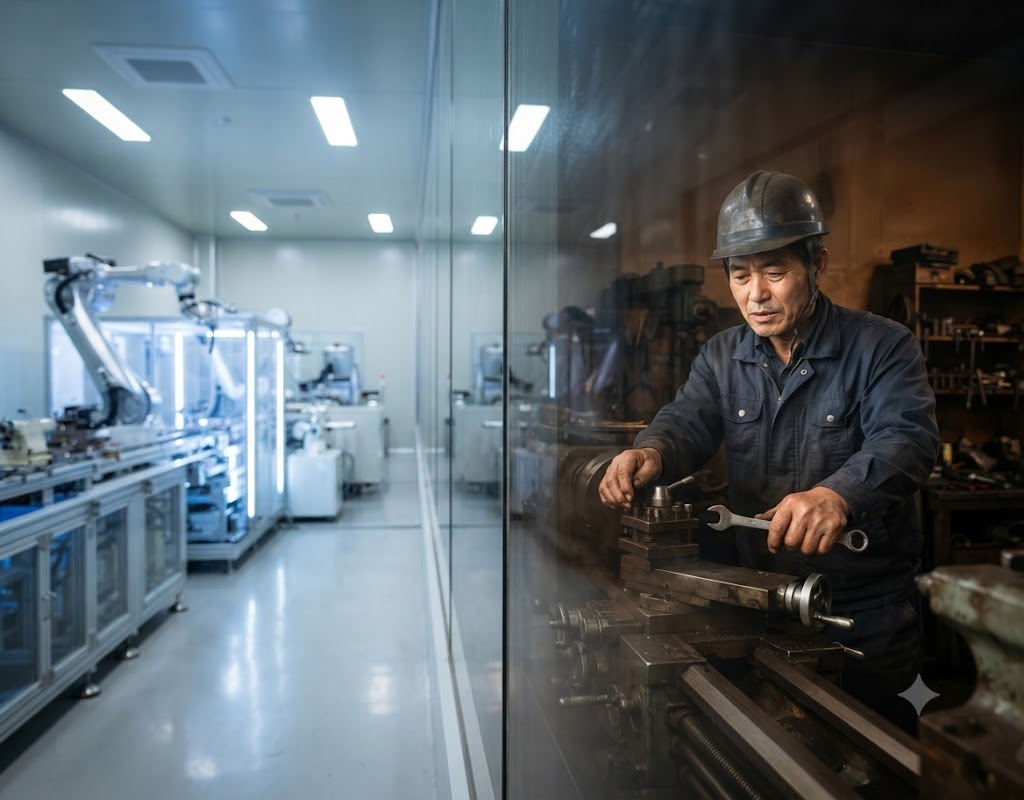
The growth of Chungbuk's high-tech industries and the growth of local small and medium-sized manufacturing enterprises do not guarantee the same trajectory. While the large-scale concentration of semiconductor, secondary battery, and bio-sectors identified in No. 013, along with SK Hynix's additional investment in Cheongju, has the potential to generate massive new demand for the local manufacturing sector, the extent to which this demand translates into new supply contracts, technology accumulation, and high-wage employment for Chungbuk companies must be verified separately.
According to North Chungcheong Province's own survey of manufacturing companies, the number of registered manufacturing firms was tallied at 13,025 and the number of operating firms at 11,381 as of the end of 2025. Of these, businesses with fewer than 50 employees numbered 10,457, accounting for approximately 91.9% of the operating firms . However, as this data is administrative information based on surveys conducted by cities and counties, and North Chungcheong Province itself specifies that it should not be used as official external statistics, it must be used limited to serving as an administrative baseline for understanding the industrial structure . ( North Chungcheong Provincial Government )
The structural size of a company is directly linked to the conditions for AX transition. While large corporations can secure in-house AI organizations and data engineers and process specialists, for manufacturing companies with only dozens of employees, the very tasks of organizing production data, searching for AI suppliers, incurring PoC costs, and securing specialized personnel become entry barriers. This structural gap is reflected in the reason why the Chungbuk Institute of Science and Technology Innovation ( KISTI) has designated small and medium-sized enterprises (SMEs) and middle-sized companies with insufficient data as key targets for the 2026 AX Fast Track , and why it is separately pursuing industrial AI mini-projects and the demonstration of core facilities and processes. ( KISTI )
Chungbuk is already transitioning from the smart factory deployment stage to the industrial AI stage. In the 2025 manufacturing innovation case study, the North Chungcheong Provincial Government announced that LM Co., Ltd., a local SME, saw a 50.5% improvement in productivity following the introduction of a Manufacturing Execution System (MES) and smart mixing tanks. By 2026, projects have expanded beyond simple MES implementation to analyze process data using AI. The scale of linked projects was proposed to exceed 100 billion won, including 12 billion won for the activation of region-specific manufacturing data, 23.6 billion won for AI factories, 43.5 billion won for smart factory construction, and 10.5 billion won for open innovation at hub institutions . ( North Chungcheong Provincial Government )
In the convergence bio sector, up to 80 million won per company will be provided to 20 small and medium-sized manufacturing enterprises in Cheongju, Chungju, Jincheon, and Eumseong in 2026 to support the entire process from data consulting and on-site application of manufacturing AI to AX verification and post-management. Eligible manufacturing sites include those in the medical, bio, cosmetics, food, and paper industries. ( Manu AI )
In the semiconductor industry as well, North Chungcheong Province is investing 5 billion won in five cities and counties—Cheongju, Boeun, Jincheon, Goesan, and Eumseong—by 2026 to support not only job placement but also Industrial Transformation AX, AI and digital job advancement, and the digital transformation of manufacturing processes. 79 companies have applied to participate in seven projects. ( North Chungcheong Provincial Government )
In process innovation, there are also cases emerging where virtual simulations are used to reduce costs and time. In a case involving a secondary battery materials company disclosed by North Chungcheong Province, external simulation costs were reduced from approximately 10 million won per case to around 1 million won, resulting in a total cost reduction of about 90%. While North Chungcheong Province has set the overall goals for the project as an 85% reduction in product development costs, a 75% shortening of development time, and a 30% improvement in productivity, these figures are project targets and should be distinguished from the actual average performance of the group of companies. ( North Chungcheong Provincial Government )
Therefore, while current evidence supports the fact that Chungbuk has begun the transition to AX beyond manufacturing DX, it is insufficient to conclude that the effects of large-scale investments by major corporations have spread extensively to the supply chain entry and scale-up of local SMEs.
The key for the next two to three years is not the number of companies building smart factories, but the conversion rate of new demand from large corporations → technology development by local companies → AI process innovation → testing and verification → supply chain entry → sales and exports → reinvestment.
Chungbuk’s Manufacturing AX Golden Time is not a period for expanding technology adoption projects, but a period for connecting companies with actual growth potential among tens of thousands of manufacturing enterprises with the demand of large corporations to scale them up into local supply chain enterprises .
In the Chungbuk economy, manufacturing is not a subsidiary industry but the central axis of the regional economy. By 2025, the proportion of mining and manufacturing in Chungbuk's industrial structure reached 46.2%, with semiconductors and electronic components, electrical equipment and secondary batteries, and pharmaceuticals constituting core high value-added industries. ( Chungbuk Provincial Government )
According to administrative data from North Chungcheong Province, there are 13,025 registered manufacturing companies in 2025. Of the 11,381 businesses in operation, 10,457 have fewer than 50 employees. Companies with 50 to 299 employees number 828, while those with 300 or more employees stood at only 96. ( North Chungcheong Provincial Government )
While small businesses dominate in terms of the number of enterprises, employment is relatively dispersed. Of the 262,706 employees in operating companies, 73,287 are employed by companies with 300 or more employees, 85,888 by companies with 50 to 299 employees, and 103,531 by companies with fewer than 50 employees. ( Chungcheongbuk-do Provincial Government )
This structure determines the ripple effect of investment in high-tech industries. To spread employment and added value throughout the regional economy, it is not enough for only the production facilities of large corporations to expand; some of the more than 10,000 small manufacturing companies must enter the high-tech supply chain and boost their productivity.
The spatial structure of North Chungcheong Province's manufacturing industry is also a significant variable. The areas eligible for semiconductor industry transition support include not only Cheongju but also Boeun, Jincheon, Goesan, and Eumseong. This reflects the policy judgment that North Chungcheong's semiconductor supply chain is not limited to the production facilities of large corporations in Cheongju, but that companies specializing in materials, components, equipment, and process services are distributed across surrounding regions. ( North Chungcheong Provincial Government )
The Convergence Bio Manufacturing AI Project targets the four cities and counties of Cheongju, Chungju, Jincheon, and Eumseong. It designates medical, bio, cosmetics, food, and paper industries as a single Convergence Bio Manufacturing Group and selects five companies equally from each city and county. ( Manu AI )
Therefore, the basic unit of Chungbuk Manufacturing AX is not just the large enterprise cluster in Cheongju. The wide-area supply chain connecting Cheongju Anchor Manufacturing with small and medium-sized manufacturing enterprises in the central and northern regions must become the actual unit of analysis.
Investment announcements by large corporations do not automatically increase sales for local small and medium-sized enterprises.
Supply chains in high-tech industries simultaneously require high quality standards, long-term certifications, delivery track records, process control, security, production capacity, and technical support. AI and data-driven quality management capabilities are rapidly becoming important as one of these entry requirements.
Therefore, the regional ripple effect of Chungbuk's advanced industries is determined not by the investment announcement → factory construction stage, but by the new demand → local company technology development → verification → mass production → supply contract stage.
Currently, North Chungcheong Province's policy is shifting toward strengthening this intermediate segment.
The Process Innovation Simulation Center is designed to enable small and medium-sized enterprises (SMEs) to utilize the analysis and simulations required for product development and production processes at a relatively low cost. The Regional Specialized Manufacturing Data Activation Project converts manufacturing site data into a format suitable for AI application, while the AI Factory Project expands to the stages of process automation and optimization. ( Chungcheongbuk-do Provincial Government )
On the other hand, actual supply chain outcomes are not yet sufficiently linked in the publicly available data.
You can check the number of companies that have adopted smart factories, as well as the number of AI demonstration companies and the scale of subsidies. However, publicly available indicators that consistently link how many of the supported companies have become new vendors for SK Hynix, LG Energy Solution, and major biotech firms, and how much their contract amounts and exports have increased, are limited.
Currently, the biggest analytical gap for Chungbuk manufacturing AX exists between Technology Adoption Data and Supply Chain Outcome Data.
The first structural change in Chungbuk's manufacturing industry is the shift from digitalization centered on smart factories to Industrial AI aiming for autonomous production .
In existing smart factories, the core focus was on collecting process data by introducing MES, ERP, sensors, and automation equipment. Currently, the business is expanding to enable AI to make decisions based on accumulated data, ranging from defect prediction and process condition optimization to production planning and equipment anomaly detection.
Chungbuk's manufacturing AX support also operates the AX Fast Track for data-deficient companies, AI model PoC, and core equipment and process demonstration in separate stages. This demonstrates a shift in the policy focus from smart factory installation to the evaluation of data readiness and AI applicability . ( Chungbuk Institute of Science and Technology Innovation )
The second change is the digitalization of the product development process itself. Process innovation simulation reduces development time and costs by verifying heat, flow, structure, and processes in a virtual environment before repeatedly producing actual molds and prototypes. This capability is particularly effective for small and medium-sized enterprises (SMEs) that find it difficult to maintain in-house analysis personnel. ( Chungcheongbuk-do Provincial Government )
The third change is a structure where labor shortages combine with AX. North Chungcheong Province is operating the "Chungbuk-type Urban Worker Project," which matches idle workers aged 20 to 75 with companies, to alleviate the labor shortage faced by small and medium-sized manufacturing enterprises. The fact that a separate labor supply policy is required demonstrates that the labor shortage in the manufacturing sector is already constraining production conditions. ( North Chungcheong Provincial Government )
In the long term, it is difficult to solve the manufacturing workforce problem solely by supplementing unskilled labor. A structure is simultaneously required where equipment automation and AI reduce repetitive tasks, and existing workers transition to high-value-added roles such as quality, process, and equipment management.
The fourth change is that the standard for supply chain competition is shifting from cost to quality, speed, and data responsiveness . As major semiconductor, battery, and biotech companies advance their production processes, partner companies are also required to possess process traceability, quality prediction, and data sharing capabilities.
Therefore, it is highly likely that AX for SMEs will transition from a selective means of productivity improvement into Supply Chain Readiness to maintain qualification as a vendor in high-tech industries in the future .
The 2026 Chungbuk Manufacturing AX policy is structured so that multiple stages, from initial digitalization to industrial AI, are operated simultaneously.
In the foundational phase, the dissemination and expansion of smart factories, as well as support for small-enterprise smart factories, will continue. Chungbuk is allocating 43.5 billion won to smart factory construction support projects for 2025–2026, and is securing entry pathways for manufacturing companies of various sizes through existing large-to-small enterprise (SME) win-win smart factories and foundational-phase support. ( Chungbuk Provincial Government )
In the intermediate stage, a foundation for process innovation simulation and manufacturing data is being established. The Process Innovation Simulation Center is operating on a scale of 26.8 billion KRW from 2024 to 2026, while the Regional Specialized Manufacturing Data Activation Project is being implemented on a scale of 12 billion KRW from 2025 to 2027. ( Chungcheongbuk-do Provincial Government )
In the advanced phase, the AI Factory project will be implemented from 2024 to 2029 on a scale of 23.6 billion won. It is a long-term project that expands from the digitization of processes to AI-based autonomous manufacturing. ( Chungcheongbuk-do Provincial Government )
The 2026 Industrial AX Leading Enterprise Development Project supports three projects, providing up to 120 million won per project, to enable AI solution providers in Chungbuk to directly develop AI specialized for the manufacturing industry and conduct Proofs of Concepts (PoCs). It is distinguished from previous Smart Factory projects in that it fosters the supplier companies themselves. ( Chungbuk Institute of Science and Technology Innovation )
In a separate industrial AI infrastructure development project, 700 million won will be invested to intensively promote the AX Alliance, a fast-track program for data-deficient companies, AI mini-projects in semiconductors, convergence bio, and mobility components, and industrial AI demonstrations in the second half of 2026. ( Chungbuk Institute of Science and Technology Innovation )
In the field application of AI in convergence bio-manufacturing, up to 80 million won per company will be provided to 20 small and medium-sized enterprises (SMEs). Investments of 1.6 billion won are planned for both 2026 and 2027, and the program includes verification and post-implementation management. ( Chungcheongbuk-do Provincial Government )
The current policy structure has begun to create a staircase of smart factory → data → AI solution → field demonstration → autonomous manufacturing.
In the next step, it is necessary to explicitly add supply chain entry and scale-up at the top of this staircase.
Competition in AX within South Korea's manufacturing industry is expanding from large conglomerates to small and medium-sized manufacturing companies. The biggest barriers to manufacturing companies adopting AI are not the general-purpose AI models themselves, but rather data usable on the production floor, industry-specific solutions, skilled personnel, and investment capacity.
Among these conditions, Chungbuk is highly advantageous in terms of demand industries. This is because semiconductor, secondary battery, and bio industries, along with numerous manufacturing companies, are concentrated in a narrow metropolitan area.
As confirmed in No. 013, Chungbuk's competitive advantage lies not in the general-purpose AI platform industry, but in the actual demand for demonstration of Industrial AI .
On the other hand, the transition is difficult in terms of corporate structure. According to administrative data from North Chungcheong Province, approximately 92% of operating manufacturing companies have fewer than 50 employees. This means that the majority of companies find it difficult to operate large-scale in-house AI teams. ( North Chungcheong Provincial Government )
Therefore, for Chungbuk’s manufacturing AX model to have national significance, it is important to create a low-cost standard model that enables manufacturing companies with tens to hundreds of employees and no in-house AI workforce to apply AI to actual production sites, rather than building a single state-of-the-art factory to the highest standards .
The case of the Process Innovation Simulation Center significantly reducing external professional service costs demonstrates the potential of this shared infrastructure approach. ( Chungcheongbuk-do Provincial Government )
The competitiveness of Chungbuk-type manufacturing AX is likely to be formed not by having individual SMEs own all the technology, but by lowering the entry costs for small businesses through Shared AI + Shared Simulation + Shared Data Infrastructure .
According to administrative data from North Chungcheong Province, there are 11,381 manufacturing companies in operation in 2025. Of these, 10,457 are companies with fewer than 50 employees. ( North Chungcheong Provincial Government )
The 2026 Industry-Specialized AI Solution Development Project supports three initiatives. The total budget for the AX Infrastructure Development Project is 700 million won, and there are 20 companies applying AI in the field for convergence bio-manufacturing. ( Chungbuk Institute of Science and Technology Innovation )
It is not appropriate to calculate the adoption rate by simply dividing these figures. This is because each project aims to create and disseminate leading models rather than directly supporting all manufacturing companies.
However, it is clear that the AX manufactured in Chungbuk is currently in the Pilot & Demonstration stage rather than Mass Adoption .
79 companies applied to participate in the semiconductor job creation project, which provides simultaneous support for recruitment, training, AX, and job transitions on a scale of 5 billion won. ( Chungcheongbuk-do Provincial Government )
In terms of smart factories, significant support has already been accumulated, and North Chungcheong Province is proposing interconnected projects worth over 100 billion won, including smart factories, AI factories, manufacturing data, and innovation at hub institutions. ( North Chungcheong Provincial Government )
Therefore, the bottleneck facing Chungbuk’s manufacturing AX is not the absence of public works.
It is impossible to track how many companies that have passed through multiple stages move to the next stage .
How many smart factory companies have moved on to AI demonstration?
How many of the AI demonstration companies have moved to the autonomous manufacturing stage?
How many of them became new vendors for large corporations?
How many of the supply chain entrants have scaled up from fewer than 50 employees to a size of 50 to 299 employees?
This conversion rate should become a tangible performance indicator for Chungbuk Manufacturing AX.
The biggest gap in Chungbuk manufacturing AX is the corporate variation of Digital Foundation .
While some companies already possess MES, ERP, sensor, and automation data, others may remain stuck with production performance and quality records based on Excel spreadsheets or manual documentation. The fact that the Chungbuk AX Fast Track specifically targets companies with insufficient data demonstrates that this gap exists as a real policy issue. ( Chungbuk Institute of Science and Technology Innovation )
The second gap lies between AI supply capabilities and the language of the manufacturing site .
Even if general-purpose AI companies enter the manufacturing sector, it is difficult to apply their technology to actual production lines without an understanding of equipment, quality, and process mechanisms. Mandating AI solutions specialized for Chungbuk manufacturing and proprietary Proof of Concept (PoC) in the Industrial AX Leading Enterprise project is an approach designed to mitigate this problem. ( Chungbuk Institute of Science and Technology Innovation )
The third is the gap between PoC and mass production application .
For AI whose performance has been verified in a demonstration environment to operate stably on a 24-hour production line, additional equipment integration, security, maintenance, worker training, and accountability systems are required.
The fourth is the gap between productivity improvement and scale-up .
Even if the process defect rate decreases, the effect of expanding the company's scale is limited if it fails to enter new markets and the supply chains of large corporations.
The fifth is the gap between large corporate investment and local procurement .
While mega-investments by companies such as SK Hynix and LG Energy Solution are expanding, it is difficult to verify integrated indicators that regularly disclose the proportion of new funding accounted for by companies in Chungbuk, the number of new vendors, and the contract value with local companies.
Ultimately, Chungbuk's core Readiness GAP is not due to a lack of AI technology, but
The problem is the lack of a structure that enables companies to complete the entire path from data → AI → mass production → supply chain → scale-up .
Chungbuk Manufacturing AX should not be based on the premise that all small and medium-sized enterprises possess their own AI teams.
Due to the structure of the company's size, shared infrastructure is essential.
Companies must be able to utilize specialized institutions such as the Process Innovation Simulation Center, the Manufacturing Data Platform, Chungbuk Technopark, the Chungbuk Institute of Science and Technology Innovation, and the Korea Institute of Mechanical Engineering and the Korea Institute of Science and Technology Information when needed. The structure established by North Chungcheong Province to combine various specialized institutions for process innovation support also reflects this necessity. ( North Chungcheong Provincial Government )
In data policy, it is necessary to standardize Manufacturing Data Readiness rather than simple collection.
Each company must structure at least the core data of equipment operation → production volume → defects → energy → maintenance → working hours → cost.
Based on this, if companies are classified into the stages of Digital Foundation → Data Ready → AI PoC → Production AI → Autonomous Manufacturing, support programs can be connected according to the company's maturity level.
Talent policies must also shift from general AI education to a focus on on-the-job training. The 2026 Semiconductor Industry AI & Digital Job Advancement Project includes customized training by company and job function, as well as support for paid AI accounts. A separate AX Practical Open Lab connects 30 hours of training with corporate project experience. ( Chungcheongbuk-do Provincial Government )
In the future, it is necessary to define the AI utilization capabilities required for production managers, quality managers, and equipment technicians by job function, and to implement Worker Augmentation that enables existing skilled personnel to integrate with AI .
Evidence of productivity improvements at some companies within the Chungbuk Manufacturing AX program is already emerging.
According to Chungbuk Province's announcement, LM Co., Ltd. saw a 50.5% increase in productivity following the introduction of an MES and smart mixing tanks. (Chungbuk Provincial Government)
In the case of a secondary battery materials company, simulation costs were reduced from a total of 20 million won to approximately 2 million won. (Chungbuk Provincial Government)
In the convergence bio sector, Cosmecca Korea is pursuing a project to smarten its packaging process based on AI, aiming for a 25% increase in productivity, a 90% reduction in analysis time, and a 10% increase in sales. However, since these figures are still targets, they cannot be used as actual achievement results. (Chungbuk Provincial Government)
Currently, the evidence is at the level where individual leading company cases can be verified.
There is still a lack of collective data sufficient to establish a causal relationship between the productivity increase of Chungbuk's entire manufacturing sector and the AX program.
Therefore, policy evaluation criteria should shift from the number of success stories to the ratio of supported companies that have reproduced the expected results.
It is necessary to measure how many companies maintained productivity improvements when the same AI model was disseminated to 10 companies, the actual payback period, and the percentage of companies that continue to operate their own AI systems even after support ends.
The fact that AX is actually deployed to local companies does not mean that they have been selected for a pilot project.
Even after support ends, the companies must be in a state where they continue to use AI at their own expense and expand it to the next process.
Regional conditions for AX manufactured in Chungbuk vary significantly.
Cheongju is close to SK Hynix, Ochang Battery, Osong Bio, and AI/R&D suppliers, so there is a simultaneous existence of supply and demand for advanced manufacturing AX.
Jincheon and Eumseong have a high density of manufacturing and industrial complexes, making them highly suitable for the application of AX optimized for automation, quality, logistics, and energy.
Chungju can combine process AI and logistics AX centered on mobility, bio, and existing manufacturing industries.
Although Boeun and Goesan are included in the customized job support regions for the semiconductor industry, the scale of manufacturing companies and accessibility to support agencies are not the same as those in the Cheongju area. ( Chungbuk Provincial Government )
Therefore, if Chungbuk Manufacturing AX is operated as a single smart factory dissemination policy, it is highly likely that the effects will vary by company and region.
A differentiated strategy is needed to lower entry costs by rapidly demonstrating advanced AI and autonomous manufacturing in the Cheongju region, expanding manufacturing AI in Jincheon and Eumseong, focusing on mobility and bio-convergence processes in Chungju, and centering on shared experts, remote AI, and shared equipment in small county areas.
This structure is connected to the Distributed Chungbuk AX Network presented in No. 014 .
While sharing a broad AI supply base, actual application models must vary according to the regional manufacturing structure.
The time risk for Chungbuk manufacturing AX lies in the fact that the speed of investment by large corporations differs from the speed of transition for small and medium-sized enterprises.
If SK Hynix's large-scale investments in P&T7 and M17, along with the expansion of demand for AI semiconductors, materialize, the technology, quality, and delivery standards required of partner companies are likely to rise rapidly.
If small and medium-sized partner companies start the transition late after large corporations' production processes have advanced to be centered on AI and automation, the entry barriers for new vendors could become even higher.
Currently, Chungbuk is simultaneously operating smart factory deployment, manufacturing data, process simulation, industrial AI, and AI factories. ( Chungbuk Provincial Government )
The fact that these projects are concentrated between 2026 and 2029 shows that the current period is a transitional phase where manufacturing DX and AX intersect.
Furthermore, the labor shortage in small and medium-sized enterprises is unlikely to resolve naturally over time. Coupled with population aging and the migration of the youth population, companies that are slow to automate may find it increasingly difficult to maintain production levels.
The most irreversible risk in Chungbuk's manufacturing sector is not just the disappearance of companies.
After the supply chain standards demanded by large corporations have risen one level, local small and medium-sized enterprises fail to meet those standards and are pushed out of the supply chain alongside growing high-tech industries .
The period from 2026 to 2028 is a key transition period for connecting the existing smart factory foundation with industrial AI and the actual large enterprise procurement market.
12-1. Golden Time Application Case in Basic Local Governments ① — Eumseong-gun
Eumseong-gun is a suitable region to verify Chungbuk Manufacturing AX from the perspective of productivity transformation for multiple manufacturing companies, rather than large high-tech industrial conglomerates.
Eumseong, along with Jincheon, forms the axis of the Chungbuk Innovation City and Central Industrial Complex, and is a region with a high proportion of manufacturing. It is included as a recipient of support in the 2026 Convergence Bio-Manufacturing AI Field Application Project, alongside Cheongju, Chungju, and Jincheon, with five companies selected equally from each city and county. ( Manu AI )
The scope of convergence bio includes not only pharmaceutical companies but also medical, cosmetic, food, and paper industries. Food, chemical, and consumer goods manufacturers located in Eumseong can apply general-purpose Manufacturing AX, such as AI-based quality inspection, production planning, predictive maintenance of equipment, and energy optimization.
The voice-based Golden Time does not lie in attracting new AI companies.
The core is to establish an iterative model that involves selecting small and medium-sized manufacturing companies in existing industrial complexes capable of securing production data, converting process data, identifying pain points, conducting an AI PoC, applying it to production lines, verifying productivity and defect rates, and expanding to the same industry.
If the performance of the first five companies does not spread to 20 or 50 similar companies, the business remains merely an individual success story. Conversely, if equipment, process, and quality data are standardized among companies within the same industrial complex, a single supplier can apply the same solution to multiple companies, drastically reducing costs.
Eumseong is a suitable region for verifying Industry-Level AX Replication .
12-2. Golden Time Application Cases in Basic Local Governments ② — Goesan-gun
Goesan has different manufacturing AX tasks than Eumseong.
Although it is not a large-scale high-tech manufacturing cluster, it was included as a recipient of support in the 2026 Semiconductor Regional Industry Customized Job Creation Project, along with Cheongju, Boeun, Jincheon, and Eumseong. It provides consulting services to semiconductor-related companies for AI and digital job advancement, as well as digital transformation in the fields of manufacturing management, processes, and industrial safety. ( Chungbuk Provincial Government )
Companies in small county regions like Goesan find it difficult to recruit their own AI specialists and are likely at a disadvantage compared to Cheongju in terms of access to specialized institutions.
In this case, the Shared Service type of the AX model is more efficient than the large-scale enterprise-specific implementation type.
This method involves expert personnel from Cheongju, Chungbuk TP, and the Chungbuk Institute of Science and Technology Innovation analyzing data remotely and deploying to the site when necessary, while manufacturing companies establish only a minimal data collection system.
If expanded to include food and agricultural processing companies in Goesan, multiple companies can jointly utilize AI services such as vision inspection, demand forecasting, production planning, and energy management.
The Goesan-style Golden Time is not the point in time to change the manufacturing structure by attracting large corporate production facilities.
The key is whether we can now establish a shared infrastructure model that ensures small manufacturing companies are not excluded from AX due to their size .
Once this model is verified, it can also be applied to small-scale manufacturing areas in North Chungcheong Province, such as Boeun, Yeongdong, and Danyang.
If the current timing is missed, the first risk is the loss of supply chain entry opportunities .
If local companies fail to secure technological, quality, and digital response capabilities during the period when large corporations such as SK Hynix begin full-scale expansion, new supply chains are highly likely to be formed around existing large partners and external companies.
The second risk is the isolation of smart factory investments.
If companies that have implemented MES and sensors fail to connect data to the AI stage, the existing systems remain merely production management tools, and they may have to invest again in data infrastructure for AI later on.
The third is manpower risk.
If the shortage of young and skilled workers is not compensated for by automation and operational advancements, the labor shortage will translate into limitations on production volume and order-taking capabilities.
The fourth is the entrenchment of the gap in firm size.
If small businesses remain in their existing processes while large and mid-sized companies increase productivity with AI, the gap in cost, quality, and delivery time widens.
The fifth is the segmentation of public investment.
If smart factories, manufacturing data, AI factories, process simulations, and talent support are not connected at the corporate level, the growth path of the same company cannot be managed even if it receives various forms of support.
The biggest loss is the divergence of the growth curves of high-tech industries and local small and medium-sized enterprises .
There are industrial conditions in Chungbuk that can rapidly spread manufactured AX.
There is demand from large corporations nearby.
There are more than 10,000 operating manufacturing companies.
Experience in supporting smart factories has been accumulated.
Joint infrastructure, such as Chungbuk TP, Chungbuk Institute of Science and Technology Innovation, and the Process Innovation Simulation Center, is also being operated.
It even has actual production sites for different industries such as semiconductors, biotechnology, and batteries.
By combining these conditions, Chungbuk can develop a general-purpose small and medium-sized manufacturing AX model.
It is a structure where companies do not need to build their own AI systems from scratch; instead, they accumulate process data, have a joint institution assess the applicability of AI, apply verified solutions in collaboration with suppliers, and disseminate proven models to peer companies.
If new procurement demand from large corporations is connected here, AX is transformed from a cost-saving business into a Growth Program .
From the perspective of small and medium-sized enterprises, the strongest incentive for AI investment is not government subsidies, but market demand that “new supply contracts can be secured by applying this technology.”
The ultimate strategy of Chungbuk Manufacturing AX should be to increase the number of companies growing through AI rather than the number of companies adopting AI .
Changes to observe | Things to do with AX | Policy decision | Verification indicators |
| New investment by large corporations | Analysis of Procurement Demand by Year | Proactive matching of local businesses | New Vendor/Contract Amount |
| manufacturing company data | Data Readiness Assessment by Company | Step-by-step support | Data Ready Rate |
| smart factory | AX transition for existing implementation companies | First, advanced | AI conversion rate |
| Industry Pain Point | Identifying defects, equipment, and energy problems | PoC Intensive Support | Problem-solving rate |
| AI PoC | Mass production line verification | Follow-up investment decision | PoC→Production Ratio |
| Process simulation | Utilization of shared equipment and experts | Fee and Access Support | Cost and time reduction |
| supplier | Fostering industry-specialized AI | Solution Standardization | Resale and spread cases |
| labor shortage | Automation of repetitive tasks and job enhancement | Education and Transition Support | labor productivity |
| Scale-up | Productivity + Market Connection | Intensive support for growth companies | Sales, Exports, Employment |
| Regional spread | Joint AX Service | Support for access to military areas | Non-Cheongju application rate |
The runtime for each company needs to be managed in the following stages: Digital Foundation → Data Ready → AI PoC → Production AI → Supply Chain Entry → Scale-up .
It is a structure that judges policy outcomes based on whether the company has moved to the next stage, rather than the completion date of the government support program.
Opportunity + Scale-up Risk
The basic Readiness of AX manufactured in Chungbuk is not low.
Experience in deploying smart factories exists, and process innovation simulation, manufacturing data, AI factories, industrial AI solutions, and AI field demonstrations are being pursued simultaneously. Related manufacturing innovation projects are also being linked on a scale exceeding 100 billion won. ( Chungcheongbuk-do Provincial Government )
Corporate demand is also being confirmed. 79 companies applied for the 2026 Semiconductor-Customized Jobs and AX projects, and industry-specific AI solutions and manufacturing AI demonstration projects are also operating separately. ( Chungcheongbuk-do Provincial Government )
Individual success stories also exist. Cases have been disclosed showing a 50.5% increase in productivity following the introduction of a smart factory and a reduction of over 90% in process simulation costs. ( Chungcheongbuk-do Provincial Government )
Therefore, Chungbuk is not a region lacking the foundation to start manufacturing AX.
However, among the numerous small and medium-sized manufacturing companies, the actual number of companies adopting AX is still limited, and there is a lack of disclosed outcomes linking mass production application, supply chain entry, and sales growth following PoC.
Even if technology adoption is successful, if companies fail to grow, the ripple effect of high-tech industrial clusters on the regional economy is limited.
Therefore, the current assessment is Opportunity + Scale-up Risk .
The core risk of Chungbuk manufacturing AX is not that AI technology fails, but that while AI demonstration is successful, the scale of local companies does not grow .
- Number of operating manufacturing companies in Chungbuk
- Proportion of manufacturing companies with fewer than 50 employees
- Cumulative number of companies that have built smart factories
- Actual operating rate after smart factory implementation
- Number of companies transitioning from smart factories to AI
- Number of Data Readiness Diagnostic Companies
- Key manufacturing data acquisition rate by company
- Number of companies conducting Industry AX PoC
- PoC success rate
- PoC → Production Line Application Rate
- Retention rate of production line AI for over 12 months
- Reduction in defect rate
- Reduction in equipment downtime
- Productivity improvement
- Change in energy intensity
- Shortening development period
- Reduction in manufacturing costs
- AI investment payback period
- Newly Registered Large Enterprise Vendor
- New supply contract amount for local companies
- Sales growth rate after entering the supply chain
- AX company export growth rate
- Scale-up companies with fewer than 50 employees → 50 or more employees
- Changes in employment of highly skilled workers in the manufacturing sector
- Proportion of AX-applied companies in rural areas
The most significant data gap currently is the lack of a public system to track the growth paths of companies by connecting data from smart factories, AI, and R&D support firms with data on supply contracts, sales, exports, and employment of large corporations .
Runtime Chain
Large Enterprise Investment → New Procurement Demand → Identification of Local Companies → Digital Foundation → Manufacturing Data → AI PoC → Mass Production Application → Quality & Productivity → Supply Chain Entry → Sales & Exports → Employment → Scale-up
The most direct administrative baseline illustrating the corporate structure of Chungbuk's manufacturing sector is the 2025 status of manufacturing companies. According to North Chungcheong Province's statistics, there are 13,025 registered manufacturing companies and 11,381 operating enterprises; among these, 10,457 companies have fewer than 50 employees. However, as North Chungcheong Province has specified that this data is based on surveys conducted by cities and counties and cannot be used as official statistics, it was used exclusively to understand the corporate structure. ( North Chungcheong Provincial Government )
The second piece of evidence is a phased change in policy. North Chungcheong Province is pursuing a manufacturing AI-linked project worth over 100 billion won by combining manufacturing data, process simulation, and AI factories with its existing smart factory initiatives. ( North Chungcheong Provincial Government )
The third point is that industrial AI is no longer confined to a few large corporations but has begun to spread into the core processes of small and medium-sized manufacturing companies. The 2026 Field Application of Convergence Bio-Manufacturing AI supports 20 small and medium-sized enterprises in Cheongju, Chungju, Jincheon, and Eumseong, covering everything from data consulting to AI application, verification, and post-management. ( Manu AI )
The fourth initiative is fostering AI suppliers. The Industrial AX Leading Enterprise Project supports local AI suppliers developing solutions specialized for Chungbuk's manufacturing industry by providing up to 120 million won per project for three tasks, while mandating actual Proof of Concept (PoC). This is an initial structure designed to simultaneously grow both the manufacturing and AI supply industries. ( Chungbuk Institute of Science and Technology Innovation )
The fifth point is that AX has begun to integrate with workforce policies in the semiconductor industry. The 5 billion won Regional Industry-Tailored Job Creation Project, scheduled for 2026, targets semiconductor companies in Cheongju, Boeun, Jincheon, Goesan, and Eumseong and covers the advancement of AI and digital job functions as well as the digital transformation of manufacturing processes; 79 companies have applied. ( Chungbuk Provincial Government )
The sixth point concerns the potential for individual company outcomes. Cases have been confirmed where productivity improved by 50.5% following the implementation of a smart factory, and a secondary battery materials company reduced simulation costs by over 90%. On the other hand, the projected increases of 25% in productivity, 90% in analysis time, and 10% in sales presented in other projects were distinguished from actual performance as they represent target values. ( Chungcheongbuk-do Provincial Government )
Structural insights remaining from this analysis
The AX challenge for Chungbuk's manufacturing industry is not a matter of whether to introduce AI technology.
Introduction has already begun.
Production data is being generated through smart factories, manufacturing AI demonstrations and AI factory projects are underway, and process simulation and industry-specialized AI suppliers are emerging.
Therefore, the axis of analysis after 2026 must shift from Adoption to Conversion.
We must verify whether companies that have adopted AI are actually transforming into growth companies.
Three conversions are important in AX manufacturing in Chungbuk.
The first is Data → AI Conversion .
Even if MES and sensors are installed, AI cannot be applied if data quality is low or standards between equipment do not match. The first step is to transform existing smart factory investments into an AI-enabled production base.
The second is PoC → Production Conversion .
Whether an AI model that demonstrates high accuracy in experimental environments is consistently used on actual production lines is a separate issue. Equipment integration, security, accountability, maintenance, and acceptance by on-site workers must be addressed.
The third and most important thing is Productivity → Growth Conversion .
Even if productivity increases and the defect rate decreases, if sales and the market do not expand, the size of the company remains the same.
At this stage, No. 013's large-scale investment in high-tech industries becomes important.
Unlike other regions, Chungbuk has a large-scale buyer right next door.
Factories of major semiconductor, battery, and bio companies are actually expanding.
Therefore, the most powerful demand policy of Chungbuk Manufacturing AX is not subsidies, but rather converting the future procurement demand of large corporations into innovation projects for local companies .
If AX can pre-structure the equipment, materials, parts, process services, and AI tasks that large corporations will need over the next three years and match companies in Chungbuk according to their technology levels, it will be able to simultaneously implement productivity policies and supply chain policies.
In the current policy, this link is the weakest.
You can check who the AI support company is.
You can also check smart factory companies.
You can also check the investment amount of large corporations.
However, there is a lack of public intelligence that connects these three data points to continuously show “whether this company actually became a new vendor after doing AX.”
It is necessary to combine this with the scale-up issue of Chungbuk's manufacturing industry.
Administrative data showing that approximately 92% of operating companies have fewer than 50 employees demonstrates how much the foundation of Chungbuk's manufacturing industry relies on small-scale enterprises. ( Chungbuk Provincial Government )
Unless at least some of these grow into medium-sized suppliers with 50 or more employees, the middle layer of the regional industrial pyramid will not thicken even if mega-investments in high-tech industries continue.
Chungbuk's goal is not to turn every small business into a medium-sized enterprise.
It should be to identify companies with growth potential and intensively connect technology, data, AI, markets, and finance .
By 2026, Chungbuk is pursuing the establishment of a 100 billion won regional growth fund, along with 402 billion won in funds for fostering SMEs and 200 billion won in funds for fostering micro-enterprises. If this financial support is combined with Manufacturing AX data, there is potential to evolve from corporate support centered on simple collateral and sales to Scale-up financing that reflects technological transformation and growth potential. ( Chungbuk Provincial Government )
Ultimately, Chungbuk Manufacturing AX is not just a single policy of technical support.
The problem is to connect industrial policy + supply chain policy + workforce policy + financial policy into a single corporate growth path.
The massive integration of semiconductors, secondary batteries, and biotechnology confirmed in No. 013 is the greatest opportunity for Chungbuk.
The city/county AX gap identified in No. 014 showed the risk that the opportunity could remain limited to certain regions and companies.
The remaining question in No.015 is located in between.
Are small and medium-sized enterprises in Chungbuk actually growing together with global conglomerates?
If the answer to this question cannot be confirmed over the next two to three years through data on new vendors, supply contracts, sales and exports, employment, and scale-up, the gap between the scale of investment by large corporations and the growth of local companies is highly likely to become structurally entrenched.
Golden Time Thesis — The golden time for Chungcheongbuk-do's manufacturing sector is not simply about distributing more AI solutions to small and medium-sized enterprises (SMEs). The key lies in whether we can transition smart factories and manufacturing data into industrial AI within the next two to three years, and connect the resulting productivity improvements with new procurement demands from major corporations in the secondary battery and bio sectors—thereby transforming PoC companies into supply chain enterprises and small businesses into scale-up enterprises. If Chungcheongbuk-do's investment in world-class high-tech industries does not translate into increased sales, exports, and employment for local manufacturing SMEs, the growth value of the industry could leak out of the region, even if production expands within the province.
Version | Reference Date/Revision Date | Major changes |
| v1.0 | 2026.08.28 | This study conducted the first analysis on whether the growth of Chungbuk's advanced industries spreads to AX, supply chains, and scale-up for local small and medium-sized manufacturing companies. It cross-validated the 2025 Administrative Baseline for manufacturers, manufacturing innovation projects linked to over 100 billion won (including smart factories, process innovation simulations, manufacturing data, and AI factories), and the 2026 Industrial AX Leading Companies, Convergence Bio Manufacturing AI, and Semiconductor AX Job Creation Projects. Through application cases in Eumseong and Goesan, it presented a Digital Foundation → Data Ready → AI PoC → Production AI → Supply Chain Entry → Scale-up Runtime, and identified the core risk as Scale-up Risk—where PoC and productivity improvements fail to translate into actual supply contracts and corporate growth—rather than a lack of AI adoption. |
