

Judgment axis | Key judgment |
| Item Identity | Raphanus cultivated variety, small, early-harvest type Radish Product |
| Taxonomy Principles | Simultaneously managing the relationship between domestic Raphanus sativus and Kew-accepted R. raphanistrum subsp. sativus |
| Key role | Raw Food · Salad · Garnish · Dining Out · School Meals · Fresh-cut · Pickled Product |
| Harvesting principle | Evaluate variety, root diameter, root shape, root color, harvest age, firmness, core enlargement, and Buyer's intended use together. |
| Product separation | Leaf-on·Leaf-off·Washed·Whole·Half·Slice·Quarter·Fresh-cut·Pickled·Frozen·Dried |
| Separation of similar items | No. 78 Separating Radish and Species into Product Entity, Harvest Stage, and Market Roles without forcibly separating them |
| Domestic official counterpart | Utilizing data from the Rural Development Administration as a major domestic reference |
| Harvest characteristics | Nongsaroo Red Radish Data: Harvestable 30–40 days after sowing, edible even after about 20 days of cultivation. |
| Domestic statistics | Nationwide cultivation area and production volume of Radish alone: To be entered after verification of official raw data. |
| Quality Risk | Excessive enlargement, hollowing, root cracking, lignification, variation in spiciness, leaf yellowing, epidermal damage, wilting |
| Production Risk | High temperature, low temperature, soil moisture variation, dense planting, bolting, diseases and pests of the Brassica family |
| Fresh-cut risk | Moisture loss, color change, microorganisms, and refrigerated distribution after washing and cutting |
| Operating Principles | Seed–Production–Small Root Lot–Wash/Cut–Fresh/Pickle–Buyer RFQ |
| Final goal | Supply capacity is evaluated based on the ratio of uniform small muscles, color, diameter, whole product rate, and fresh-cut yield, rather than just kg. |
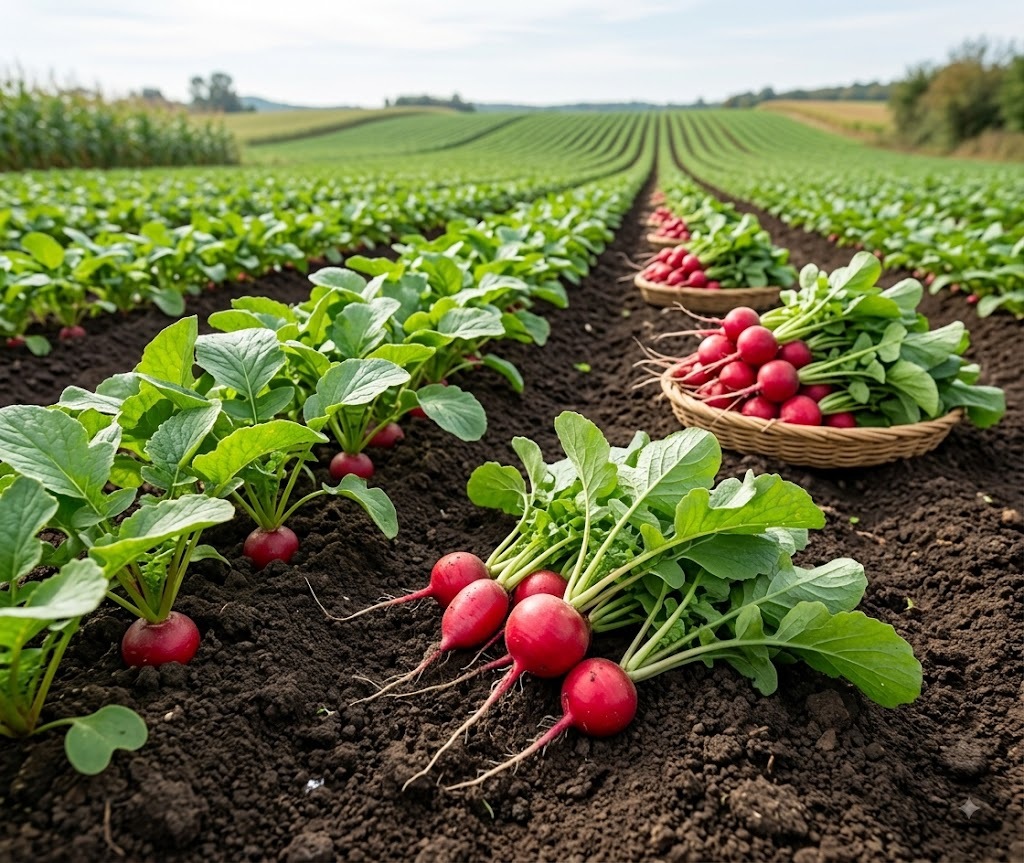
The Rural Development Administration's data on red radish describes it as *Raphanus sativus* of the Brassica family, uses roots and leaves as the utilitarian part, seeds as the planting part, and comes in red and red+white varieties. It also presents its rapid cultivation characteristics, noting that it can be harvested approximately 30 to 40 days after sowing. ( Nongsaroo )
Plant Identity
Basic fields | Radish Registration Criteria |
| Korean name | Radish |
| Domestic response name | Red Radish · Small Radish Product |
| English name | Radish |
| Kew Accepted Taxon | Raphanus raphanistrum subsp. sativus (L.) Schmalh. |
| Domestic agricultural data scientific names | Raphanus sativus L. |
| classification | Brassicaceae · Raphanus |
| Edible parts | bloated underground |
| Separate edible parts | young leaves |
| Reproductive part | satellite |
| Non-edible · Separate management | Aged leaves, diseases, rotten roots, processing residues |
| Major harvesting stages | Baby / Small Fresh / Leaf-on / Fresh-cut / Pickling / Seed |
| Basic product form | Leaf-on·Leaf-off·Washed·Whole·Half·Quarter·Slice·Fresh-cut·Pickled·Frozen·Dried |
| Basic processing stage | Leaf trimming → Washing → Sorting → Cutting → Fresh-cut · Pickling · Freezing · Drying |
| Basic use | Raw Food · Salad · Garnish · School Meals · Eating Out · Pickles · HMR |
| Similarity Principle | No. 78 belongs to the same Species family as Radish, but operates a separate Product Master. |
Kew manages Raphanus sativus not as a currently accepted taxon, but as a synonym of Raphanus raphanistrum subsp. sativus. ( Plants of the World Online )
Product Master
Product ID | Product type | Key Management Standards |
| RAD-P01 | Seed Lot | Variety, Color Family, Germination |
| RAD-P02 | Baby Radish | Harvest age, diameter, and year |
| RAD-P03 | Leaf-on Radish | Root and leaf quality |
| RAD-P04 | Leaf-off Fresh | Root shape, diameter, color |
| RAD-P05 | Red Round Radish | Red, spherical, and uniform |
| RAD-P06 | Red-white Radish | Color and uniformity |
| RAD-P07 | White Radish Type | White · Root shape |
| RAD-P08 | Elongated Radish | elongated oval · length |
| RAD-P09 | Small Premium Whole | Diameter, epidermis, leaf scars |
| RAD-P10 | Washed Whole | Cleaning · Surface damage |
| RAD-P11 | Trimmed Whole | trim leaves and roots |
| RAD-P12 | Half Cut | Diameter and cross-section |
| RAD-P13 | Quarter Cut | uniformity |
| RAD-P14 | Round Slice | Thickness and color |
| RAD-P15 | Thin Slice | For salads and pickles |
| RAD-P16 | Fresh-cut Salad | Microorganisms · Refrigeration |
| RAD-P17 | Garnish Grade | Size, color, and uniformity |
| RAD-P18 | Whole for school meals | Cleaning and safety |
| RAD-P19 | Small Whole for dining out | Size uniformity |
| RAD-P20 | Pickling Raw Material | Diameter and hardness |
| RAD-P21 | Pickled Radish | Acid, Salt, Sugar, Tissue |
| RAD-P22 | Mixed Pickle Ingredient | Color and size |
| RAD-P23 | HMR Salad Ingredient | Fresh-cut Spec |
| RAD-P24 | Frozen Whole | Freezing and thawing |
| RAD-P25 | Frozen Slice | Cutting specifications |
| RAD-P26 | Dried Slice | Moisture and color |
| RAD-P27 | Dried Flake | Moisture content and particle size |
| RAD-P28 | Radish Powder | Moisture content and particle size |
| RAD-P29 | Radish Leaf | Leaf Lot |
| RAD-P30 | Extra-standard healthy muscles | Processing upon safety compliance |
| RAD-P31 | Leaf and Trim By-products | Generation and Resource Recovery |
| RAD-P32 | PB·OEM finished products | Raw Material Lot · Processing Batch |
Classification criteria | Subdivision type | Management principles |
| Taxonomy | R. raphanistrum subsp. sativus | Species/Subspecies Master |
| Operational Name | Raphanus sativus | Linking domestic agricultural data |
| Product Entity | Regular radish / Radish / Young radish, etc. | Separate operation |
| varieties | Actual Cultivar | Seed Lot Connection |
| Root color | Red, Red and White, White, Others | Variety Attribute |
| Geunhyeong | Spherical, elliptical, elongated elliptical, etc. | Actual measurements |
| Edible parts | enlarged root and leaf | Product Separation |
| Harvesting stage | Baby·Small Fresh·Mature·Processing | separation |
| diameter | Specifications by Buyer | Actual measurements |
| Cultivation method | Spring·Autumn·Facility·Year-round | Production Container |
| Distribution methods | Leaf-on·Leaf-off·Washed·Trimmed | Product Separation |
| Processing form | Whole·Slice·Fresh-cut·Pickled·Frozen·Dry | Process Lot |
| Final use | Salad · Garnish · School Meals · Dining Out · Pickle | Buyer |
| Transaction type | In-kind · Regular supply · Contract farming · Private brand | Contract |
| origin | Domestic/Imported | Traceability |
step | Essential Dataset | Management purpose |
| Cultivation plan | Variety · Root Color · Buyer · Shipping Date | Production plan |
| satellite | Variety · Seed Lot · Germination | Traceability |
| sowing | Date·Density·Deepness | Production schedule |
| germination | Appearance Date · Appearance Rate | uniform growth |
| Thinning | Planting distance and uniformity | Muscle standard |
| Leaf growth | Number of leaves and leaf color | Production Diagnosis |
| rising | Temperature, Precipitation, Solar Radiation | Growth Risk |
| soil | Saturn · pH · Drainage | Geunhyeong |
| Watering | Soil moisture and timing | Management of hypertrophy and fibula |
| dispute | Soil testing and prescription | Production Management |
| pests | Occurrence and Control | Product rate |
| Initiation of muscle hypertrophy | Diameter and harvest age | Forecast |
| Muscle hypertrophy | Diameter, weight, shape | Product Forecast |
| Muscle development | Skin color and uniformity | Quality |
| bolting | Occurrence/Temperature | Fresh Grade |
| Harvest judgment | Diameter, Color, Hardness, Buyer Spec | Harvest |
| harvest | Date · Harvest Lot | Traceability |
| Root/Leaf separation | Root and Leaf Product | Dual Product |
| Leaf trimming | Leaf-on/Leaf-off | Product Branch |
| Trimming fine roots | Trim | commercialization |
| purifying | soil and epidermal damage | Fresh |
| Selection | Diameter, color, root shape | Grade |
| Pre-cooling | Product temperature if necessary | Freshness |
| save | Wilting, moisture loss, and yellowing | Supply |
| Whole packaging | Size uniformity | Retail |
| Half/Quarter | Cutting specifications | Foodservice |
| Slice | Thickness and color | Salad/Pickle |
| Fresh-cut | Microorganisms · Refrigeration | Convenience |
| pickles | Acids, Salts, Sugars | Pickled |
| freezing | Whole/Slice | Frozen |
| dry | Moisture and color | Ingredient |
| packaging | Whole/Cut | Buyer |
| shipment | Buyer · Lot · Delivery Date | Delivery |
Quality items | raw materials | Pre-treated products | processed goods | finished product | Public rating |
| Accepted Taxon | essential | succession | succession | tracking | Public |
| Operational Taxon | essential | succession | tracking | - | Public |
| Product Entity | Radish | succession | succession | tracking | Public |
| varieties | essential | succession | tracking | tracking | Public/Verified |
| mountainous district | essential | succession | succession | mark | Public |
| producer | ID | succession | tracking | - | Verified |
| Lot | Harvest | Process | Batch | Finished | Verified/NDA |
| Sowing date | record | succession | - | - | Verified |
| Harvest day | core | succession | tracking | tracking | Verified |
| Harvest period | calculate | succession | Processing evaluation | - | Verified |
| Root diameter | core | Selection | Cut Input | - | Member |
| root length | By variety | Selection | - | - | Member |
| Muscle weight | Actual measurements | Batch | Input | - | Verified |
| Geunhyeong | Sphere, ellipse, oblong | Selection | Whole Quality | - | Member |
| skin color | core | Selection | Post-processing tracking | By product | Member |
| Color uniformity | test | core | Pickle | finished product | Verified |
| Interior color | Cut confirmation | core | processed goods | By product | Verified |
| hardness | Fresh | Fresh-cut | Pickle | finished product | Verified |
| lignification | test | Cutting inspection | Fabrication aptitude | - | Verified |
| cavity | Cut confirmation | check | Processing and sorting | - | Verified |
| cracks and splits | Selection | Processing review | - | - | Verified |
| leaf color | Leaf-on | Selection | Leaf Product | - | Member |
| Yellowing of leaves | test | eliminate | - | - | Verified |
| epidermal damage | test | Check after washing | Processing review | - | Verified |
| disease and decay | exception | exception | Food conversion ban | - | Verified |
| Foreign matter/soil | test | purifying | Compliance with standards | Compliance with standards | Verified |
| pesticide residues | test | succession | Compliance with standards | Compliance with standards | Verified/NDA |
| microorganism | If necessary | Fresh-cut key | Pickle/Frozen | Compliance with standards | Verified/NDA |
| Trim Yield | - | core | cost | - | NDA |
| Washing Yield | - | core | Input | - | NDA |
| Whole Grade Yield | - | core | - | - | NDA |
| Slice Yield | - | core | Input | - | NDA |
| Pickling Yield | - | - | core | cost | NDA |
| Frozen Yield | - | - | core | cost | NDA |
| Dry Yield | - | - | core | cost | NDA |
| save | Wilting and moisture loss | cold storage | By product | By product | Verified |
| Expiration date | The relevant city | Fresh-cut | processed products | mark | Member |
| Returns and Claims | record | record | record | record | NDA |
| Repurchase | connection | connection | connection | connection | NDA |
The pesticide residue tolerance standard system of Food Safety Korea prioritizes the application of individual standards when they exist for specific agricultural products, and mandates management according to relevant regulations when no separate standards exist. Therefore, the pesticide residue specifications for radishes are not arbitrarily substituted with figures from other radish products; instead, the actual product classifications in the Korean Food Code and Food Safety Korea are verified. ( Food Safety Korea )
Lot Master Required Field
Lot ID · Item/Product Type · Kew Accepted Taxon · Operational Scientific Name · Product Entity · Variety · Cultivation Type · Origin/Cultivation Area · Producer · Seed Lot · Sowing Date · Harvest Date · Harvest Age · Root Diameter · Root Length · Weight · Root Shape · Skin Color · Color Uniformity · Internal Color · Hardness · Lignification · Hollowness · Cracking · Splitting · Leaf-on Status · Leaf Color · Yellowing · Skin Damage · Diseases · Spoilage · Pesticide Use History · Pesticide Residue/Microbiological Test Report · Storage History · Harvest Lot · Root/Leaf Lot · Washing/Trim Lot · Whole/Half/Quarter/Slice · Fresh-cut · Pickled · Frozen · Dried History · Packaging Date · Best Before Date · Shipper · Returns/Claims · Repurchase
Customers | Purchase criteria | Cooperation opportunities |
| Specialized vegetable farm | Variety, Color, Harvest Cycle | contract farming |
| production area distribution organization | Diameter, color, root shape | Fresh |
| wholesale market | Size, Color, Leaf Condition | raw materials |
| local food | Locally sourced and fresh | local sales |
| Large-scale distribution | Small Whole · Wash · Packing | Retail |
| Online ingredients | Color and small packaging | B2C |
| salad maker | Diameter, color, and hardness | Key RFQ |
| Fresh-cut company | Slice · Microorganisms · Shelf-life | B2B |
| hotel | Uniform Small Whole | Garnish |
| restaurant | Whole·Half·Slice | dining out |
| Cafe · Brunch | Color · Small Whole | Premium |
| food service companies | Washing · Whole/Slice | Foodservice |
| Catering | Uniformity · Freshness | B2B |
| Meal kit | Whole/Slice · Small Packaging | Meal Kit |
| HMR Salad | Fresh-cut | Convenience |
| Pickle company | Small Whole · Hardness | Pickle |
| frozen vegetable company | Whole/Slice | Frozen |
| Drying company | Slice·Dry Yield | Ingredient |
| PB·OEM | Salad/Pickle | Product Development |
| exporters | Fresh/Pickled | Trade |
| Research Institute | Variety · Early Harvest · Fresh-cut | PRP |
step | Key variables | Operational judgment |
| Securing seeds | Variety · Color · Seed Lot | production base |
| sowing | Crop type and density | Supply cycle |
| Growth | Leaf color and root hypertrophy | Forecast |
| contract farming | Buyer Diameter·Color | stable procurement |
| harvest | Diameter, Hardness, Harvest Age | Product Branch |
| Root/Leaf separation | Product Purpose | Grade |
| Trim | leaves and rootlets | Whole Product |
| purifying | Epidermal damage · Soil and debris | Retail |
| Whole Selection | Diameter, color, root shape | Premium |
| Slice/Fresh-cut | Cut Spec | Salad |
| pickles | Whole/Slice | Pickle |
| freezing | Whole/Slice | Frozen |
| dry | Color and moisture | Ingredient |
| circulation | Refrigerated and small packaging | Freshness |
| RFQ | Whole/Fresh-cut/Pickle | Match |
| Repurchase | Uniformity, Quality, Delivery Time | Repeat trading |
HS·Trade Management
Product | HS Operating Principles |
| Fresh and chilled radishes | Check the current HSK lower three numbers related to radishes and other root vegetables |
| Baby Radish | Verify whether the Fresh state is the same three times |
| Fresh-cut | Check three times depending on the degree of processing |
| Frozen Radish | Check frozen vegetable classification |
| Dried Radish | Check dried vegetable classification |
| Pickled Radish | Check prepared and preserved vegetables three times |
| Seed | Seeds for sowing are separate |
Products and processes | Key conditions | RFQ conversion |
| Seed | Variety/Color Family | Farmer RFQ |
| Leaf-on Fresh | Root and leaf quality | Premium Fresh |
| Leaf-off Fresh | Diameter and color | Retail |
| Washed Whole | Washing · Epidermis | Salad |
| Small Whole | uniformity | Hotel/Garnish |
| Half/Quarter | Cut Spec | Foodservice |
| Slice | Thickness and color | Salad |
| Thin Slice | Color and hardness | Pickle |
| Fresh-cut | Microorganisms · Refrigeration | Convenience |
| Pickling Whole | Small size and hardness | Pickled |
| Pickled Slice | Acids, Salts, Sugars | PB |
| Frozen Whole | Thawing quality | Processing |
| Frozen Slice | Cut Spec | HMR |
| Dried Slice | Moisture and color | Ingredient |
| Flake | Moisture content and particle size | Food Material |
| Leaf Product | Leaf freshness | Salad/Processing |
| Extra-standard healthy muscles | Safety suitability | Slice/Pickle |
| Trim Leaf | Soundness verification | Processing Review |
| Disease and decay roots | Food supply chain exclusion | Review of waste and compost |
PRP — Product Research Profile
PRP ID | Product Research Profile |
| PRP-RAD-01 | No.78 Mu – No.91 Radish Product Mapping |
| PRP-RAD-02 | R. sativus–Kew Accepted Taxon Mapping |
| PRP-RAD-03 | Variety–Root Color Mapping |
| PRP-RAD-04 | Variety–Root Type Mapping |
| PRP-RAD-05 | Seed Lot – Harvest Uniformity |
| PRP-RAD-06 | Planting density – root diameter |
| PRP-RAD-07 | Sowing time – Harvest age |
| PRP-RAD-08 | Temperature–Muscle Hypertrophy |
| PRP-RAD-09 | Soil moisture – cracks |
| PRP-RAD-10 | Harvest age – Hardness |
| PRP-RAD-11 | Harvest age – Lignification and cavity |
| PRP-RAD-12 | Leaf-on vs. Leaf-off storage |
| PRP-RAD-13 | Washing – Epidermal damage |
| PRP-RAD-14 | Whole Grade–Buyer Pack |
| PRP-RAD-15 | Slice Thickness–Salad Suitability |
| PRP-RAD-16 | Fresh-cut–Shelf-life |
| PRP-RAD-17 | Whole/Slice Pickling |
| PRP-RAD-18 | Frozen/Dry Aptitude |
| PRP-RAD-19 | Non-standard Product Recovery |
| PRP-RAD-20 | Variety–Diameter–Color–Buyer AI Match |
first of all | Execution item | Performance indicators |
| 1 | Accepted Taxon·Product Entity·Variety·Origin·Sowing·Harvesting·Lot Mandatory | Input completion rate |
| 2 | Separation of Product Entities: Radish/Radish/Young Radish | Duplication error rate |
| 3 | Linking weather, sowing, root enlargement, and harvest data | Runtime connection rate |
| 4 | Data conversion of quality, certificates, storage, and processing history | Lot completion rate |
| 5 | Farm – Salad, Hotel, Restaurant, Pickle Buyer RFQ Connection | Match rate |
| 6 | AI automatic root diameter measurement | Measurement error |
| 7 | AI determination of muscle type and epidermal color | Grade Accuracy |
| 8 | AI Heat and Wound Detection | Defect detection rate |
| 9 | Harvest age prediction | Harvest Error |
| 10 | Small Whole Production Forecast | Forecast Error |
| 11 | Risk of excessive enlargement and lignification | Non-conformity rate |
| 12 | Leaf-on Quality AI | Leaf non-conformity detection rate |
| 13 | Washing Yield Prediction | Actual measurement error |
| 14 | Whole Grade Yield Prediction | Actual measurement error |
| 15 | Slice/Fresh-cut Yield Prediction | Input–Output Error |
| 16 | Pickling aptitude prediction | Buyer approval rate |
| 17 | Non-standard Product Recovery | Recovery rate |
| 18 | AI Buyer Match | Sample approval rate |
| 19 | Finished Product → Seed Lot Traceback | Traceability rate |
| 20 | Repurchase Runtime | Buyer reorder rate |
Problem group | Problem Definition | Required data |
| Radish Species Duplication | Mistaking the same cultivar lineage for a different species | Taxonomy |
| Confusion of names: Red Radish and Radish | Discrepancy between domestic and English Product Names | Synonym/Product |
| Confused with young radish | Difference in Harvest Stage within the same Species | Plant Part |
| Mixed varieties | Differences in color, root shape, and ripeness | Variety |
| Variation in sowing density | Non-uniform muscle size | Density |
| Non-uniform germination | Decline in Whole Grade rate | Emergence |
| Discrepancy in sowing week | Unstable delivery cycle | Scheduling |
| High temperature risk | Quality and hypertrophy fluctuations | Climate |
| Low temperature and bolting risk | deterioration of marketability | Temperature |
| Moisture fluctuation | Recessive muscle and muscle shape problems | Soil Water |
| Poor drainage | Disease and Root Quality Risk | Drainage |
| Root diameter deviation | Whole Buyer Spec Discrepancy | Diameter |
| Hypertrophy | Small Product Value Depreciation | Harvest Age |
| lignification | Fresh texture degradation | Texture |
| cavity | Internal quality issues | Internal Quality |
| heat | Fresh Grade Loss | Cracking |
| Color unevenness | Premium product value decline | Color |
| epidermal wound | Shelf-life decline | Surface |
| Yellowing Leaf | Leaf-on marketability decline | Leaf Quality |
| soil | Increase in cleaning costs | Washing |
| Washing damage | Deterioration of epidermal quality | Processing |
| Whole Grade Rate Deviation | Decrease in actual supply quantity | Yield |
| Fresh-cut microorganisms | Salad safety | Microbiology |
| Slice yield deviation | B2B Cost Difference | Cutting Yield |
| Pickle hardness variation | Difference in finished product quality | Pickling |
| Wither when stored | Weight and appearance loss | Storage |
| Tissue changes after freezing | Processing quality | Frozen |
| Lack of non-standard utilization | Fresh rejection loss of value | Recovery |
| Lack of domestic production statistics | Limitations on market size assessment | Statistics |
| Mixed scope of trade statistics | Difficulty separating large radishes and radishes | HS |
| Discrepancy in contract farming | Buyer Diameter and Actual Production Gap | Contract |
| Lot history interruption | Seed→Fresh-cut tracking lacks | Traceability |
| Repurchase not reflected | Buyer evaluation non-recovery | Repurchase |
RFQ Type | Public Registration | Verify/NDA |
| Buy Radish Seeds | Variety, Color, Root Type | Seed Lot · Volume · Unit Price |
| Procurement of raw materials from the source | Variety, Color, Shipping Date | Farm, actual volume, unit price |
| Baby Radish | Diameter and harvest age | Lot · Price |
| Leaf-on Radish | Root and leaf specifications | Actual volume |
| Leaf-off Fresh | Diameter and color | Lot · Price |
| Small Premium Whole | Size, Color, Shape | Pack Count |
| Washing Radish | Epidermis and washing condition | Washing Yield |
| Regular supply | Product Cycle | Weekly and monthly physical volume |
| contract farming | Variety, Diameter, Color | Area, Quantity, Unit Price |
| For salad | Whole/Slice | Microorganisms · Shelf-life |
| For hotels and garnishes | Small Whole | Uniform Count |
| For dining out | Whole/Half/Slice | Delivery cycle |
| For school meals | Washed/Slice | Report |
| Catering | Whole/Slice | Delivery date |
| Fresh-cut | Slice · Packaging | Microorganisms and expiration dates |
| For pickles | Small Whole/Thin Slice | Pickle Test |
| HMR | Fresh-cut | Process conditions |
| freezing | Whole/Slice | Thawing test |
| dry | Slice/Flake | Dry Yield |
| Leaf Product | Leaf and quality | safety |
| Extra-standard healthy muscles | Safety suitability | Recovery |
| PB·OEM | Salad/Pickle | MOQ · Contract |
| export | Fresh/Pickled | HS·Quarantine |
| Technology demonstration | AI size and color sorting | Dataset |
| Research cooperation | Variety · Early Harvest · Fresh-cut | PRP |
① Need Products & Materials
Companies and institutions seeking necessary products, agricultural products, raw materials, and processed goods register purchasing demands. Registered requests are utilized to review cooperation with potential suppliers and producers based on the RFQ Intelligence Library.
Process:
RFQ Registration → Supplier/Product Review → Collaboration Connection → Future AI Matching
Register
② We are looking for production and manufacturing partners. (Need Suppliers & Manufacturers)
Register a request to find necessary production and supply partners, ranging from farms and producer organizations to processing companies, OEM, ODM, and private label manufacturers.
Process:
RFQ Registration → Review of Production & Manufacturing Capabilities → Collaboration Connection → Future AI Partner Matching
Register
③ We are looking for domestic and international buyers. (Need Buyers)
Farmers, producer organizations, and manufacturing companies are requesting cooperation with new buyers, such as domestic and international distributors, importers, brand companies, and food service and catering businesses.
Process:
RFQ Registration → Product & Supply Capability Review → Market & Buyer Connection → Future AI Buyer Matching
Register
Contact : mail@markethub.org
Version | Main contents | situation |
| v1.0 | Taxonomy · No. 78 Radish Overlap Relationship · Red Radish Mapping · Small Root · Early Harvest · Leaf-on · Whole · Fresh-cut · Pickle · RFQ Basic Structure | complete |
| v1.1 | Verification of official domestic production, region, market, price, current HSK, and import/export raw data | expected |
| v2.0 | Detailed quality standards for variety, root color, root shape, diameter, harvest age, whole grade, fresh-cut, and pickle | expected |
| v3.0 | Seed–Producer–Fresh-cut·Pickling Processing–Salad·Hotel·Tutoring·Buyer Verified Container Combination | expected |