


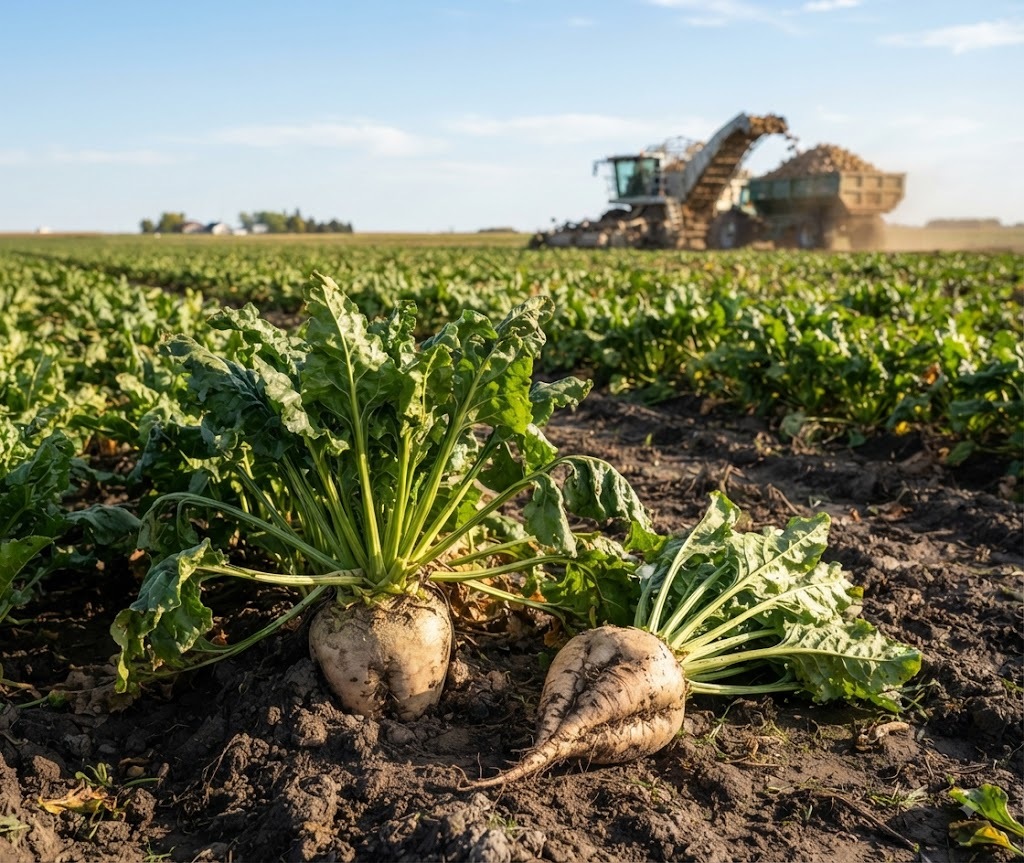
Judgment axis | Key judgment |
| Item Identity | Sugar Beet Crop Type bred from Beta vulgaris L. for the purpose of sugar extraction |
| Key role | Temperate sugar crops connected from Root → Cossette → Diffusion Juice → Thick Juice → Beet Sugar·Molasses |
| Harvesting principle | Manages not only root yield but also sucrose concentration, extractable sugar, impurities, and storage stability together. |
| Product separation | Fresh Root·Stored Root·Cossette·Raw Juice·Thick Juice·White Sugar·Molasses·Beet Pulp Separation |
| Separation of similar items | Although it belongs to the Beta vulgaris family like beetroot and Swiss chard, it differs in production purpose, variety group, harvest stage, and processing method. |
| Sugarcane separation | Sugarcane stems and sugar beet storage roots are raw materials for sugar extraction. |
| World production | The FAO estimates global sugar beet production in 2024 at 294 Mt , describing it as a sugar crop with significant year-to-year variability. ( Open Knowledge FAO ) |
| 2023 Comparison | The FAO estimated global sugar beet production in 2023 at 281 million tonnes . ( FAOHome ) |
| World Sugar Market | The OECD-FAO 2026–2035 forecast projects that global sugar production will increase from a base period of approximately 181 Mt to 203 Mt in 2035. ( OECD ) |
| Domestic production statistics | South Korea Sugar Beet Exclusive Commercial Cultivation Area and Production Volume: To be entered after verification of official raw data |
| Sugar content | The USDA ARS explains that the modern Sugar Beet is a crop with significantly improved sugar content through breeding. Actual lot sugar content must be managed based on analytical values. ( ARS ) |
| Storage risk | The USDA ARS is researching that sucrose loss can occur due to spoilage, injury, and microorganisms during post-harvest storage. ( ARS ) |
| Processing risk | USDA research confirms that sucrose loss and viscosity increase caused by microorganisms during storage and processing can reduce sugar extraction efficiency. ( ARS ) |
| Operating Principles | Cultivar–Field–Root Lot–Sucrose–Storage–Factory–Sugar Lot–Buyer RFQ Connection |
| Final goal | Connecting producers, sugar refineries, refining/food manufacturing, distribution, catering, restaurants, and PB buyers all the way to repurchase. |
According to FAO's 2024 production statistics, global sugar beet production was recorded at 294 Mt. Although the total volume is smaller than that of sugarcane, it is an important feedstock for the sugar industry in temperate regions, and the OECD-FAO also manages sugar beets and sugar canes as separate feedstocks for the global sugar supply. ( Open Knowledge FAO )
Basic fields | detail |
| Korean name | sugar beet |
| English name | Sugar Beet |
| Representative scientific name | Beta vulgaris L. — Sugar Beet Crop Type |
| classification | Amaranthaceae, Beta genus |
| Edible and processed parts | enlarged storage roots |
| Non-edible · Separate management | Separate management of leaves, petioles, soil, root tail, processing residue, etc. by use |
| Major harvesting stages | Leaf growth → Root enlargement → Sucrose accumulation → Industrial maturity → Excavation |
| Basic product form | Root·Cossette·Raw Juice·Thin Juice·Thick Juice·Sugar·Molasses·Pulp |
| Basic processing stage | Washing, cutting, diffusion, cleaning, filtration, evaporation, crystallization, centrifugation, drying |
| Basic use | Sugar, food manufacturing, beverages, confectionery, fermentation, molasses, feed by-products |
| Principle of similar items | You must separate Table Beet, Beetroot, and Leaf Beet from Cultivar Group and Use Type. |
The USDA ARS explains that the sugar beet is a relatively recent crop type bred from the fodder beetle for the purpose of sugar extraction, while the table beetle and leaf beetle have developed into separate vegetable crop groups. ( ARS )
Product Master
Product ID | Actual product form | Key Management Standards |
| SUGARBEET-P01 | seeds for cultivation | Cultivar · Seed Lot · Germination Rate · Treatment History |
| SUGARBEET-P02 | Roots during growth | Root Growth · Sugar Accumulation |
| SUGARBEET-P03 | Root immediately after harvest | Weight · Soil · Damage · Sucrose |
| SUGARBEET-P04 | Factory-grade Root | Sucrose · Impurities · Damage · Spoilage |
| SUGARBEET-P05 | Save Root | Storage Period · Temperature · Shrink · Sucrose Loss |
| SUGARBEET-P06 | Washed Root | Removal of soil and foreign matter |
| SUGARBEET-P07 | Cossette | Cutting specifications and extraction suitability |
| SUGARBEET-P08 | Raw Diffusion Juice | Brix, Sucrose, Impurities |
| SUGARBEET-P09 | Purified/Thin Juice | Purity, color, and impurities |
| SUGARBEET-P10 | Thick Juice | Concentration · Sucrose |
| SUGARBEET-P11 | Beet Sugar | Crystals, Purity, and Moisture |
| SUGARBEET-P12 | Liquid Beet Sugar | Solids, color, microorganisms |
| SUGARBEET-P13 | Beet Molasses | Residual sugar, solid content, fermentation suitability |
| SUGARBEET-P14 | Wet Beet Pulp | Moisture, fiber, and feed suitability |
| SUGARBEET-P15 | Dried/Pelleted Beet Pulp | Moisture content, pellet specifications, and storage properties |
| SUGARBEET-P16 | PB Sugar Product | Raw material traceability · Lot · Packaging · Labeling |
Classification criteria | Subdivision type | Management principles |
| Plant classification | Beta vulgaris | Species Master |
| Cultivar Group | Sugar Beet·Table Beet·Leaf Beet·Fodder Beet | Must be separated |
| production purpose | Sugar, Seed, Feed, etc. | Use Type |
| Harvesting stage | Immature Root·Mature Sugar Root | Harvest Stage |
| Cultivation method | By region and sowing time | Production Runtime |
| Root condition | Fresh · Stored · Damaged | Product Attribute |
| Processing form | Root·Cossette·Juice·Sugar·Molasses | Product ID |
| by-product | Pulp·Molasses·Lime/Filter Residue, etc. | Separate Entity |
| Final use | Sugar·Food Manufacturing·Fermentation·Feed | Buyer Spec |
| Transaction type | Contract cultivation·Factory Procurement·Sugar Supply·Bulk·PB | Contract NDA |
In the USDA's genetic diversity study as well, the Table Beet and Sugar Beet are classified as the Crop Group, even though they are both based on B. vulgaris. ( ARS )
For sugar beets, both root weight and sucrose concentration determine economic viability. The USDA ARS has been researching the improvement of root yield per unit area and extractable sucrose together as a strategy to increase sugar yield. ( ARS )
Furthermore, sugar beets are not processed entirely immediately after harvest but may be stored in factory yards, outdoor piles, or ventilated storage; during storage, root rot, wounding, respiration, and sucrose loss caused by microorganisms are important. ( ARS )
step | Essential Dataset | Management purpose |
| Cultivation plan | Cultivar · Area · Factory · Contract Quantity | Production plan |
| satellite | Seed Lot · Germination Rate · Treatment | breed tracking |
| sowing | Sowing date and density | Production Lot |
| budding | Budding rate · Hair emergence | Early growth |
| Leaf growth | Leaf area and growth status | Sugar Production |
| Root formation | Root Number · Shape | Yield Forecast |
| Root enlargement | Root Weight · Diameter | Yield |
| rising | Temperature, rainfall, frost, drought | Crop Risk |
| Watering | Soil moisture and irrigation | Yield |
| dispute | Input amount and timing of nitrogen, etc. | Root/Sugar Balance |
| weeds | Occurrence and Control | productivity |
| pests | Occurrence and Control | Root Quality |
| Sucrose accumulation | Sucrose·Brix | Harvest Forecast |
| Harvest judgment | Root Yield · Sucrose | Factory Allocation |
| Remove Tops | Crown·Leaf Management | Root Quality |
| Excavation | Date · Machine · Damage | Harvest Lot |
| soil removal | Soil Tare | Factory Efficiency |
| transit | Field→Factory | Logistics |
| save | Pile · Period · Temperature · Decay | Sucrose Preservation |
| purifying | Soil and Stone Removal | Factory Input |
| cutting | Cossette specifications | Diffusion |
| Diffusion extraction | Temperature, Time, Juice Recovery | Sucrose Extraction |
| purity | Impurity removal | Juice Purification |
| percolation | Sludge removal | Process Quality |
| Evaporation Concentration | Brix · Solids | Thick Juice |
| crystallization | Sugar Crystal | Sugar Yield |
| centrifugation | Sugar/Molasses Separation | Product Yield |
| Sugar drying | moisture | Storage |
| Pulp processing | Dehydration, drying, and pellets | By-product |
| Packaging and shipping | Buyer·Lot | Delivery |
Quality items | Root | Juice·Thick Juice | Sugar·Molasses | finished product | Public rating |
| Species | essential | succession | succession | tracking | Public |
| Cultivar | essential | succession | tracking | tracking | Verified |
| Origin | essential | succession | succession | tracking | Public |
| Field | essential | tracking | - | - | Verified |
| Lot | essential | new | new | new | Verified/NDA |
| Sowing date | record | succession | - | - | Verified |
| Harvest day | essential | succession | tracking | - | Verified |
| Root weight | core | Yield connection | - | - | NDA |
| Root Size | core | Amputation aptitude | - | - | Member |
| Soil/Tare | core | Factory Efficiency | - | - | Verified |
| Crown/Tops | check | Impurity connection | - | - | Verified |
| wound | core | Loss of storage connection | - | - | Verified |
| corruption | core | Microorganisms · Sucrose Loss | - | - | Verified |
| Sucrose | core | core | Sugar Yield | Product specifications | Verified/NDA |
| Extractable Sugar | core | Core of the process | Yield | - | NDA |
| Brix | analyze | core | Syrup/Molasses | By product | Verified |
| impurities | Root Chemistry | Juice core | Refining load | Product Standards | Verified/NDA |
| microorganism | Save Root | Juice core | If necessary | Product Standards | Verified/NDA |
| pesticide residues | Legal standards | Raw material inheritance | check | Legal standards | Verified/NDA |
| Sugar Recovery | - | core | Factory yield | - | NDA |
| Crystal quality | - | - | core | Product specifications | Verified |
| Molasses sugar | - | - | core | Buyer Spec | Verified/NDA |
| Refining history | - | process | essential | tracking | NDA |
| save | Root Pile | Tank | Dry/Tank | By product | Verified |
| Shipment | record | record | record | record | Verified |
| Returns and Claims | record | record | record | record | NDA |
| Repurchase | connection | connection | connection | connection | NDA |
The USDA ARS reports that sucrose loss during sugar beet storage directly affects quality and economics, and the 2025 study also addresses storage spoilage bacteria and root storage quality as key challenges. ( ARS )
Lot Master Required Field
Lot ID · Item · Product Type · Species · Scientific Name · Cultivar · Production Purpose · Crop Year · Country · Origin · Field · Producer · Seed Lot · Sowing Date · Growth · Root Enlargement · Harvest Date · Root Weight · Size · Grade · Soil Tare · Crown/Tops · Damage · Spoilage · Sucrose · Brix · Extractable Sugar · Pests and Diseases · Pesticide Use Records · Pesticide Residue Test Report · Storage Date · Pile ID · Storage Period · Factory Arrival Date · Root Lot · Cossette Lot · Diffusion Juice Lot · Juice Brix · Sucrose · Purity · Thick Juice Lot · Sugar Recovery · Beet Sugar Lot · Molasses Lot · Pulp Lot · Quality Certificate · Packaging Date · Shipper · Returns · Claims · Repurchase
Customers | Purchase criteria | Cooperation opportunities |
| Domestic test cultivation farms | Cultivar·Root Yield·Sucrose | Regional Pilot |
| Seed company | Sugar Beet Cultivar · Germination Rate | Seed RFQ |
| Overseas Producer | Crop Year, Sucrose, and Factory Linkage | Global Supply |
| sugar factory | Root Yield · Sucrose · Tare | Contract Farming |
| Sugar import and distribution company | Beet Sugar · Origin · Grade | Trade RFQ |
| Food manufacturer | Refined sugar and crystal specifications | Bulk Supply |
| Beverage company | Liquid Sugar | Ingredient |
| Confectionery and Bakery | Sugar, particle size, color | Regular Supply |
| Fermentation company | Molasses · Sugars | Fermentation |
| feed company | Beet Pulp | Feed RFQ |
| food service companies | Refined sugar and packaging | Foodservice |
| School and public meals | Safety and Standards | Contract |
| PB·OEM | Beet Sugar Product | Manufacturing |
| Research Institute | Variety · Adaptability · Sucrose | Pilot |
| Processing technology institute | Diffusion·Storage·Sugar Recovery | Technology RFQ |
step | Key variables | Operational judgment |
| Global production | Country·Crop Year·Root Production | Sugar Supply |
| contract farming | Cultivar·Factory Allocation | Procurement |
| harvest | Root Yield · Sucrose | Factory Value |
| save | Period · Temperature · Spoilage · Shrink | Sugar Preservation |
| Factory stock | Tare·Sucrose·Damage | Payment Grade |
| Diffusion | Extractable Sugar | Process Efficiency |
| Sugar production | Recovery·Quality | Beet Sugar Supply |
| Molasses | Remaining quantity | By-product Market |
| Pulp | Moisture · Feed Quality | Feed Market |
| International Sugar Trade | Origin · Raw/White Sugar | Procurement |
| Korean imports | HS · Country · Quantity · Amount | Import Runtime |
| RFQ · Repurchase | Grade · Price · Delivery Time | Supplier Ranking |
The OECD-FAO 2026–2035 forecast analyzes the global sugar market as a combined structure of sugar cane and sugar beet raw material production, as well as sugar production, consumption, and trade. Global sugar production is projected to increase from a base period of 181 Mt during the forecast period to 203 Mt in 2035. ( OECD )
Import and export management
item | Management principles |
| Fresh Sugar Beet | Register after checking current HSK |
| Beet Sugar | Check HSK and customs records to see if cane sugar and the origin of the raw materials can be separated. |
| Raw Sugar | Raw Sugar Product State Separation |
| Refined Sugar | Separate management of refined sugar |
| Beet Molasses | Molasses HS Check |
| Beet Pulp | Check HS Code by Fresh/Dried/Pelleted Status |
| Seed | Sugar Beet Seeds for Sowing Separate |
| Korea's import volume | Input after verification of raw data by the Korea Customs Service for 2025/2026 |
| Revenue | Input after official verification of raw data |
| major countries | Enter after verifying HS, Origin, Quantity, and Amount |
| FTA | Check preferential tariff rates by Product State and Origin |
| Customs clearance unit price | Separate calculation of Root, Sugar, Molasses, and Pulp |
| Food standards | Check the latest Food Code standards for each sugar product |
Products and processes | Key conditions | RFQ conversion |
| Fresh Sugar Beet | Root Yield · Sucrose · Tare | Factory RFQ |
| Stored Beet | Storage Period · Spoilage · Sucrose Loss | Processing Allocation |
| Washed Beet | Soil removal/damage | Factory |
| Cossette | Cutting dimensions · Surface area | Diffusion |
| Raw Juice | Brix, Sucrose, Impurities | Process |
| Purified Juice | Purity · Color | Evaporation |
| Thick Juice | Brix·Sucrose | Sugar Production |
| Beet Sugar | Crystals, Purity, and Moisture | Food RFQ |
| Liquid Sugar | Solids and microorganisms | Beverage |
| Molasses | Sugars and solids | Fermentation |
| Wet Beet Pulp | Moisture and fiber | Feed |
| Pressed Pulp | Moisture and density | Feed |
| Dried Beet Pulp | Moisture and storage properties | Feed Trade |
| Pelleted Beet Pulp | Pellet Size · Durability | Export/Feed |
| Factory Residue | Safety and properties | Circular utilization verification |
| Incompatible Root | decay and pollution | Food Supply excluded |
The USDA ARS reported that microorganisms from the storage root in sugar beet processing can migrate into juice processing, causing process failures such as sucrose loss and the formation of high-viscosity substances. ( ARS )
Product Research Profile (PRP)
PRP area | Key question |
| Cultivar | Is the Root Yield and Extractable Sucrose high? |
| Root | Is the root shape suitable for harvesting, washing, and cutting efficiency? |
| Sucrose | What is the actual extractable sugar, not just the simple Brix? |
| impurities | What are the factors that hinder sugar recovery during the process? |
| Harvest | Does excavation damage increase storage loss? |
| Storage | What is the sucrose loss for each storage period? |
| Disease | What is the impact of Root Rot on storage capacity and factory yield? |
| Cossette | Is the cutting shape suitable for diffusion efficiency? |
| Diffusion | How much sucrose is recovered per kg of root? |
| Juice | What is the effect of Purity and microorganisms on process efficiency? |
| Sugar Recovery | What is the final sugar yield relative to the amount of root input? |
| Molasses | Do residual sugars and fermentation suitability meet the buyer's requirements? |
| Pulp | Is an economic transition to a Feed Product possible? |
| Buyer | What are the effects of sucrose, recovery, quality, and delivery time on repurchase? |
first of all | Execution item | Performance indicators |
| 1 | Species·Cultivar·Field·Harvest Date·Root Lot required | Required value completion rate |
| 2 | Root·Cossette·Juice·Sugar·Molasses·Pulp Product Separation | Product identification rate |
| 3 | Linking weather, growth, root enlargement, sucrose, and harvest data | Production history connection rate |
| 4 | Quality, Storage, Factory, and Test Report History Data Conversion | Traceability rate |
| 5 | Producer–Factory–Sugar Buyer RFQ connection | RFQ Match Rate |
| 6 | Video AI Root Size and Damage Judgment | Grade Accuracy |
| 7 | Pest and disease AI diagnosis | Early detection rate |
| 8 | Root Yield Prediction | Error compared to performance |
| 9 | Sucrose prediction | Error compared to Lab value |
| 10 | Harvest timing prediction | Improvement of extractable sugar |
| 11 | Storage Loss Prediction | Sucrose Loss Error |
| 12 | Pile Risk Monitoring | Corruption and Hot Spot Detection Rate |
| 13 | Diffusion Yield Prediction | Error compared to the actual |
| 14 | Sugar Recovery Prediction | Error compared to the actual |
| 15 | Factory Capacity Optimization | Reduced standby and storage periods |
| 16 | Pulp·Molasses Allocation | By-product yield |
| 17 | AI Supplier/Buyer Match | Sample→Contract Conversion Rate |
| 18 | Traceability | Field→Sugar Lot Traceability |
Problem group | Problem Definition | Required data |
| Table Beet Blend | Confusion between common beet and sugar beet varieties | Cultivar Group |
| Unclear domestic production base | Verification of commercial cultivation scale is necessary | Area·Production |
| dependence on seeds and varieties | Need to secure high-sugar, disease-resistant Cultivar | Seed/Cultivar |
| Weather risk | Effects of temperature, drought, and excessive moisture | Climate |
| Weed competition | Early growth and root yield reduction | Weed |
| pests | Root and Leaf Productivity and Shelf Life Decline | Pest/Disease |
| Root Yield deviation | Factory Raw Material Quantity Fluctuation | Root Weight |
| Sucrose deviation | Difference in economic value of the same weight | Sucrose |
| Tare | Soil and Tops increase factory logistics costs | Tare |
| Excavation damage | Increased storage spoilage and sucrose loss | Harvest Damage |
| Storage loss | Sugar Yield decreases due to respiration and decomposition | Storage |
| Pile temperature deviation | Hot Spot · Risk of Corruption | Temperature |
| Juice microorganisms | Sucrose Loss · Process Failure | Microbiology |
| Diffusion deviation | Change in extractable sugar recovery rate | Process |
| Sugar Recovery deviation | The actual difference in Factory Economics | Recovery |
| Raw Material – Sugar Traceability | Difficulty tracing Field Origin | Relationship |
| Molasses low value | Unrecovered residual value | By-product |
| Beet Pulp Low Value | Lack of connection to the feed market | Feed Dataset |
| International sugar prices | Changes in Beet Sugar Competitiveness | Price |
| Repurchase not reflected | Buyer results not distributed to Cultivar, Farms, and Factories | Reorder |
Problem group | Problem Definition | Required data |
| Table Beet Blend | Confusion between common beet and sugar beet varieties | Cultivar Group |
| Unclear domestic production base | Verification of commercial cultivation scale is necessary | Area·Production |
| dependence on seeds and varieties | Need to secure high-sugar, disease-resistant Cultivar | Seed/Cultivar |
| Weather risk | Effects of temperature, drought, and excessive moisture | Climate |
| Weed competition | Early growth and root yield reduction | Weed |
| pests | Root and Leaf Productivity and Shelf Life Decline | Pest/Disease |
| Root Yield deviation | Factory Raw Material Quantity Fluctuation | Root Weight |
| Sucrose deviation | Difference in economic value of the same weight | Sucrose |
| Tare | Soil and Tops increase factory logistics costs | Tare |
| Excavation damage | Increased storage spoilage and sucrose loss | Harvest Damage |
| Storage loss | Sugar Yield decreases due to respiration and decomposition | Storage |
| Pile temperature deviation | Hot Spot · Risk of Corruption | Temperature |
| Juice microorganisms | Sucrose Loss · Process Failure | Microbiology |
| Diffusion deviation | Change in extractable sugar recovery rate | Process |
| Sugar Recovery deviation | The actual difference in Factory Economics | Recovery |
| Raw Material – Sugar Traceability | Difficulty tracing Field Origin | Relationship |
| Molasses low value | Unrecovered residual value | By-product |
| Beet Pulp Low Value | Lack of connection to the feed market | Feed Dataset |
| International sugar prices | Changes in Beet Sugar Competitiveness | Price |
| Repurchase not reflected | Buyer results not distributed to Cultivar, Farms, and Factories | Reorder |
RFQ Type | Public Registration | Verify/NDA |
| Sugar Beet Contract Farming | Cultivar · Region · Harvest season | Farms, Area, Unit Price |
| Factory Root sales | Sucrose · Root Grade | Lot · Physical Volume |
| Factory Root purchase | Sucrose · Tare · Delivery Date | Price and Contract Conditions |
| Seed supply | Cultivar · Germination rate | Seed Supplier |
| Regular supply | Crop Year/Period | Contract volume |
| Save Root | Storage Date·Quality | Sucrose Loss |
| Beet Sugar | Origin·Grade | Actual price |
| Liquid Sugar | Brix · Quality | Food Manufacturer |
| Molasses | Sugars and solids | Fermentation |
| Wet Beet Pulp | Moisture · Feed Grade | Feed Buyer |
| Dried Beet Pulp | Moisture and packaging | Feed Trade |
| Pelletized Pulp | Pellet Spec | Export |
| Sugar for food manufacturing | Crystals/Purity | Bulk Contract |
| School meals and dining out | Packaging and Safety | Regular Supply |
| PB·OEM | Beet Sugar | Manufacturing conditions |
| import | Sugar/Pulp·Origin | Exporter·Freight |
| Technology demonstration | Sucrose · Storage · Diffusion | Pilot |
| Research cooperation | Cultivar, disease, sugar recovery | Dataset·IP |
① Need Products & Materials
Companies and institutions seeking necessary products, agricultural products, raw materials, and processed goods register purchasing demands. Registered requests are utilized to review cooperation with potential suppliers and producers based on the RFQ Intelligence Library.
Process:
RFQ Registration → Supplier/Product Review → Collaboration Connection → Future AI Matching
Register
② We are looking for production and manufacturing partners. (Need Suppliers & Manufacturers)
Register a request to find necessary production and supply partners, ranging from farms and producer organizations to processing companies, OEM, ODM, and private label manufacturers.
Process:
RFQ Registration → Review of Production & Manufacturing Capabilities → Collaboration Connection → Future AI Partner Matching
Register
③ We are looking for domestic and international buyers. (Need Buyers)
Farmers, producer organizations, and manufacturing companies are requesting cooperation with new buyers, such as domestic and international distributors, importers, brand companies, and food service and catering businesses.
Process:
RFQ Registration → Product & Supply Capability Review → Market & Buyer Connection → Future AI Buyer Matching
Register
Contact : mail@markethub.org
Version | Main contents | situation |
| v1.0 | Plant Identity · Sugar/Table Beet Isolation · Root · Sucrose · Storage · Diffusion · Beet Sugar · Molasses · Pulp · RFQ Basic Structure Registration | complete |
| v1.1 | Domestic Production Statistics · Cultivar · Current HS · Korean Imports · Food Code · FAOSTAT Latest Raw Data Verification | expected |
| v2.0 | Root Yield·Sucrose·Extractable Sugar·Tare·Storage Loss·Diffusion Yield·Sugar Recovery·Pulp Specification Subdivision | expected |
| v3.0 | Seed Supplier–Producer–Field–Storage–Sugar Factory–Importer/Distributor–Food Manufacturer–Food, Dining Out, Retail Buyer Verified Container combined | expected |