

Judgment axis | detail |
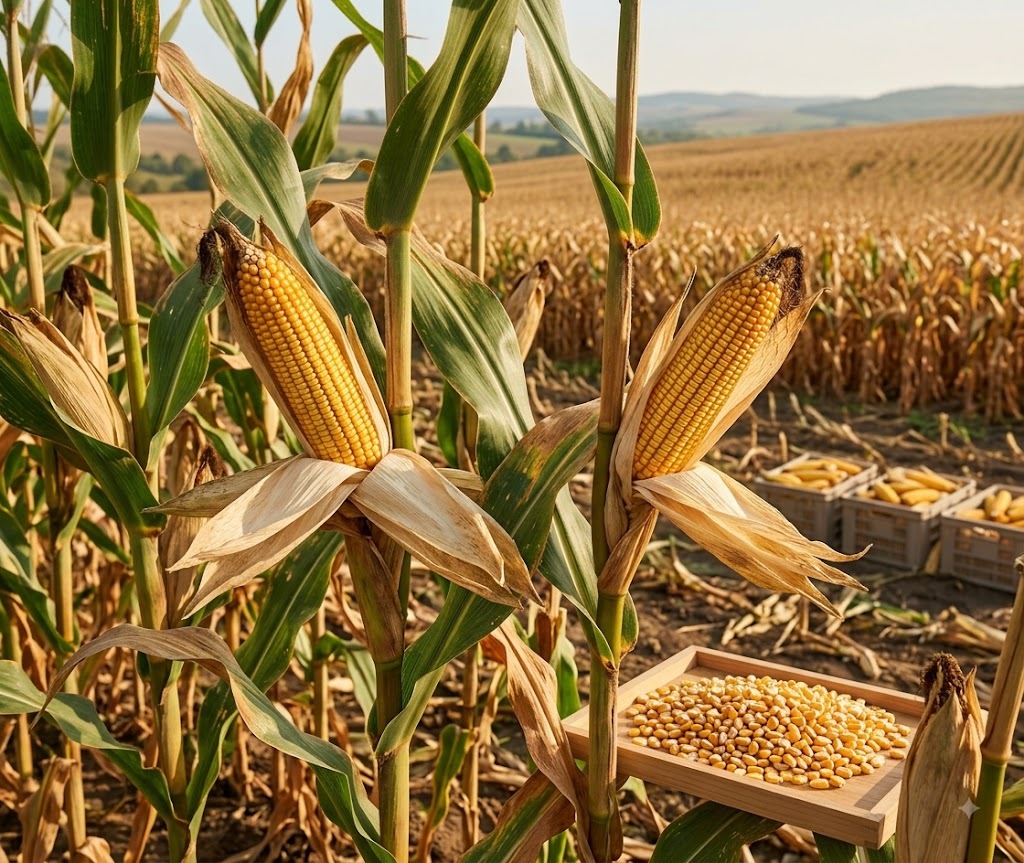
| Item Identity | Corn is an annual grain crop belonging to the genus Zea of the family Poaceae, and its representative scientific name is Zea mays L. The Rural Development Administration also manages corn under the names Corn, Maize, and Zea mays L. ( Nongsaroo ) |
| Key role | Domestically, there is consumption of sweet corn such as waxy corn and sweet corn, as well as grain utilization, and industrially, it expands into a large-scale raw material market for starch, sugars, food processing, and compound feed. |
| Difference from the previous item | No.002 While wheat is centered on milling and gluten, noodle, and bread-making suitability, corn changes its product at the harvesting stage itself , and must clearly separate sweet corn, dried grain, starch, sugars, and feed ingredients. |
| Harvesting principle | For sweet corn, taste, kernel fullness, sweetness, gluten, and timely harvesting are important, whereas for grain corn, ripeness, kernel moisture, dryness, and storage stability are important, so the same harvesting standards are not applied. |
| Product separation | Glutinous corn, sweet corn, green corn ears, grain corn, dried grain, corn flour/powder, raw materials for starch, grain for popcorn, grain for feed, and grain for silage are managed as separate products. |
| Korean production | Based on the 2024 miscellaneous grain production data from the National Statistical Portal, the nationwide corn cultivation area is 8,698 ha, the yield per 10a is 241 kg, and the production volume is 20,997 tons. Areas and production volumes with different base years are not aggregated. ( KOSIS ) |
| production environment | The Rural Development Administration distinguishes between edible and feed corn varieties and suggests different planting times for the central and northern regions versus the south, making it necessary to manage cultivation calendars by region, variety, and intended use. ( Nongsaroo ) |
| Pest and disease risk | Official cultivation data identifies smut, stem rot, and brown spot as major diseases, and cutworms, armyworms, corn earworms, and tropical armyworms as major pests. ( Nongsaroo ) |
| Import supply chain | It is connected to the supply chain of large-scale imported raw materials to the extent that the government's 2025 tariff quota plan sets limit quantities at 11 million tons for feed corn and 1.9 million tons for other edible and some industrial corn. ( Ministry of Agriculture, Food and Rural Affairs ) |
| TRQ structure | Under the 2026 WTO TRQ operation plan, a separate allocation structure is in place for corn intended for popcorn and starch syrup; therefore, even for the same corn variety, the HS code, intended use, and end-user must be separated. ( Ministry of Agriculture, Food and Rural Affairs ) |
| AX Core | It links variety, plot, growth, harvesting stage, lot, drying/storage, processing, inspection, RFQ, delivery, and repurchase, and manages origin, use, quality, price, and logistics for domestic and imported products using separate datasets. |
| Final goal | Corn is not managed as a simple grain, but is operated as a supply chain intelligence connecting production, quality, processing, RFQ, and repurchase . |
division | Registration details |
| Korean name | corner |
| English name | Corn / Maize |
| Representative scientific name | Zea mays L. |
| classification | Poaceae, Zea |
| Edible parts | Immature or mature seeds |
| Non-edible · Separate management | Stems, leaves, cobs, fibrous hairs, roots, grains for seeds, plants for silage |
| Major harvesting stages | Emergence/Pollination → Softening → Flourishing → Sweet corn Red ripening → Yellow ripening → Fully ripened kernels → Risk of overripening/quality deterioration |
| Basic product form | Fresh ears, green corn, hulled raw grain, dried grain, ground grain, corn flour, raw material for starch, raw grain for popcorn, grain for animal feed |
| Basic processing stage | Sowing → Growth → Silking/Pollination → Harvesting → Peeling/Sorting → Shattering → Drying → Storage → Grinding/Milling → Starch Separation/Processing → Packaging |
| Basic use | Boiling, Steaming, Grilling, Frozen, Retort, Milling, Confectionery, Starch, Sugars, Popcorn, Alcoholic Beverages, Fermentation, Food Ingredients, Feed |
| Similarity Principle | It is separated from miscellaneous grains such as sorghum, millet, and foxtail millet, and within corn, it is separated into glutinous corn, sweet corn, grain corn, popcorn corn, and feed corn according to variety and use. |
Product | Key Management Standards |
| corn for seeds | Variety · Seed Lot · Germination Rate · Purity · Use |
| Sweet corn | Variety, Glutinousness, Ear Size, Grain Fullness, Harvest Date |
| sweet corn | Variety, Sugar Content, Ripness, Time After Harvest, Refrigeration |
| raw corn | Harvest stage · Ear size · Appearance · Freshness |
| frozen corn | Raw Material Lot · Blanching · Freezing · Packaging · Frozen Distribution |
| Retort and vacuum-packed corn | Raw Material Lot · Heating · Sterilization · Packaging · Use-by Date |
| grain corn | Variety, Harvest Year, Moisture Content, Weight, Damaged Grains |
| Drying grain | Original Grain Lot · Dry Moisture · Storage Conditions · Foreign Matter |
| Original song for popcorn | Variety, moisture, puffiness, grain uniformity |
| Corn flour/powder | Original Grain Lot · Milling Method · Particle Size · Moisture |
| Corn for starch | Starch content, yield, moisture, and origin |
| feed grains | Moisture, Energy, Mycotoxins, Foreign Matter, Country of Origin |
| Corn for silage | Variety · Harvesting stage · Dry matter content · Cutting · Fermentation conditions |
Classification criteria | Subdivision type | Management principles |
| Variety and taste | Glutinous corn / Sweet corn / Standard grain type | Separation of harvest season and consumption use |
| Harvesting stage | Young corn / Ripe grain / Whole plant | Even for the same crop, Product separation |
| Usage patterns | Ear of grain / Threshed grain / Dried grain / Powder | Step-by-step Lot inheritance |
| Processing use | Frozen / Retort / Milled / Starch / Sugars / Popcorn | Separation of processing conditions and specifications |
| Food and Feed | For edible / food industry / animal feed | Separation of food safety and feed standards |
| cultivation method | Open field / Facility/Tunnel / Paddy cultivation / Others | Classification of crop type, region, and weather risks |
| origin | Domestic / Imported | Separation of origin, quarantine, quality, and price |
| Supply type | Farm shipments / Production organizations / Bulk / Containers | Separation of logistics structure |
| Transaction type | Local Procurement / Contract Farming / Import Procurement / Regular Supply | Contract, quantity, and unit price are Verified/NDA |
| final end-user | Consumer / Food Manufacturing / Starch Sugar / Feed / Food Service & Restaurant | Buyer specification separation |
step | Essential Dataset | Management purpose |
| Seeds and varieties | Variety · Use · Seed Source · Lot | Final product conformity |
| sowing | Region, Plot, Sowing Date, Sowing Rate, Planting Distance | Growth and harvest prediction |
| Germination and early growth | Temperature, soil moisture, and emergence rate | Initial growth management |
| Vegetative growth | Plant height, leaf count, fertilization, and irrigation | Productivity Management |
| Shooting · Moisture | Date of shoot, weather, and moisture conditions | Grain set and yield prediction |
| Deungsuk | Maturity, temperature, moisture, pests and diseases | Quality prediction |
| Harvesting green corn | Variety, Harvest Date, Grain Fullness, Glutinousness, Sugar Content | Suitability for reproduction |
| Grain harvest | Ripness, moisture, damaged grains, harvest date | Suitability for storage and processing |
| Selection | Ear, grain size, disease, foreign matter | Product specifications |
| evasion | Raw Material Lot · Detachment Date · Damage Rate | Grain Lot Conversion |
| dry | Incoming moisture · Drying method · Outgoing moisture | Ensuring storage stability |
| save | Temperature, humidity, pests, mold, inventory | Quality stability |
| Cooling/Refrigeration | Time and temperature after sweet corn harvest | Maintaining taste and freshness |
| Processing and receiving | Origin·Moisture·Quality·Lot | Manufacturing suitability |
The Rural Development Administration recommends that the sowing period for edible corn grown in paddy fields be mid-April to early May in the central and northern regions, and early April to late April in the southern regions; it also suggests different sowing rates depending on whether the corn is for grain, green corn, or feed. Therefore, the calendar is managed by separating the region, use, sowing, and harvest . ( Nongsaroo )
Quality items | sweet corn | For grain | Starch for processing | for animal feed | Public rating |
| Variety · Origin · Farm · Lot | core | core | core | core | Verified |
| Harvest date/harvest stage | core | core | importance | importance | Verified |
| Ear and grain specifications | core | importance | importance | reference | Verified/NDA |
| Stickiness, sweetness, and taste | core | By use | By use | Not applicable | Verified/NDA |
| Seed pollination | importance | core | core | core | Verified/NDA |
| Damaged ribs, broken ribs, foreign matter | importance | core | core | core | Verified/NDA |
| Starch and processing yield | Not applicable | importance | core | importance | NDA |
| Mold/Spoilage | core | core | core | core | Verified/NDA |
| Safety of mycotoxins, etc. | core | core | core | core | NDA |
| pesticide residues | core | core | core | Check application criteria | NDA |
| Origin/Import Lot | The relevant city | The relevant city | core | core | Verified/NDA |
| GMO related verification | The relevant city | The relevant city | The relevant city | The relevant city | Verified/NDA |
| Delivery, Claims, Repurchase | core | core | core | core | NDA |
Lot Master Required Field
Lot ID · Item · Product Type · Scientific Name · Variety · Usage Classification · Origin/Place of Origin · Cultivation Area · Plot · Producer · Seed Lot · Sowing Date · Silkling Date · Harvest Date · Harvest Stage · Ear Size · Grain Size · Sugar Content/Sticky Texture · Moisture Content · Damaged Grains · Broken Grains · Foreign Matter · Pests and Diseases · Pesticide Usage Records · Pesticide Residues · Mold/Mycotoxin Test Report · Shattering Date · Drying History · Storage Facility · Processing History · Packaging Date · Proof of Origin · Import Lot · Inspection Report · Shipper · Claim · Repurchase
Customers | Purchase criteria | Cooperation opportunities |
| Production Area Distribution Organizations · Agricultural Cooperatives | Variety, Ear Size, Harvest Date, Quantity | Sweet Corn Joint Shipment RFQ |
| Fresh food distribution and online | Appearance, ear size, sweetness, glutinousness, freshness | Direct from the farm · Private brand |
| School meals and dining out | Washing, peeling, specifications, safety, delivery time | Fresh and Frozen Corn RFQ |
| frozen food companies | Lip uniformity, yield, color, and sweetness | Frozen rib ingredients |
| Retort company | Ear/Grain Specifications/Heating Suitability | Raw materials for room temperature products |
| Flour milling company | Moisture, particle size, variety, and uniformity of the original grain | Cornmeal RFQ |
| Starch and sugar companies | Starch yield, moisture, bulk supply, origin | Industrial Raw Material RFQ |
| Confectionery and snack companies | Variety · Puffing · Grinding · Texture | Snack/Popcorn RFQ |
| Alcohol and fermentation companies | Starch, saccharification, and fermentation suitability | Fermented Raw Material RFQ |
| feed company | Moisture, energy, mycotoxins, price | Bulk Grain RFQ |
| livestock farms | Quality of feed grains and silage | Local feed supply |
| importing companies | Origin, Price, Shipment, Quarantine, Logistics | Overseas Procurement RFQ |
| Research Institute | Variety, Appetite, Feed, Starch, Climate Dataset | Joint demonstration |
According to official 2024 statistics on miscellaneous grain production, domestic corn production stands at 20,997 tons, with a cultivated area of 8,698 hectares. On the other hand, since industrial and feed corn are subject to the government's large-scale import and tariff policies, the domestic sweet corn market and the market for imported industrial grains are not treated as the same supply and demand market. ( KOSIS )
step | Key variables | Operational judgment |
| Seeds and production plans | Type, Use, Area, Contract | Clarification of production purpose |
| culture | Weather, Soil, Pests and Diseases, Growth | Production risk |
| Harvesting green corn | Optimal ripening period, sugar content, stickiness, and harvest time | Fresh product value |
| Grain harvest | Ripness, moisture, damaged grains | Suitable for storage and processing |
| Selection and De-establishment | Specifications, damage, foreign matter | Product Switching |
| Drying and storage | Moisture, temperature, mold, inventory | Quality and Inventory Management |
| Freezing and processing | Blanching, freezing, heating, and packaging | Food Lot Connection |
| Starch and sugars | Raw material quality, yield, and process | Industrialization of materials |
| feedstuff | Nutrition, Safety, Price, and Mass Procurement | livestock supply chain |
| Import procurement | Country · HS · Shipment · Unit Price · Volume | Supply risk |
| Quarantine and Customs Clearance | Plant Quarantine, Food, and Feed Standards | Assessment of suitability |
| Port and inland logistics | Bulk · Silo · Warehouse · Transportation | Procurement costs |
| RFQ · Repurchase | Specifications · MOQ · Inspection · Delivery · Performance | Supplier evaluation |
In the 2026 WTO TRQ operational plan, the allocation system for corn is differentiated by end-user, such as for popcorn and starch syrup. Therefore, the Corn Trade Dataset must be subdivided by tariff code, use, allocation agency, end-user, and tariff conditions , rather than simply relying on the HS 1005 total volume. ( Ministry of Agriculture, Food and Rural Affairs )
Products and processes | Key conditions | RFQ conversion |
| Fresh young corn | Variety, Harvest Date, Glutinousness, Sugar Content, Ear Size | Fresh Food Distribution RFQ |
| Frozen ears | Raw Material Lot · Blanching · Freezing · Packaging | Food Service & Distribution RFQ |
| Frozen corn ribs | Shattering · Grain size · Sugar content · Color · Microorganisms | HMR·School Meal RFQ |
| Vacuum/Retort Corn | Raw materials, heating, sterilization, packaging | Retail and Export RFQ |
| popcorn | Variety, moisture, puffing rate, and grain uniformity | Popcorn Manufacturing RFQ |
| cornmeal | Raw grain, milling, particle size, moisture | Confectionery, Baking, and Food RFQ |
| corn starch | Starch yield, purity, and moisture | Food and Industrial Materials RFQ |
| Sugar raw materials | Starch, Saccharification Process, and Raw Material Specifications | Starch and Sugar Company RFQ |
| Fermented ingredients | Starch, Saccharification, and Fermentation Suitability | Alcohol and Fermentation Industry RFQ |
| feed grains | Moisture, nutrients, and mycotoxins | Feed Company RFQ |
| Silage | Harvest maturity · Dry matter content · Cutting · Fermentation | Livestock Farm RFQ |
| corn embryo | Oil content, separation, and storage | Maintenance and Material RFQ |
| Corn gluten and by-products | Protein, moisture, process | Feed & Material RFQ |
| inner core | Amount generated, moisture, and contamination | Review of materials and bio transition |
| Stem and leaves | Moisture, yield, and harvesting method | Feed and Biomass Review |
While the potential for agricultural utilization of harvest by-products such as corn stalks is presented in official cultivation data, compliance with relevant laws and safety requirements for each intended use are verified separately when converting them into food, feed, or biomaterials. ( Nongsaroo )
first of all | Execution item | Performance indicators |
| 1 | Variety–Use–Plot–Sowing–Harvesting Stage–Lot Mandatory | Production history connection rate |
| 2 | Separation of Glutinous, Sweet, Grain, Popcorn, Starch, and Feed Products | Misclassification reduction rate |
| 3 | Sowing–Shidding–Graining–Harvesting Weather Dataset Connection | Return forecasting accuracy |
| 4 | Datafication of ears, grains, sugar content, glutinousness, moisture, and damaged grains | Quality classification accuracy |
| 5 | Pest, Disease, Control, and Pesticide Use Runtime Connection | Risk early detection rate |
| 6 | Sweet corn harvest – pre-cooling – refrigeration – sales time linkage | Reduced freshness loss |
| 7 | Grain–Drying–Storage–Processing Lot Tracking | Lot tracking rate |
| 8 | Comparison of Quality, Price, and Country of Origin Between Domestic and Imported Products | Procurement judgment accuracy |
| 9 | Connecting RFQs and Supply Lots for Starch, Feed, and Food Processing Companies | Matching rate |
| 10 | Delivery evaluation, processing yield, claims, and repurchase feedback | Repurchase rate |
Problem group | Problem Definition | Required data |
| Mixed uses | Treating sweet corn, grains, animal feed, and starch as the same product | Variety, Harvest Stage, Use |
| Disconnection of variety information | Variety information weakens at the final distribution stage | Seeds · Lot · Distribution |
| Harvesting at the right time | The quality of sweet corn is sensitive to the time of harvest. | Shooting · Harvest · Sweetness · Stickiness |
| freshness deterioration | Variation in taste due to increased post-harvest distribution time | Harvest time, pre-cooling, temperature |
| weather changes | Rainfall, high temperatures, drought, etc. affect growth and moisture | Weather, Soil, Growth |
| pests | Risks of smut, stem rot, corn borer, etc. | Occurrence, Control, Weather |
| Original quality variation | Difference between moisture, damaged granules, and foreign matter | Quality inspection |
| Mycotoxins | Need for safety management of stored and imported grains | Moisture, Storage, and Test Report |
| Dualization of domestic and import markets | Structural differences between domestic sweet corn and imported industrial grains | Production, Import, and Demand |
| Origin management | Use of multinational raw materials in processing and feed supply chains | Country · Shipment · Lot |
| GMO Information Management | The level of verification required varies depending on the purpose of the transaction. | Origin, Proof, Inspection |
| Starch processing aptitude | Original song information is not linked to starch yield | Ingredients, Process, Yield |
| feed procurement risk | Sensitive to international prices, exchange rates, and freight rates | International prices, exchange rates, and inventory |
| Low value-added by-products | Lack of utilization of inner cores, stems, and processing by-products | Amount, Composition, and Demand |
| Repurchase non-refund | Delivery performance not reflected in next production and purchasing plans | Inspection · Claims · Reorders |
RFQ Type | Public Registration | Verify/NDA |
| Glutinous corn sourced directly | Variety · Production Area · Harvest Period · Ear Size | Farm · Lot · Volume · Unit Price |
| Sweet corn procurement | Variety, Sugar Content Standard, Harvest Period, Use | Sweetness · Lot · Price · Contract |
| contract farming | Variety, Purpose, Harvest Period, Quality Standards | Contract Area, Quantity, Unit Price |
| For frozen processing | Product form, rib specifications, processing purpose | Actual Lot, Yield, and Test Report |
| For retort | Ear of grain · Grain size · Heating use | Processing Test · MOQ · Unit Price |
| For popcorn | Variety, Grain Size, and Puffing Requirements | Swelling test · Quantity · Contract |
| For starch | Country of origin, starch use, and basic specifications | Yield, Volume, Unit Price, Shipment |
| For food processing | Product forms such as powder, granules, and starch | Test results, prescription, contract |
| for animal feed | Origin, Grain Type, Supply Period | Ingredients, Mycotoxins, Unit Price |
| Silage | Variety, Production Region, Harvest Season | Building ratio, volume, contract |
| Import procurement | Country of Origin · Product Type · Port of Arrival | Shipment, Customs Clearance, Unit Price, Contract |
| by-product | coccyx, embryo, gluten, stem, etc. | Amount, Composition, Price |
| Technology demonstration | Purpose of variety, cultivation, and processing tests | Sample, Result, IP Conditions |
| Community project | Production, Sorting, Freezing, Processing, Branding | Investment, Production, and Sales Contracts |
Trading operations
RFQ Submission → Producer/Supplier Search → Verified → Sample → Lot Inspection → Report Verification → Processing Test → Negotiation → Contract → Quantity/Delivery Confirmation → Shipment/Dispatch → Incoming Inspection → Processing Performance Evaluation → Claim → Repurchase
① Need Products & Materials
Companies and institutions seeking necessary products, agricultural products, raw materials, and processed goods register purchasing demands. Registered requests are utilized to review cooperation with potential suppliers and producers based on the RFQ Intelligence Library.
Process:
RFQ Registration → Supplier/Product Review → Collaboration Connection → Future AI Matching
Register
② We are looking for production and manufacturing partners. (Need Suppliers & Manufacturers)
Register a request to find necessary production and supply partners, ranging from farms and producer organizations to processing companies, OEM, ODM, and Private Label manufacturers.
Process:
RFQ Registration → Review of Production & Manufacturing Capabilities → Collaboration Connection → Future AI Partner Matching
Register
③ We are looking for domestic and international buyers. (Need Buyers)
Farmers, producer organizations, and manufacturing companies are requesting cooperation with new buyers, such as domestic and international distributors, importers, brand companies, and food service and catering businesses.
Process:
RFQ Registration → Product & Supply Capability Review → Market & Buyer Connection → Future AI Buyer Matching
Register
Contact : mail@markethub.org
Version | Main contents | situation |
| v1.0 | Corn Plant·Product·Sweet Corn·Grain·Processing·Import·RFQ Basic Structure Registration | complete |
| v1.1 | Reflecting the latest official statistics on production, varieties, and cultivation types by domestic region | expected |
| v2.0 | Variety–Plot–Sweet Corn·Grain–Dry·Storage Lot Runtime Integration | expected |
| v2.5 | Linking Datasets for Frozen, Popcorn, Milling, Starch, Sugars, and Feed Processing Suitability | expected |
| v3.0 | Integration of Domestic–Import Origin, Quality, Price, TRQ, and Logistics Intelligence | expected |
| v3.5 | Farms – Local Distribution – Processing Companies – Starch & Sugar – Feed Companies – Buyers Verified Connection | expected |
| v4.0 | Production Forecast – Quality Forecast – Procurement – Processing Suitability – RFQ – Repurchase AI Runtime Application | expected |