

Judgment axis | Key judgment |
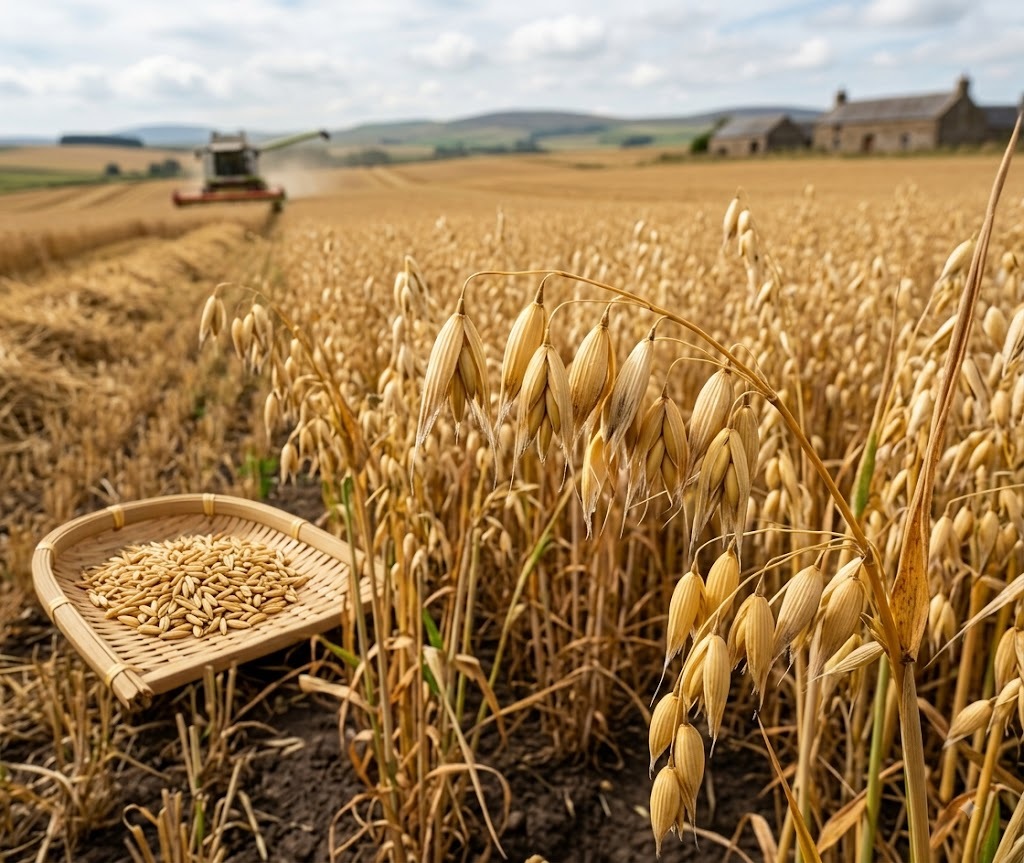
| Item Identity | It is a grain of the genus Avena in the family Poaceae, and the representative scientific name for edible oats is Avena sativa L. |
| Key role | Processed grains for which product segmentation—such as sorting, hulling, rolling, powdering, and food ingredients—is more important than raw grain sales. |
| Harvesting principle | For edible seeds, harvesting, drying, and storage management are based on the quality, moisture, foreign matter, and damage of mature seeds. Distinguished from forage seeds. |
| Product separation | Separating raw grain, selected grain, hulled oats, rolled oats, oat powder, food processing raw materials, and finished products |
| Separation of similar items | Separating Plant Entities from other grasses such as barley, wheat, and rye, and managing the presence of contamination |
| Domestic statistics | Official raw national statistical data that can confirm the latest nationwide production volume and cultivation area for oats alone in this registration will be entered later after verification of the official raw data. |
| Supply and demand risk | Weather and crop conditions, variety and cultivation method, harvest time, drying and storage, variation in raw grain quality, competition with imported raw materials, processing suitability, and discrepancy in contract volume |
| Operating Principles | Separate Plant–Product–Lot and link Origin, Variety, Harvest Date, Processing History, Certificates, and Buyer RFQ |
| Final goal | Establishing Supply Chain Intelligence capable of recurring procurement by connecting domestic oat producers with processing companies, food service, restaurant, distribution, private brand, and export buyers. |
As Nongsaroo has registered farming application technologies that evaluate cultivation suitability using soil and climate conditions for fodder crops, including oats, it is necessary to manage climate and soil data together when determining cultivation sites for oats. ( Nongsaroo )
Plant Identity
Basic fields | oat registration criteria |
| Korean name | oats |
| English name | Oat / Common oat |
| Representative scientific name | Avena sativa L. |
| classification | Poaceae · Avena |
| Edible parts | Mature seeds |
| Non-edible · Separate management | Stems, leaves, hulls, sorting by-products, etc. Forage oats are separated from edible products. |
| Major harvesting stages | Mature harvesting for edible seeds and harvesting for forage are managed as separate entities. |
| Basic product form | Raw grain, refined grain, dehulled grain, pressed rice cake, powder, processed raw material |
| Basic processing stage | Harvesting → Drying → Sorting → Dehulling → Heat Treatment · Rolling/Grinding → Blending · Productization |
| Basic use | Raw materials for rice, oatmeal, cereal, confectionery and baking, powder, beverages, and food processing |
| Similarity Principle | Barley, wheat, rye, etc., are separate Plant Entities. Internal varieties and product forms within oats are also classified at the Product level. |
Product Master
Product ID | Product type | Key Management Standards |
| OAT-P01 | Harvest original grain | Variety · Origin · Harvest Date · Moisture · Foreign Matter · Damage · Lot |
| OAT-P02 | Jeongseon oats | Foreign matter/Other grain contamination/Specifications/Sorting history |
| OAT-P03 | Removal oats | Detachment rate, damage, foreign matter, processing date, storage conditions |
| OAT-P04 | Rolled oats | Raw Material Lot · Heat Treatment · Rolling Conditions · Thickness · Moisture · Packaging |
| OAT-P05 | oat powder | Particle size, moisture, raw material lot, grinding, microorganisms, packaging |
| OAT-P06 | raw materials for food processing | Buyer's required specifications, machinability, safety, and delivery cycle |
| OAT-P07 | semi-finished products | Blending, Heat Treatment, Process Conditions, and Raw Material Lot Inheritance |
| OAT-P08 | finished product | Labeling · Ingredients · Manufacturing Lot · Use-by Date · Shelf Life |
| OAT-P09 | oats for forage | Separated from edible products, feed use, harvesting stage, and quality conditions are managed separately. |
Classification criteria | Subdivision type | Management principles |
| Plant classification | Avena sativa center | Other Avena species are subject to a separate Plant Entity review. |
| varieties | Domestic breeding and introduction varieties | Variety name and seed source records |
| Harvesting stage | For seeds / For forage | Do not mix harvesting stage and final use |
| Cultivation method | By region, sowing season, and cultivation purpose | Linking official cultivation standards with actual production records |
| Distribution methods | Original Song · Selected Song · Exclusionary Song | Product ID assigned separately |
| Processing form | Pressing, Grinding, Heat Treatment, Blending | Processing Lot Creation and Raw Material Lot Inheritance |
| Final use | Rice, Oatmeal, Cereal, Baking, Beverages, Food Ingredients, Feed | Coding by Buyer RFQ |
| Transaction type | In-kind · Regular supply · Contract farming · Processed raw materials · OEM/PB | Volume, Price, and Contract are Verified/NDA |
| origin | Domestic / Imported | Prohibition of mixing of origin/lot or specification of mixing history |
| processing level | Raw Material / Primary Processing / Semi-finished Product / Finished Product | Separation of quality standards and responsible parties by stage |
Even within the same Avena sativa, seeds and forage, as well as whole grains and rolled pieces/flour, are managed as separate products. Other species are separated at the Plant Entity stage, even if there is a possibility that they could be distributed under the same "oat" name.
Quantity, actual unit price, MOQ, and contract conditions are managed in Verified/NDA .
step | Essential Dataset | Management purpose |
| Cultivation plan | Variety · Usage · Planned Area · Crop Type · Expected Buyer | Production-demand alignment |
| satellite | Varieties · Seed Sources · Lot | Breed Traceability |
| sowing | Sowing date, cultivation area, and sowing method | Identification of cultivation types |
| Growth management | Growth stage and field conditions | Production forecast |
| rising | Temperature, Precipitation, Disaster | Weather Risk Analysis |
| Watering | Watering Date and Method | Growth and Quality Control |
| dispute | Record of fertilizer, timing, and usage | Production management and verification |
| pests | Occurrence, Control, and Pesticide Records | Quality and Safety Management |
| Harvest judgment | Maturity, weather, and use | Optimal harvest |
| harvest | Harvest Date · Packaging · Harvest Lot | Raw Material Lot Creation |
| dry | Drying method and condition before and after | Storage stability |
| Selection and sorting | Foreign matter, damaged granules, contamination | Securing product specifications |
| detachment | Raw Material Lot · Processing Date · Yield | edible processing raw materials |
| save | Temperature, humidity, period, warehouse | Tracking quality changes |
| packaging | Packaging specifications · Packaging date | Create trading units |
| shipment | Shipment Date · Buyer · Quantity | Delivery tracking |
| Pressed piece | Raw Material · Heat Treatment · Rolled Lot | Oatmeal raw material processing |
| smash | Particle Size · Processing Lot | Powdered raw material processing |
| Blending and processing | Blending Ratio · Process · Finished Product Lot | Finished Product Traceability |
Oats must be classified into grain and fodder crops depending on the cultivation purpose, and Nongsaroo provides criteria for utilizing soil and climatic factors in evaluating cultivation suitability for fodder crops, including oats. ( Nongsaroo )
Quality items | raw materials | Pre-treated products | processed goods | finished product | Public rating |
| mountainous district | essential | succession | succession | Traceable | Public/Verified |
| Cultivation method | essential | succession | succession | Connect if necessary | Member |
| varieties | essential | essential | Raw material connection | Raw material connection | Public/Member |
| farmhouse | ID Management | succession | succession | tracking | Verified |
| Lot | essential | New Lot | New Lot | Manufacturing Lot | Verified/NDA |
| Harvest day | essential | succession | succession | tracking | Verified |
| appearance | check | check | Product specifications | Product specifications | Member |
| weight | record | record | record | Marking standards | Member/NDA |
| size | If necessary | Selection criteria | By process | The relevant city | Member |
| rating | Transaction Standards | Transaction Standards | Buyer specifications | Product specifications | Member |
| pests | check | Inheritance of original property | Raw material inheritance | tracking | Verified |
| impairment | check | Selection | Process inspection | Quality inspection | Verified |
| corruption | check | exception | test | test | Verified |
| alien substance | check | Core Management | Core Management | Product Standards | Verified |
| pesticide residues | Required test | Raw material linkage | Raw Material and Product Standards | Compliance with relevant standards | Verified/NDA |
| microorganism | If necessary | By process | By product | Food standards | Verified/NDA |
| purifying | The relevant city | record | succession | succession | Verified |
| Processing history | - | record | essential | essential | Verified/NDA |
| packaging | Won-gok packaging | packaging | Product packaging | Final packaging | Member |
| save | essential | essential | essential | Product Standards | Verified |
| refrigeration conditions | Product-specific judgment | By product | By product | By product | Member |
| Expiration date | Not applicable/By product | By product | By product | Essential Management | Member |
| Shipment | record | record | record | record | NDA |
| Returns | record | record | record | record | NDA |
| Claim | record | record | record | record | NDA |
| Repurchase | RFQ connection | RFQ connection | RFQ connection | Buyer Connection | NDA |
Lot Master Required Field
Lot ID · Item/Product Type · Scientific Name or Variety · Cultivation Type · Origin/Cultivation Area · Producer · Cultivation Method · Sowing/Planting Date · Harvest Date · Quality Indicators · Weight/Specifications/Grade · Pest/Disease/Appearance Check · Pesticide Use Records · Pesticide Residue/Microbiological Test Reports · Pre-cooling/Storage History · Raw Material Lot · Pre-treatment/Processing History · Packaging Date · Use-by Date · Shipper · Returns/Claims · Repurchase
Customers | Purchase criteria | Cooperation opportunities |
| Producer organizations and agricultural cooperatives | Variety, moisture, quality, quantity, harvest time | Joint sorting and contract production |
| grain distributors | Country of Origin, Specifications, Stock, Delivery Date | Regular procurement |
| Wholesale and food ingredients | Packaging, Specifications, Price, Delivery Time | B2B supply |
| Grain processing company | Detachment · Processability · Safety · Lot | Exclusive raw material contract |
| Cereal and oatmeal manufacturing | Variety, Compression Suitability, Uniformity, Safety | RFQ for domestic raw materials |
| Confectionery and bakery companies | Powder, particle size, mixing suitability, supply stability | oat powder supply |
| Beverage and food manufacturers | Processing suitability, raw material specifications, and test reports | Joint development of food ingredients |
| School and public meals | Country of origin, safety, and delivery specifications | Linking local agricultural products |
| Foodservice and catering companies | Convenience of cooking · Packaging · Regular delivery | Regular supply |
| HMR · Meal Kit | Pretreatment, Mixing Convenience, and Standards | Dedicated Product Development |
| Distribution/Online | Small packaging, labeling, and expiration date | B2C productization |
| PB business operator | Differentiation, Country of Origin, and OEM Conditions | Local Oat PB |
| Local specialty product business operator | Regionality, Story, and Manufacturability | Regional brand development |
| exporters | Standards, Quarantine, Certification, Price, Logistics | Export of processed products |
| Research and technology institutions | Variety, cultivation, processing, and quality data | Demonstration and product development |
The official raw national statistical data values for the latest nationwide production volume and cultivated area, focusing solely on oats, are not arbitrarily replaced in this v1.0.
step | Key variables | Operational judgment |
| Production in the producing area | Variety, Crop Type, Area, Expected Harvest | Pre-linked with Buyer demand |
| Contract farming and procurement | Specifications, Estimated Quantity, Delivery Date | Demand-based production |
| Drying and sorting | Moisture, foreign matter, damage | Suitability for storage and processing |
| Sorting and packaging | Specifications, Country of Origin, Lot | Standardization of transaction units |
| Storage and Shipment Control | Inventory, Storage Period, Quality | Assessment of year-round supply feasibility |
| De-assembly and pre-treatment | Yield · Damage · Processing Lot | Processed raw material conversion |
| Pressing and grinding | Processing specifications and yield | Product creation by use |
| food processing | Formulation and manufacturing conditions | Conversion between semi-finished and finished products |
| Distribution and supply | Orders, Delivery, and Logistics | Buyer SLA Management |
| RFQ · Repurchase | Standards, Evaluation, Claims | Accumulation of recurring transaction data |
Trade Management
While oats can be managed under the international HS 4-digit basic category HS 1004 (Oats) , actual Korean import and export registration requires reconfirming the detailed HS Code from the Korea Customs Service's Commodity Classification Table and the product status at the time of transaction. The Korea Customs Service provides an official Tariff DB that allows users to search the Tariff Schedule by HS Code or product name. ( Korea Customs Service )
item | Registration Principles |
| HS | Review HS 1004 series; verify detailed codes by actual product type. |
| Import volume | Subsequent verification of raw data from the Korea Customs Service's import and export trade statistics |
| Revenue | Further verification |
| Major importing countries | Subsequent verification of official raw data |
| Export volume | Further verification |
| export value | Further verification |
| Quarantine | Verification of Animal and Plant Quarantine Agency requirements based on plant/grain status and country of origin |
| FTA | Verification of preferential tariff rates by country of origin and tariff classification |
| certification | Check by Buyer, Country, and Product Type |
| Customs clearance | Separation of HS and requirements for raw grains and processed foods |
| distribution | Raw materials focus on drying and moisture protection, while processed products are subject to product-specific storage conditions. |
Export and import quantities, amounts, and customs clearance unit prices are not entered until the HS description, base year, quantity, amount, and unit are confirmed in the official source data.
Products and processes | Key conditions | RFQ conversion |
| Harvest original grain | Variety, origin, harvest date, moisture, foreign matter | Sanji Original Song RFQ |
| Selected | Management of foreign matter, damaged grains, and contamination with other grains | Food Processing Company Procurement |
| Removal oats | Detachment status, damage, yield | Grain Processing RFQ |
| Washed items | Washing process, drying, hygiene | Food service and processing ingredients |
| Pressed piece | Heat Treatment · Rolled Sheet Specifications · Lot | oatmeal and cereal manufacturing |
| powder | Particle size, moisture, microorganisms, packaging | Confectionery, Baking, and Food Ingredients |
| Processed raw materials | Specifications by Buyer | Regular supply of food manufacturing |
| semi-finished products | Mixing, Heat Treatment, and Process Standards | OEM supply |
| finished product | Labeling, packaging, and expiration date | PB · Online · Export |
| by-product | Occurrence Process, Safety, and Components | RFQ after usability verification |
| Non-commercial items | Causes of occurrence and safety | Review of legality of feed, compost, etc. |
| Selected items | Damage, foreign matter, or quality issues | Verification of possibility for conversion of use |
Decision on by-product utilization
The potential of oat processing by-products for use as food ingredients, animal feed, compost, extracts, fermented products, or biomaterials shall be reviewed separately depending on their form of occurrence; however, their utilization as food, functional, pharmaceutical, or cosmetic materials shall be promoted to Product Candidate status only when relevant laws, safety, and official research grounds are confirmed .
PRP — Product Research Profile
The Oat PRP is structured not as a general introduction to nutritional information, but as a Research Profile for actual product development and procurement decisions.
PRP | Core Research |
| PRP-OAT-01 | Edible processing suitability by domestic oat variety |
| PRP-OAT-02 | Selection and De-shaving Yield and Quality Variation |
| PRP-OAT-03 | Fit for the pressing process |
| PRP-OAT-04 | Applicability of Oat Powder to Confectionery and Baking by Particle Size |
| PRP-OAT-05 | Standardization of specifications for raw materials used in food manufacturing |
| PRP-OAT-06 | Comparison of Supply Conditions for Domestic and Imported Raw Materials |
| PRP-OAT-07 | By-product utilization and waste reduction |
| PRP-OAT-08 | Buyer Required Specifications – Product Type – Processing Process Match |
first of all | Execution item | Performance indicators |
| 1 | Item, Crop Type, Variety, Origin, Harvest Date, and Lot must be required values | Required field input rate |
| 2 | Separation of Raw Grain, Sorting, Deboning, Pressing, and Powdered Products | Product identification rate |
| 3 | Linking weather, growth, pests, and harvest data | Production Lot Data Connection Rate |
| 4 | Datafication of quality, certificate, storage, and processing history | Quality traceability |
| 5 | Connecting Farms – Processing Companies – Distribution – Buyer RFQs | Match/Contract Conversion Rate |
| 6 | Production volume and harvest time forecast | Prediction Error · On-time Delivery Rate |
| 7 | Demonstration of Video AI-based Original Grain, Foreign Object, and Appearance Sorting | Selection accuracy and working time |
| 8 | Smart storage and inventory management | Storage loss rate · Inventory turnover |
| 9 | Data conversion of processing yields for deboning, pressing, and grinding | Yield variation by Lot |
| 10 | AI Match | Effective Supplier Recommendation Rate · Sample Conversion Rate |
| 11 | Traceability | Time required for Lot tracing upon Buyer request |
| 12 | Repurchase Runtime | Repurchase rate, claim rate, and buyer retention rate |
Problem group | Problem Definition | Required data |
| Mixed varieties | Production and processing suitability by variety is not sufficiently reflected in trade | Variety, Seed, Processing Test |
| Mixed materials for food and feed | Possibility of confusion regarding uses under the same oat name | Harvesting Stage · Usage · Lot |
| Lack of Korean production information | It is difficult for buyers to determine the supply capacity by production area | Cultivation area, production volume, and projected shipment |
| Weather risk | Weather fluctuations by crop type and region affect production | Weather, Growth, Harvest |
| pests | Occurrence and control information may be disconnected from the Lot | Pests, diseases, pesticides, and packaging |
| Quality deviation | Moisture, foreign matter, damage, and differences in uniformity | Quality inspection and screening |
| Harvest season concentration | Possibility of concentrated shipments during a specific period | Scheduled Harvest · Storage · Buyer Order |
| Storage loss | Poor storage conditions lead to quality degradation | Temperature, humidity, period, and quality |
| Mixing in the original song | Risk of mixing with other grains, origins, or lots | Jeongseon · Warehouse · Lot |
| Processing yield deviation | Yield differences by raw material in the dehulling, pressing, and grinding processes | Raw material weight · Finished product weight · Process |
| Discontinuity of raw material-processing history | Difficulty in tracing back producer and raw material lots in finished products | Parent–Child Lot |
| Dispersion of test reports | Inspection data is separated by supply chain entity | COA · Inspection Agency · Lot |
| Discrepancy in contract farming | Discrepancy between production specifications and buyer requirements | RFQ · Contract · Production Plan |
| Competition in imported raw materials | Competition between domestic and imported products in price, specifications, and procurement stability | Trade, Price, Country of Origin, Specifications |
| Market price fluctuations | Uncertainty in contractual judgment between producer and buyer | Farmgate price · Raw material price · Contract |
| Repurchase not reflected | Delivery performance does not lead to the next production plan | Buyer Reviews · Claims · Repurchases |
RFQ Type | Public Registration | Verify/NDA |
| Procurement of raw materials from the source | Item, Region, Product Type | Farm · Quantity · Unit Price · Lot |
| sale | Variety, Origin, Harvest Season | Stock, Price, Delivery Time |
| purchase | Required Product/Use | Target Price · MOQ · Contract |
| Regular supply | Product Type · Supply Cycle | Actual volume and unit price |
| contract farming | Region, variety, use | Area, Price, and Contract Conditions |
| Supply of processed raw materials | Sorting, dehulling, powdering, etc. | Test Reports, Specifications, Yield |
| Pre-treated products | Product type · General specifications | Process · Unit Price · Lot |
| processed goods | Product Type/Use | Manufacturing Conditions · MOQ |
| Dining Out & School Meals | Supplied Products · Region | Price, Cycle, Volume |
| HMR · Meal Kit | Applications | Mixing · Sample · Unit Price |
| OEM·PB | Product Concept · Production Type | MOQ · Recipe · Contract |
| export | Product/Target Country | Price, Certification, and Customs Data |
| Technology demonstration | Empirical topics | Farm, Facility, and Test Data |
| local specialties | Regional and Product Concepts | Manufacturer, Raw Material Costs, Contract |
| Research cooperation | Research Topic · Required Data | Test conditions · Confidential results |
Operation Runtime:
RFQ Registration → Supplier Verification → AI Match → Sample → Inspection → Negotiation → Contract → Production/Securing → Lot → Delivery → Inspection → Performance Evaluation → Repurchase
① Need Products & Materials
Companies and institutions seeking necessary products, agricultural products, raw materials, and processed goods register purchasing demands. Registered requests are utilized to review cooperation with potential suppliers and producers based on the RFQ Intelligence Library.
Process:
RFQ Registration → Supplier/Product Review → Collaboration Connection → Future AI Matching
Register
② We are looking for production and manufacturing partners. (Need Suppliers & Manufacturers)
Register a request to find necessary production and supply partners, ranging from farms and producer organizations to processing companies, OEM, ODM, and Private Label manufacturers.
Process:
RFQ Registration → Review of Production & Manufacturing Capabilities → Collaboration Connection → Future AI Partner Matching
Register
③ We are looking for domestic and international buyers. (Need Buyers)
Farmers, producer organizations, and manufacturing companies are requesting cooperation with new buyers, such as domestic and international distributors, importers, brand companies, and food service and catering businesses.
Process:
RFQ Registration → Product & Supply Capability Review → Market & Buyer Connection → Future AI Buyer Matching
Register
Contact : mail@markethub.org
Version | Main contents | situation |
| v1.0 | Registration of basic structure of Plant Identity, Production, Product, and RFQ | complete |
| v1.1 | Verification of official raw data on production, market, supply and demand, and trade | expected |
| v2.0 | Subdivision of product forms, processing, and quality specifications, such as raw grain, sorting, dehulling, pressed dough, and powder. | expected |
| v3.0 | Producer–Processing–Distribution–Buyer Verified Container Combination | expected |