

Judgment axis | Key judgment |
| Item Identity | Aquatic grains of the genus Zizania in the family Poaceae. The key species in the North American edible seed market is Zizania palustris L. |
| Key role | Food ingredients for whole grains, mixed grains, soups, salads, HMR, dining out, and premium private brands |
| Harvesting principle | Separate the natural water harvesting type and the artificially created submerged paddy cultivation type, and harvest mature seeds. |
| Product separation | Immediately after harvest, separate the seeds, curing grain, cracked grain, hulled grain, sorted grain, and finished product for cooking. |
| Separation of similar items | Separate Oryza sativa from rice, and manage Z. palustris, Z. aquatica, Z. latifolia, etc. by species. |
| Domestic statistics | Official national statistics on exclusive production and cultivation area of wild rice in Korea: To be entered after verification of official raw data. |
| Supply and demand risk | Potential for import dependence, mixing of species and origins, mixing of naturally harvested and cultivated types, chipping and drying quality, moisture, damage, price, exchange rate, and transportation risks |
| Operating Principles | Species–Source Type–Harvest Lot–Processing Lot–Import Lot–Buyer RFQ Connection |
| Final goal | Connecting North American Producers/Exporters–Importers–Processors/Distributors–Foodservice/PB Buyers to Traceability and Repurchase |
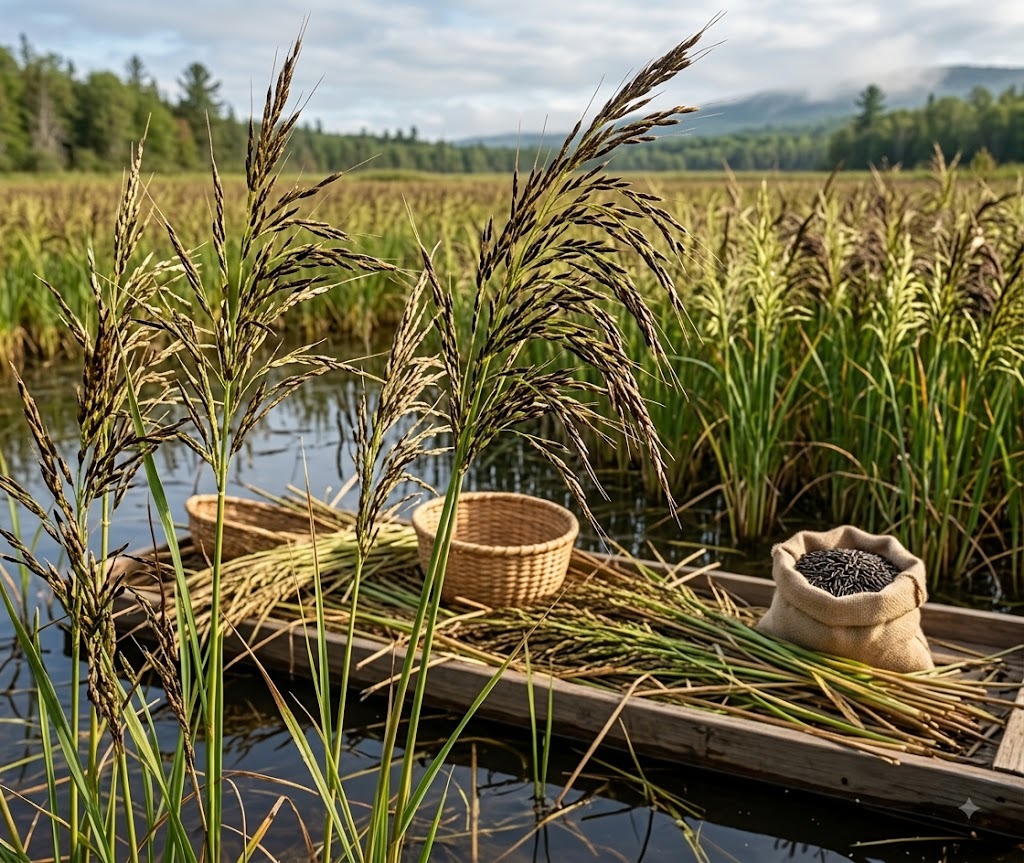
The USDA ARS describes Northern wild rice as an aquatic grass native to North America , explaining that it is cultivated in artificially created flooded fields in Minnesota, USA, and harvested in natural bodies of water such as lakes and rivers in Manitoba, Canada. Therefore, MarketHub must list Wild Harvest and Cultivated Paddy as separate Source Types. ( ARS )
A study listed in FAO AGRIS also explains that Zizania palustris is an aquatic grass that grows naturally in lakes and gentle streams in North America and has been used as a edible grain. ( Agris )
Plant Identity
Basic fields | Wild Rice Registration Standards |
| Korean name | wild rice |
| English name | Wild rice / Northern wild rice |
| Representative scientific name | Zizania palustris L. |
| classification | Poaceae · Zizania |
| Edible parts | Mature seeds |
| Non-edible · Separate management | Leaves, stems, roots, rice husks, processing by-products |
| Major harvesting stages | Mature edible seeds / Seeds for planting |
| Basic product form | Harvested Grains · Raw Grains Before Fragmentation · Fragmented Grains · Fragmented Grains · Selected Grains · Cooking Products |
| Basic processing stage | Harvesting → Curing → Flapping → Shelling → Sorting → Grading → Packaging → Cooking/Productization |
| Basic use | Whole grains · Mixed grains · Salad · Soup · Pilaf · HMR · Dining out · PB |
| Principle of similar items | Common rice (Oryza sativa), Z. aquatica, Z. latifolia, etc. are separate entities |
A recent USDA study on Northern wild rice identifies Zizania palustris as an aquatic Poaceae species endemic to North America and a crop that produces edible seeds. ( ARS )
Product Master
Product ID | Product type | Key Management Standards |
| WRI-P01 | Wild rice seeds immediately after harvest | Species · Origin · Harvest Date · Moisture · Source Type |
| WRI-P02 | Wild Rice | Natural waters · Extraction entity · Species · Lot |
| WRI-P03 | Cultivated Paddy Wild Rice | Farm · Variety · Cultivation Field · Harvest Lot |
| WRI-P04 | Curing ingredients | Aging · Storage Time · Moisture · Lot |
| WRI-P05 | Paching Wild Rice | Heat treatment conditions, moisture, color, aroma |
| WRI-P06 | Wild Rice | Descaling rate, breakage, and yield |
| WRI-P07 | Jeongseon Whole Grain | Whole grains, foreign matter, uniformity |
| WRI-P08 | Broken Wild Rice | Crushing rate, particle size, and uses |
| WRI-P09 | Wild Rice for Mixed Grains | Mixing Ratio · Origin · Lot |
| WRI-P10 | HMR cooking ingredients | Immersion, heating, cooking time, packaging |
| WRI-P11 | Soup and salad ingredients | Cookability, Texture, Delivery Type |
| WRI-P12 | Ready-to-eat products | Cooking, sterilization, packaging, and expiration date |
| WRI-P13 | Powder and processed raw materials | Grinding, particle size, and processing suitability |
| WRI-P14 | Wild Rice for Seed | Species·Germination·Seed Lot |
| WRI-P15 | by-product | Rice husks, crushed materials, and sorted items |
| WRI-P16 | PB finished products | Origin · Species · Blend · Manufacturing Lot |
Classification criteria | Subdivision type | Management principles |
| Plant classification | Z. palustris / Z. aquatica / other Zizania | Plant Entity by Species |
| Production type | Natural water sampling / Cultivation in flooded rice paddies | Source Type required |
| Seeds and varieties | Natural population / Cultivated variety | Seed·Genetic Source connection |
| Harvesting stage | Edible maturity / For seeds | Product Separation |
| Processing status | Raw, Curing, Patching, Dehulling, Refining | Step-by-step Lot creation |
| Particle form | Whole / Broken / Powder | Buyer Spec Separation |
| Final use | Whole grains · Mixed grains · Soup · Salad · HMR · PB | Separation by RFQ |
| Transaction type | Spot Imports · Regular Procurement · Contracts · Private Banking | Actual Transaction NDA |
| origin | State · Region · Natural Waters/Farm | Traceability |
| Culture and harvesting types | Traditional natural harvesting / Commercial cultivation | Maintain Source Metadata without mixing |
The USDA ARS verifies both natural water Northern wild rice and commercial paddy cultivation. Furthermore, as naturally grown wild rice has been treated as an important crop in Native American cultures, naturally harvested ingredients and industrially produced paddy ingredients are not combined under the same Source Type. ( ARS )
step | Essential Dataset | Management purpose |
| Production plan | Species · Source Type · Buyer | Establishment of procurement structure |
| Seeds and natural populations | Variety · Group · Seed Lot | Origin Management |
| Water body/pavement | Water depth, water quality, soil, location | Cultivation environment |
| sowing | Sowing Date · Seed Lot | Cultivation-type production |
| Germination and rooting | Appearance/Population Density | production stability |
| Water level management | Water depth, fluctuations, and drainage | Aquatic crop growth |
| Growth management | Plant height, tillering, heading | Harvest forecasting |
| rising | Temperature, Precipitation, Wind | Heading, Harvesting, Shattering |
| disease | Symptoms, Pathogens, and Control | Production stability |
| Pests and wildlife | Type and extent of damage | production loss |
| Maturity assessment | Seed maturation, moisture, and shattering | Harvest time |
| harvest | Date · Method · Lot | Harvest Lot |
| Natural harvest | Water area · Extraction method · Lot | Source Traceability |
| mechanical harvesting | Packaging, Equipment, Loss | Cultivation-type harvest |
| curing | Time · Temperature · Humidity · Lot | Ripening and preparation for processing |
| Paching | Heat treatment conditions | Aroma, Color, Shelf Life |
| peeling | Yield and Breakage Rate | production of edible grains |
| Jeongseon | Foreign object · Broken · Whole | Grading |
| dry | Moisture, temperature, time | Storage stability |
| Selection | Particles, color, appearance | Buyer Spec |
| save | Temperature, humidity, period, pests | Quality maintenance |
| packaging | Specifications/Date | trading unit |
| Cooking and processing | Immersion, heating, and mixing | HMR |
| shipment | Buyer · Lot · Delivery Date | Transaction tracking |
Northern wild rice is an aquatic annual grass that grows in both natural lakes and streams as well as in flooded cultivation areas. Therefore, instead of using the standard rice cultivation dataset as is, fields for water bodies, water levels, and natural harvesting/cultivation types must be added. ( ARS )
The USDA's 2025 study reported the first occurrence of disease caused by Bipolaris zeicola in Northern wild rice and explains that pathogen identification is important because various Bipolaris species can produce similar symptoms. Disease data is managed not merely at the level of 'leaf blight,' but, whenever possible, down to the pathogen level. ( ARS )
Quality items | raw materials | Pre-treated products | processed goods | finished product | Public rating |
| Species | essential | succession | succession | tracking | Public/Verified |
| Production type | Wild/Cultivated | succession | tracking | If necessary | Member |
| Mountains, waters, and farms | essential | succession | tracking | Country of origin labeling | Verified |
| Producer/Extractor | ID | succession | tracking | - | Verified |
| Lot | essential | new | new | Manufacturing Lot | Verified/NDA |
| Harvest day | essential | succession | succession | tracking | Verified |
| appearance | check | Selection | Product specifications | Product Standards | Member |
| color | check | Key points after Paching | standard | By product | Member |
| incense | - | Confirm after Paching | Product specifications | By product | Member |
| moisture | core | core | By product | By product | Verified |
| Complete lip | check | Selection | Whole Spec | tracking | Member |
| Crushed granules | record | Grading | Broken Product | By product | Member |
| alien substance | check | core | test | Compliance with standards | Verified |
| Mixing of other grains | check | core | tracking | Display management | Verified |
| Byeonghaerip | check | eliminate | tracking | - | Verified |
| mold | test | test | By product | Related standards | Verified/NDA |
| pesticide residues | When cultivation type is needed | Linkage | By product | Related standards | Verified/NDA |
| microorganism | By product type | Post-processing inspection | By product | Food standards | Verified/NDA |
| Pachin history | - | essential | succession | tracking | Verified/NDA |
| Heating history | - | essential | succession | tracking | Verified |
| Processing history | - | record | essential | essential | Verified/NDA |
| packaging | Raw material packaging | By product | Product packaging | Final packaging | Member |
| save | essential | essential | essential | Product Conditions | Verified |
| Expiration date | The relevant city | By product | By product | Labeling standards | Member |
| Shipment · Return · Claim | record | record | record | record | NDA |
| Repurchase | RFQ connection | connection | connection | Buyer Connection | NDA |
Lot Master Required Field
Lot ID · Item · Product Type · Species · Scientific Name · Naturally Harvested/Cultivated Type · Variety or Population · Country of Origin · Region · Water Area · Farm · Producer/Harvesting Entity · Seed/Source Lot · Water Level · Cultivation Environment · Sowing Date · Heading Date · Harvest Date · Quality Indicators · Moisture · Weight · Dimensions · Grade · Whole Grains · Cracked Grains · Appearance · Diseases · Wildlife Damage · Pesticide Usage Records · Pesticide Residue · Microbial Test Report · Curing · Punching · Shelling · Drying · Storage History · Raw Material Lot · Sorting · Processing History · Packaging Date · Best Before Date · Shipper · Returns · Claims · Repurchase
Korean production
Domestic wild rice cultivation area: To be entered after verification of official raw data
Domestic wild rice production volume: To be entered after verification of official raw data
In this v1.0 version, national statistics on nationwide production volume and cultivation area for edible seeds of Zizania palustris could not be verified in South Korea. Therefore, domestic online sales and import distribution cases are not substituted for Korean production statistics.
From the current perspective of MarketHub operations, it is appropriate to evaluate the economic feasibility of the domestic aquatic cultivation pilot separately while prioritizing the verification of the import-procurement-buyer market, rather than assuming it is a large-scale domestic production crop .
Customers | Purchase criteria | Cooperation opportunities |
| import grain companies | Species · Origin · Processing Status · Price | Regular procurement |
| Grain distributor | Whole/Broken · Paching · Packaging | B2B supply |
| Mixed grain manufacturer | Origin, particle size, and mixing ratio | Premium Mixed Songs |
| HMR manufacturers | Cooking time, texture, and pretreatment | Instant rice and grain food |
| Soup maker | Cooking stability and particles | Soup Product |
| salad companies | Cooking, Refrigeration, Texture | Ready-to-eat |
| food service companies | Cookability · Regular supply | Premium Menu |
| Hotel & Catering | Quality uniformity · Delivery time | premium ingredients |
| School and public meals | Safety, Price, Cookability | Limited Pilot after verification |
| PB·Distribution | Origin, Story, Specifications | Premium PB |
| online food companies | Small Packaging · Cooking Information | B2C |
| Food processing research institute | Paching · Cooking · Texture · Storage | PRP |
| Seed and Aquatic Crop Research Institute | Adaptability, Water Quality, Water Level | Domestic Pilot |
| Import and export companies | HS · Quarantine · Country of Origin | Procurement Intelligence |
step | Key variables | Operational judgment |
| natural production/cultivation | Country·Region·Source Type | Supply risk |
| Producer/Retrieved tissue | Species · Lot · Quality | Supplier Verification |
| Paching and processing | Process, Yield, Grade | Product Spec |
| exporters | Origin · Lot · MOQ | Contract procurement |
| International shipping | Freight · Lead-time · Packaging | Landed Cost |
| Domestic customs clearance | HS, Quarantine, and Food Requirements | Compliance |
| Domestic storage | Moisture, stock, pests | Quality maintenance |
| Repackaging and mixing | Blending/Raw Material Lot | PB·HMR |
| Distribution and supply | Delivery Date/Specifications | Buyer SLA |
| RFQ · Repurchase | Quality, Price, and Sales Performance | recurring procurement |
Trade Management
Wild rice is botanically different from ordinary rice, and for customs clearance, the detailed item description in the actual current HSK must be checked. In this v1.0, the Korea Customs Service has not been able to officially confirm the current standalone tariff code for wild rice, so an HS Code is not arbitrarily assigned.
item | Operating Principles |
| HS | Input later after official verification of the current HSK by the Korea Customs Service |
| Item Description | Check for Wild rice / Zizania spp. |
| Regular rice | Oryza sativa and statistical separation |
| Natural harvesting and cultivation type | Retain Source Metadata after customs clearance |
| For seeds | Separate quarantine and item classification from edible grains |
| Powder/Mixed Grain | Separate HS review by processing status |
| instant food | Finished goods HS code separate |
| Import volume | Subsequent verification of official raw data by the Korea Customs Service |
| Revenue | Further verification |
| Major suppliers | Enter after checking the detailed HS code |
| Quarantine | Quarantine verification by raw grain and seed status |
| FTA | Check Country of Origin, Tariff Code, and Rules of Origin |
| Customs clearance unit price | Compare only the same HS, product condition, and unit |
Domestic wild rice import volume, import value, major supplier countries, and customs clearance unit price: To be entered later after verification of official raw data from the Korea Customs Service.
The total import volume of ordinary rice or 'other grains' is not arbitrarily converted to the import volume of wild rice.
Products and processes | Key conditions | RFQ conversion |
| Harvest fresh seed room | Species·Source·Moisture | Mountain Processor |
| Curing ingredients | Changes in time, moisture, and fermentation | Parching RFQ |
| Pachinkok | Heat treatment, color, scent | food ingredients |
| Detachment | Whole · Broken · Yield | Distribution RFQ |
| Jeongseon Whole Grain | Uniformity, foreign matter, color | Premium Buyer |
| Broken Grain | Particle size and ratio | Soup · Processing |
| Mixed grains | Mixing ratio · Origin | PB |
| HMR | Cooking, Moisture, Texture | Meal Product |
| Soup ingredients | Cooking durability · particles | manufacturing company |
| Salad ingredients | Cooking, Cooling, Storage | Dining Out · HMR |
| Instant cooking | Heat treatment and packaging | Retail |
| powder | Particle size and microorganisms | food processing |
| chaff | Generation process/contamination | Review of resource utilization |
| Crushing and sorting by-products | Safety and amount generated | Food and feed suitability verification |
| finished product | Labeling, packaging, and expiration date | PB·Retail |
Utilization of by-products
Review Area:
Food processing · Feed · Compost · Biomaterials · Rice husk utilization · Waste reduction
However, the conversion of raw materials for food, functional, pharmaceutical, or cosmetic products shall be registered as a Product only when safety, relevant laws, and official research grounds have been confirmed.
PRP — Product Research Profile
PRP ID | Product Research Profile |
| PRP-WRI-01 | Z. palustris·Z. aquatica Species Identification |
| PRP-WRI-02 | Comparison of Naturally Harvested vs. Cultivated Raw Grain Quality |
| PRP-WRI-03 | Water Level/Environment–Growth–Quantity Relationship |
| PRP-WRI-04 | Heading/Maturation – Shattering – Harvest Loss |
| PRP-WRI-05 | Harvest Lot–Curing Condition |
| PRP-WRI-06 | Parching Conditions – Color, Aroma, Texture |
| PRP-WRI-07 | Dehulling & Refining – Whole Grain Yield |
| PRP-WRI-08 | Whole/Broken Buyer Spec |
| PRP-WRI-09 | Cooking time, moisture absorption, texture |
| PRP-WRI-10 | Mixed grain blend suitability |
| PRP-WRI-11 | Soup and HMR Processing Suitability |
| PRP-WRI-12 | Source Spec by North American Production Location |
| PRP-WRI-13 | Comparison of Supply Risks Between Natural Harvesting and Commercial Cultivation |
| PRP-WRI-14 | Pilot for Adaptability to Domestic Aquatic Cultivation |
| PRP-WRI-15 | Comparison of Domestic Pilot vs. Imported Landed Cost |
| PRP-WRI-16 | Utilization of by-products and rice husks |
| PRP-WRI-17 | Buyer Spec–Species–Source–Process AI Match |
first of all | Execution item | Performance indicators |
| 1 | Species·Source Type·Origin·Harvest Date·Lot Mandatory | Required input rate |
| 2 | Separation of Naturally Harvested and Cultivated Products | Source identification rate |
| 3 | Linking water level, weather, growth, and harvest data | Production connection rate |
| 4 | Data conversion of curing, patching, dehulling, and sorting history | Process Traceability |
| 5 | Producer/Exporter–Importer–Processor–Buyer RFQ Connection | Match rate |
| 6 | Water level and weather-based growth prediction | Prediction error |
| 7 | Video AI Maturity/Descent Risk Assessment | Judgment accuracy |
| 8 | Optical Whole/Broken Sorting | Selection accuracy |
| 9 | Data conversion of Paching quality | Reduced variation in color and scent |
| 10 | Product yield prediction | Whole Grain yield error |
| 11 | Inventory/Import Runtime | Inventory Renewal Rate |
| 12 | Exchange Rate, Freight, and Procurement Risk | Landed Cost Prediction Error |
| 13 | Domestic Pilot – Import Arbitrage | Comparable Product Ratio |
| 14 | AI Buyer Match | Effective recommendation rate |
| 15 | Traceability | Retail→Source Lot Traceability Rate |
| 16 | Repurchase Runtime | Repurchase rate · Claim rate |
Problem group | Problem Definition | Required data |
| Mistake for 'rice' | Can be misclassified as the same plant as common rice. | Taxonomy |
| Mixed Species | Z. palustris, Z. aquatica, etc. are traded as wild rice. | Species |
| Confusion of Z. latifolia | Risk of mixing East Asian edible stem-type and North American seed-type edibles | Scientific name · Edible parts |
| Mixed natural and cultivated types | Source differences based on production method not indicated | Source Type |
| Absence of Korean production statistics | The actual scale of the domestic cultivation industry is unclear. | National Statistics |
| dependence on imports | Impact on supply, exchange rates, and logistics in the country of origin | Trade |
| Aquatic cultivation expertise | Water level, water quality, and field composition differ from ordinary grains. | Water Dataset |
| disease | Effects of pathogens such as Bipolaris | Pathogen |
| wildlife damage | Impact of birds and mammals on aquatic ecosystems | Wildlife Loss |
| evasion | Harvest loss of mature seeds | Maturity·Loss |
| Harvest date variation | The difference between natural waters and redistribution fields | Harvest |
| Paching deviation | Heat treatment conditions determine color, aroma, and texture | Process |
| Descarburization rate | Whole yield difference based on raw material and process | Input–Output |
| Broken ratio | Product Grade · Buyer's Usage Impact | Grading |
| Jeongseon Imul | Management of foreign substances in raw materials harvested from natural waters | Cleaning |
| Storage moisture | Storage stability · Mold | Moisture |
| Buyer Awareness | Lack of domestic purchasing standards | Buyer Spec |
| Cooking time | Cooking characteristics different from regular rice | Cooking Dataset |
| HS verification | Limitation on calculating the volume of unilateral trade | Customs |
| Origin Traceability | Need to connect natural harvesting, farms, and processing sites | Source Lot |
| Distinction between traditional harvesting and commercial cultivation | Product story and supply structure may be misleading | Harvest Method |
| Contract procurement | MOQ · Exchange Rate · Inventory Risk | Contract |
| Repurchase not reflected | Lack of demand verification for new premium grains | Buyer Evaluation |
The USDA verifies that Northern wild rice is produced not only in natural waters but also in created flooded rice paddies. Therefore, if a supply contract accepts only simple wild rice without verifying the production method, Source Intelligence is lost. ( ARS )
In addition, as the USDA releases reports on new pathogens in Northern wild rice in 2025, disease management is not automatically mapped to disease names of common rice. ( ARS )
RFQ Type | Public Registration | Verify/NDA |
| Procurement of naturally harvested raw grains | Species · Region · Source Type | Supplier, quantity, price |
| Procurement of cultivated raw grain | Species · Farm · Harvest Season | Farm, Volume, Unit Price |
| Import purchase | Country of Origin · Product · Spec | MOQ · CIF · Contract |
| Regular supply | Product · Supply Cycle | Actual quantity and unit price |
| Whole Grain | Species · Classification | Lot · Price |
| Broken Grain | Particle size and uses | Price · MOQ |
| Paching raw materials | Process condition, color, scent | Process conditions/Test reports |
| Mixed grains | Mixing Spec | Price and blend |
| HMR | Product Type | Cooking Test · MOQ |
| Soup ingredients | Whole/Broken | Sample · Cookability |
| salad ingredients | Cooking/refrigeration type | Delivery conditions |
| Dining & Hotel | Product type and country of origin | Volume, Price, Cycle |
| School meals | Safety and cooking methods | Test Report · Delivery Date |
| OEM·PB | Product concept | Recipe · MOQ · Contract |
| domestic test cultivation | Species · Region · Research Purpose | Seed · Water · Production Cost |
| Seed supply | Species · Seed form | Germination · Seed Lot |
| Technology demonstration | Aquatic cultivation, harvesting, and processing | Test Dataset |
| Research cooperation | Species·Diseases·Water Level·Processing | Confidential materials |
| export | Processed Products · Target Countries | HS · Price · Certification |
| Comparison of Domestic and Imported Products | Identical Product Spec | Cost · Lead-time · MOQ |
Verified/NDA: Actual Producer · Harvesting Organization · Natural Water Source · Farm Details · Importer · Processing Facility · Quantity · Actual Unit Price · MOQ · Certificate · Lot · Sample · Filing Process · Contract Terms · Freight · Delivery Date · Claims · Repurchase
RFQ Runtime:
RFQ Registration → Species/Source Verification → Supplier Verification → AI Match → Sample → Quality/Cooking/Processing Testing → Negotiation → Contract → Production/Import Securing → Lot → Processing → Delivery → Inspection → Buyer Evaluation → Repurchase
① Need Products & Materials
Companies and institutions seeking necessary products, agricultural products, raw materials, and processed goods register purchasing demands. Registered requests are utilized to review cooperation with potential suppliers and producers based on the RFQ Intelligence Library.
Process:
RFQ Registration → Supplier/Product Review → Collaboration Connection → Future AI Matching
Register
② We are looking for production and manufacturing partners. (Need Suppliers & Manufacturers)
Register a request to find necessary production and supply partners, ranging from farms and producer organizations to processing companies, OEM, ODM, and private label manufacturers.
Process:
RFQ Registration → Review of Production & Manufacturing Capabilities → Collaboration Connection → Future AI Partner Matching
Register
③ We are looking for domestic and international buyers. (Need Buyers)
Farmers, producer organizations, and manufacturing companies are requesting cooperation with new buyers, such as domestic and international distributors, importers, brand companies, and food service and catering businesses.
Process:
RFQ Registration → Product & Supply Capability Review → Market & Buyer Connection → Future AI Buyer Matching
Register
Contact : mail@markethub.org
Version | Main contents | situation |
| v1.0 | Plant·Species·Aquatic Production·Source Type·Patching·Processing·Import·RFQ Basic Structure Registration | complete |
| v1.1 | Verification of raw data for domestic production, current HS, importing country, customs clearance volume, and price | expected |
| v2.0 | Detailed quality standards by Wild/Cultivated, Whole/Broken, Parching, and HMR | expected |
| v3.0 | Overseas Production/Extraction Tissue – Exporter – Importer – Processing – Buyer Verified Container Combination | expected |