

Judgment axis | Key judgment |
| Item Identity | It is a grain of the genus Secale in the family Poaceae, with the representative scientific name being Secale cereale L. |
| Key role | A multi-purpose crop used not only for food and milling of mature seeds but also as winter forage, silage, paddy field rotation, mulch, and green manure. |
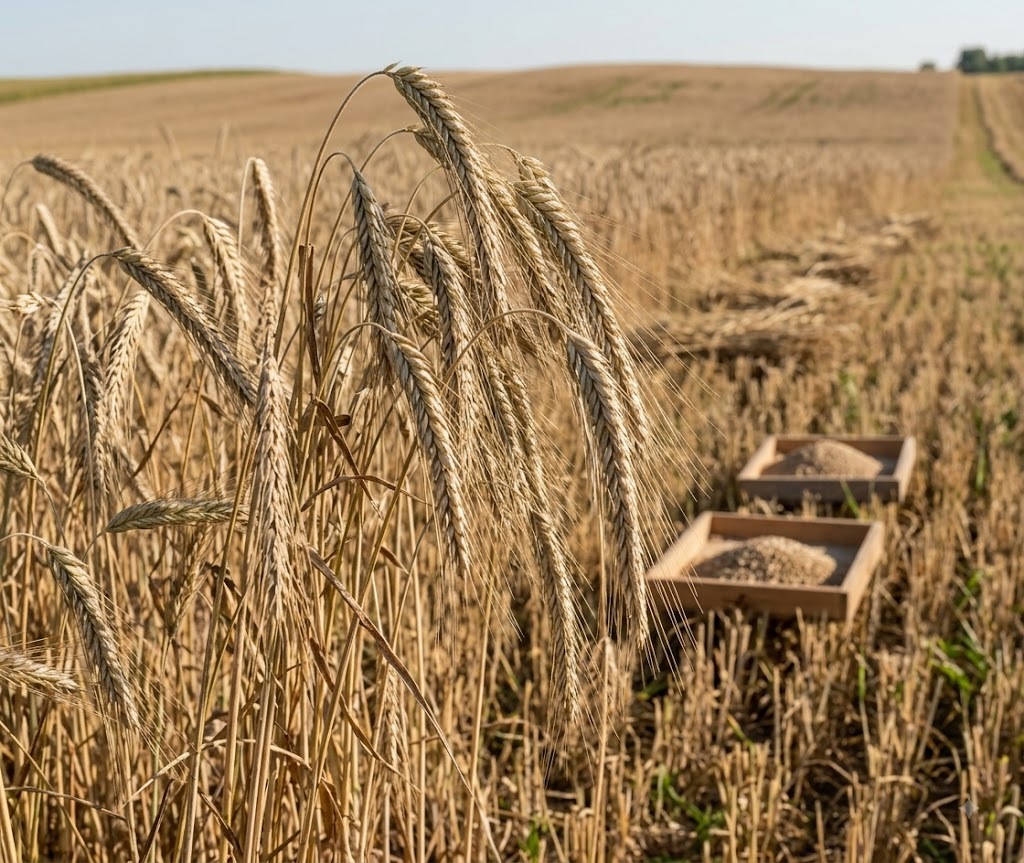
| Harvesting principle | Rye for edible seeds and rye for fodder are separated. The Rural Development Administration advises that the optimal harvest time for fodder rye is during the flowering period, that is, about 10 days after heading. ( Rural Development Administration ) |
| Product separation | Separating edible raw grains, refined grains, and powder from green fodder rye, hay, silage, mulching, and green fodder products |
| Separation of similar items | Separating oats, barley, wheat, triticale, and Plant Entities, and notably not registering triticale, a wheat × rye hybrid, as rye. |
| Domestic statistics | The latest official raw national statistical data for nationwide rye-only production and cultivation area are not finalized in this v1.0: to be entered later after verification of the official raw data. |
| Supply and demand risk | Decline in forage value due to delayed harvest, seed securing, sowing time, overwintering and weather, forage logistics, silage quality, mixture of edible and feed materials |
| Operating Principles | Separate and connect variety, harvest stage, use, growing area, harvest date, lot, processing, silage production, and buyer specifications. |
| Final goal | Establishing a recurring RFQ supply chain by connecting rye producers with livestock farms, forage distributors, food processors, millers, agricultural corporations, eco-friendly farms, and research institutions. |
The Rural Development Administration suggests an optimal growth temperature of 13–21°C and an optimal soil pH of 5.6–6.5 for forage rye. It describes it as a cold-tolerant crop suitable for well-drained soils and cultivation as a follow-up crop in paddy fields in the central and northern regions. Since these figures are based on technical data standards for forage rye, they should not be extended as absolute standards for edible rye as a whole. ( Nongsaroo )
In addition, the Rural Development Administration explains that early-maturing rye varieties for animal feed, including Gogu, E-Green, All Green, and Jo Green, have been bred domestically and are utilized as a preceding crop for silage corn or as a second crop in paddy fields. ( Nongsaroo )
Plant Identity
Basic fields | Rye registration standards |
| Korean name | rye |
| English name | Rye |
| Representative scientific name | Secale cereale L. |
| classification | Poaceae · Secale |
| Edible parts | Mature seeds |
| Non-edible · Separate management | Stems, leaves, roots, straw. The entire above-ground portion is sold separately as a product for forage, mulching, and green manure. |
| Major harvesting stages | Edible seed maturation stage / Heading to flowering stage for green fodder and forage / Mowing stage for cover crops and green manure |
| Basic product form | Raw grain · Selected grain · Powder · Baking ingredients · Green fodder · Hay · Silage · Covering · Green fodder |
| Basic processing stage | Edible: Harvest → Dry → Sort → Mill / Feed: Mowing → Cutting/Drying or Silage / Green Manure: Mowing → Soil Reintroduction |
| Basic use | Milling, baking, food ingredients, forage, silage, mulching, green manure, soil management |
| Similarity Principle | Oats, barley, and wheat are separate Plant Entities. Triticale is a hybrid crop of wheat and rye and is a separate Entity. |
The Nongsaroo Dictionary of Agricultural Terms defines rye as a grass grain whose seeds are milled to be used for foods such as bread and noodles, as a raw material for whiskey, or as animal feed. ( Nongsaroo )
Product Master
Product ID | Product type | Key Management Standards |
| RYE-P01 | Rye Original Song | Variety · Origin · Harvest Date · Moisture · Foreign Matter · Lot |
| RYE-P02 | Jeongseon rye | Foreign matter, contamination with other grains, and seed uniformity |
| RYE-P03 | Edible rye grains | Edibility, Selection, Storage, and Origin |
| RYE-P04 | rye powder | Particle size, moisture, microorganisms, raw material Lot |
| RYE-P05 | Ingredients for baking and confectionery | Powder specifications, mixing suitability, and safety |
| RYE-P06 | semi-finished food products | Raw Material Ratio, Processing Lot, and Labeling Standards |
| RYE-P07 | Cheongye rye | Variety · Harvest stage · Moisture · Feed use |
| RYE-P08 | rye hay | Mower · Dry condition · Moisture · Storage |
| RYE-P09 | Rye silage | Harvesting stage · Cutting · Moisture · Fermentation · Storage |
| RYE-P10 | Rye for cover crops | Purpose of sowing, growth, mowing, and soil covering |
| RYE-P11 | Green manure rye | Biomass, mowing, and soil reduction history |
| RYE-P12 | Rye for seeds | Variety · Germination · Seed Lot · Verification Status |
| RYE-P13 | By-products and rye straw | Generation process, moisture, contamination, and suitability for use |
| RYE-P14 | finished product | Raw materials · Processing Lot · Packaging · Use-by date |
Classification criteria | Subdivision type | Management principles |
| Plant classification | Secale cereale | Other species and hybrids are separate Plant Entity |
| varieties | Domestic breeding and introduction varieties | Connect variety name, seed source, and use with Lot |
| Harvesting stage | Mature seeds, heading stage, flowering stage, mowing for cover | Product separation by harvesting stage |
| Cultivation method | Winter cropping, paddy field cropping, upland cropping, highland follow-up cropping, etc. | Region, sowing date, and preceding/following crop records |
| Distribution methods | Raw grain, selected grain, powder, fresh grass, hay, silage | Separate Product ID |
| Processing form | Drying, sorting, milling, cutting, silage, soil reduction | Process Lot Management |
| Final use | Food, Baking, Feed, Covering, Green Manure, Soil Management | Direct connection with Buyer and Farm RFQ |
| Transaction type | In-kind · Regular supply · Contract farming · Seeds · Forage · Research cooperation | Quantity, unit price, and contract are NDAs |
| Storage type | Dry grain, hay, and silage | Separation of quality standards by storage method |
| production method | General cultivation, eco-friendly cultivation, mulching cultivation, etc. | Registration after verification of actual certification and field records |
According to data from the Rural Development Administration, fodder rye is resistant to cold and grows quickly in the spring; as the delay in harvesting can lower its nutritional value and palatability, it is important to differentiate the harvesting stage according to the intended use. ( Nongsaroo )
step | Essential Dataset | Management purpose |
| Cultivation plan | Variety · Use · Area · Pre- and Post-crop · Buyer | Classification for food, feed, and covering purposes |
| satellite | Variety · Source · Seed Lot · Germination | Breed Traceability |
| sowing | Sowing date, sowing quantity, and plot | Overwintering and Growth Management |
| Winter management | Growth, frost damage, and field conditions | Winter cropping stability |
| Growth management | tillering, heading, flowering, biomass | Harvest forecasting |
| rising | Temperature, Precipitation, Snowfall, Disaster | Growth and overwintering risks |
| Watering | Watering records if necessary | Stabilization of hair growth |
| dispute | Fertilizer, Timing, and Input Records | Production and Environmental Management |
| drainage | Soil, drainage, and waterlogging | Packaging stability |
| pests | Monitoring, Control, and Chemicals | Quality and Safety |
| Harvest judgment | Uses, Heading, Flowering, Maturity | Harvest time by product |
| Harvesting edible seeds | Harvest date, moisture, and seed condition | Edible Raw Material Lot |
| Harvesting forage | Heading, flowering stage, and biomass | Feed Lot |
| mowing | Date, Height, Biomass | Hay, mulch, green manure |
| dry | Moisture, Time, Method | Grain and Hay Storage |
| Jeongseon | Foreign matter, damage, or contamination | Edible quality |
| Milling | Particle Size · Yield · Lot | food ingredients |
| cutting | Cutting length · Process | Forage and Silage |
| Silage | Moisture·Packaging·Fermentation·Opening | Fermented forage quality |
| Soil reduction | Mowing day, reduction amount, subsequent crop | green manure and mulch effects |
| save | Temperature, humidity, period, and facilities | Prevention of quality loss |
| packaging | Packaging date/specifications | trading unit |
| shipment | Shipment Date · Buyer · Lot | Delivery Traceability |
The Rural Development Administration suggests that the optimal harvest time for rye for forage use is during the flowering period , specifically about 10 days after heading . Based on 2014 data, it advised that since the moisture content of crops harvested at this time can be around 80%, the crop should be pre-dried for about a day to reduce it to approximately 60–70% before silage production. These figures are based on the conditions of the relevant research and technical data and are not applied uniformly to all fields. ( Rural Development Administration )
Quality items | raw materials | Pre-treated products | Processed products and feed | finished product | Public rating |
| mountainous district | essential | succession | succession | tracking | Public/Verified |
| Cultivation method | essential | succession | succession | If necessary | Member |
| varieties | essential | essential | Raw material connection | tracking | Member/Verified |
| farmhouse | ID Management | succession | succession | tracking | Verified |
| Lot | essential | New Lot | New Lot | Manufacturing Lot | Verified/NDA |
| Sowing date | essential | succession | succession | tracking | Verified |
| Harvest day | essential | succession | succession | tracking | Verified |
| Harvesting stage | Edible, heading, flowering, etc. | essential | essential | If necessary | Member/Verified |
| appearance | check | check | By product | By product | Member |
| weight | record | record | record | Marking standards | NDA |
| biomass | forage | succession | Silage connection | - | Verified |
| moisture | core | core | Hay and Silage Core | By product | Verified |
| rating | Transaction Standards | Transaction Standards | Buyer's Standard | Product Standards | Member |
| pests | check | succession | tracking | tracking | Verified |
| impairment | check | Selection | Processing inspection | Product inspection | Verified |
| Mold and decay | check | test | Key Examination | Compliance with standards | Verified |
| alien substance | check | core | core | Compliance with standards | Verified |
| pesticide residues | By edible/use | Raw material linkage | Related standards | Related standards | Verified/NDA |
| microorganism | By product | If necessary | Silage · By Food | legal standards | Verified/NDA |
| purifying | The relevant city | record | succession | succession | Verified |
| Processing history | - | record | essential | essential | Verified/NDA |
| Fermentation history | - | - | Silage essential | The relevant city | Verified/NDA |
| packaging | Won-gok · Saengcho | packaging | Silage powder | Final packaging | Member |
| save | essential | essential | essential | Product Conditions | Verified |
| Expiration date | The relevant city | By product | By product | Labeling standards | Member |
| Shipment | record | record | record | record | NDA |
| Returns | record | record | record | record | NDA |
| Claim | record | record | record | record | NDA |
| Repurchase | Buyer Connection | Buyer Connection | Buyer Connection | Buyer Connection | NDA |
Lot Master Required Field
Lot ID · Item/Product Type · Scientific Name or Variety · Cultivation Type · Origin/Cultivation Area · Producer · Cultivation Method · Sowing Date · Harvest Date · Harvest Stage · Quality Indicators · Weight/Specifications/Grade · Biomass/Moisture · Pest/Disease/Appearance Check · Pesticide Use Records · Pesticide Residue/Microbiological Test Reports · Drying/Storage History · Raw Material Lot · Pretreatment/Processing History · Silage/Fermentation History · Packaging Date · Use-by Date · Shipper · Returns/Claims · Repurchase
If rye is viewed solely as a food grain in the domestic market, its market size may be underestimated or overestimated. Data from the Rural Development Administration confirms its primary domestic role as a winter fodder crop, double cropping in paddy fields, silage, and cover crop; therefore, the supply chains for food grains and forage must be assessed separately. ( Nongsaroo )
Latest nationwide rye exclusive cultivation area and production volume: To be entered after verification of official raw data.
While KOSIS provides statistics on the cultivated area of open-field food crops, this v1.0 version does not finalize the latest national values for rye alone. ( KOSIS )
Customers | Purchase criteria | Cooperation opportunities |
| Forage producer organizations | Variety, Harvest Time, Biomass, Moisture | contract production |
| livestock farms | Feed value, moisture, fermentation quality, delivery time | supply of green fodder and silage |
| feed distributors | Bale · Weight · Moisture · Storage · Transport | Regular supply |
| Silage manufacturing facility | Harvest stage · Moisture · Biomass | Mountain area linkage |
| Nonghyup/Farming Cooperative | Cultivation area, expected harvest, and volume | Joint harvesting and distribution |
| Food manufacturer | Edible Grains, Safety, and Origin | Domestic rye food |
| flour mill | Raw grain quality and milling yield | rye flour |
| Confectionery and Baking | Powder specifications and mixing suitability | Rye bread · Mixed powder |
| Dining Out & School Meals | Product form, cookability, and packaging | edible finished products |
| HMR·PB | Differentiation, origin, and processability | Domestic rye products |
| eco-friendly farm | Covering properties, mowing time, and subsequent cropping influence | Cover crop seeds and technology |
| Fruit and greenhouse farms | For the purpose of green manure and soil reduction | supply of green manure crops |
| Seed company | Variety, Germination, Seed Purity | Seed supply |
| Research and technology institutions | Growth, forage, and soil data | Verification of varieties, cultivation, and covering |
| exporters | HS · Quality · Price · Customs Clearance | Review of food and processed product exports |
Organic cultivation research by the Rural Development Administration includes cases where rye was utilized as a cover crop to suppress weed growth, and field techniques have been presented to reduce the use of chemical fertilizers by returning rye to the soil during the fallow period for greenhouse cucumbers. Since these are results obtained under specific test conditions, they should not be used as general values guaranteeing the same effect for all cropping types. ( Nongsaroo )
step | Key variables | Operational judgment |
| Securing seeds | Variety, Origin, Germination, Supply Quantity | Secure before sowing |
| Production in the producing area | Crop type, use, area, and expected harvest | Distinction between edible and feed |
| contract farming | Variety, Harvest Time, Specifications | Pre-reflecting Buyer's requirements |
| harvest | Seed, heading, and flowering stages | Final Product Decision |
| Drying and sorting | Moisture, foreign matter, contamination | Edible grains |
| forage mowing | Biomass, moisture, harvest time | Feed quality |
| Silage | Moisture, cutting, fermentation, packaging | Ensuring storage stability |
| Storage and shipment | Stock · Warehouse · Veil · Original Song | Year-round supply |
| Milling | Powder Specifications · Yield | food ingredients |
| Distribution and supply | Delivery, Logistics, Inspection | Buyer SLA |
| RFQ · Repurchase | Quality, Performance, Price, Demand | Repeat trading |
Trade Management
Although the international HS 4-digit classification of rye is generally classified under the HS 1002 (Rye) series, the detailed tariff code, tariff rate, and quarantine requirements for actual domestic trade are re-verified at the time of trade through the official product classification of the Korea Customs Service and UNI-PASS.
item | Operating Principles |
| HS | Review of the 1002 series, official verification of domestic detailed satellites to follow. |
| Import of raw grains for food | Management of quantity, amount, and country of origin based on official raw data |
| Seed import | Confirmation of seed use, quarantine, and variety |
| export | Classification of raw grains, powders, and processed products |
| major countries | Enter after verifying official trade data by base year |
| Quarantine | Check Animal and Plant Quarantine Agency requirements based on the condition of the original grain and seeds |
| FTA | Check Rules of Origin and Agreement Tariff Rates by Detailed HS Code |
| certification | Separate review by food, feed, and seeds |
| distribution | Raw grain requires drying and moisture protection, while forage requires bale and silage logistics. |
| Customs clearance unit price | Calculated by matching HS code, quantity unit, and product type |
Import volume, export volume, amount by country, customs clearance unit price: To be entered later after verification of official raw data from the Korea Customs Service
Trade figures for edible rye raw grain, feed, seeds, and processed products are not aggregated until official raw data is verified.
Products and processes | Key conditions | RFQ conversion |
| Original song | Variety, Origin, Harvest Date, Moisture | Edible Original Grain RFQ |
| Selected | Foreign matter, damage, or contamination | flour mill |
| Edible polished grain | Safety, Country of Origin, Standards | food companies |
| rye powder | Particle size, moisture, microorganisms | Confectionery and Baking |
| Baking ingredients | Mixing ratio and processing suitability | Bakery · Private Brand |
| semi-finished products | Raw Material Lot · Process | OEM |
| finished product | Ingredients, Labeling, and Use-by Date | Distribution/Online |
| Cheongye rye | Harvest stage · Biomass | livestock farms |
| hay | Dryness, moisture, and bale | Forage RFQ |
| Silage | Moisture, cutting, fermentation | Livestock and forage distribution |
| Bio-coating | Growth and Harvesting Season | Eco-friendly and no-till farms |
| buckskin | Biomass and reduction time | Soil management |
| rye straw | Moisture, Contamination, Storage | Review of feed, bedding, and bio-utilization |
| Selected items | Causes of occurrence and safety | Lawful conversion of use |
| satellite | Variety, Purity, Germination | Seed RFQ |
Utilization of by-products
The following possibilities are examined for rye by-products and non-commercial products.
Feed · Bedding · Compost · Soil Cover · Biomaterials · Fermentation · Energy · Resource Recovery
Conversion into food, functional, pharmaceutical, or cosmetic ingredients is registered as a Product candidate only when safety, legal compliance, and official research grounds are secured.
PRP — Product Research Profile
PRP ID | Product Research Profile |
| PRP-RYE-01 | Comparison of Early Maturing, Overwintering, and Biomass by Domestic Rye Varieties |
| PRP-RYE-02 | Relationship between heading and flowering time and forage quality |
| PRP-RYE-03 | Optimization of silage moisture and fermentation conditions |
| PRP-RYE-04 | Suitability of raw rye for consumption and milling |
| PRP-RYE-05 | Applicability of rye flour in baking and confectionery |
| PRP-RYE-06 | Weed suppression and follow-up cropping effects of cover crop rye |
| PRP-RYE-07 | Soil reduction conditions for green manure rye |
| PRP-RYE-08 | Matching Domestic Seeds–Cultivation Area–Forage Demand |
| PRP-RYE-09 | Double cropping production model of rye, corn, rice, etc. |
| PRP-RYE-10 | Investigation of Buyer Requirements for Edible Rye |
| PRP-RYE-11 | Possibility of resource utilization for rye straw and residues |
| PRP-RYE-12 | Comparison of Supply Conditions for Domestic and Imported Seeds and Raw Grains |
PRP is operated as a Product Research Profile that verifies variety, harvest stage, processing, feed/food suitability, Buyer specifications, and procurement feasibility, rather than a general description of rye.
first of all | Execution item | Performance indicators |
| 1 | Item, variety, use, origin, sowing date, harvest date, and lot are mandatory. | Required field input rate |
| 2 | Separation of Edible, Green Forage, Hay, Silage, Cover, and Green Manure Products | Product identification rate |
| 3 | Linking weather, overwintering, growth, heading, flowering, and harvest data | Cultivation Lot Connection Rate |
| 4 | Data conversion of biomass, moisture, quality, certificates, storage, and fermentation | Quality history completion rate |
| 5 | Connecting Farms–Forage Suppliers–Livestock Farms–Food Companies RFQ | Valid Match Rate |
| 6 | Prediction of heading and harvest times | Prediction error |
| 7 | Video AI Growth and Heading Assessment | Judgment accuracy |
| 8 | Production and biomass prediction | Error compared to the actual |
| 9 | Silage Quality Runtime | Non-conformity and claim rates |
| 10 | Optimization of feed logistics | Transportation distance and delivery compliance rate |
| 11 | Edible Grain Traceability | Original song → Product traceability |
| 12 | Covering · Green Manure Runtime | Marquis connection data acquisition rate |
| 13 | AI Match | Variety, Harvest Season, and Buyer Specification Match Rate |
| 14 | Repurchase learning | Buyer repurchase rate |
Problem group | Problem Definition | Required data |
| Mixed materials for food and feed | Confusion in supply chains by use due to the same rye name | Use · Harvesting Stage · Product |
| Lack of variety information | The characteristics and uses of domestic and imported varieties are not reflected in trade | Variety, Seed, Characteristics |
| Seed supply instability | The problem of securing suitable varieties before the sowing season | Seed stock, germination, and demand |
| Delayed sowing | Late sowing affects seedling establishment and overwintering | Sowing date, weather, seedling establishment |
| Winter risk | Regional differences in East Sea and snowfall | Temperature, snow cover, and growth |
| Drainage and waterlogging | Growth variation according to packaging conditions | Soil, Drainage, Precipitation |
| Harvest time error | Reduced feed value and palatability during late harvest | Heading, flowering, and harvest dates |
| Biomass deviation | Differences in forage quantity depending on variety, region, and weather | Growth and yield |
| Moisture management | Impact on silage and hay quality | Harvest, pre-drying, moisture |
| Silage fermentation variation | Differences in manufacturing and storage conditions | Moisture, cutting, fermentation |
| Logistics costs for feed | Transportation costs for bulky fresh grass and bales | Origin · Buyer · Transportation Distance |
| Quality variation of edible grains | Lack of standards for food sorting and milling | Moisture, foreign matter, and milling yield |
| Discontinuity of raw material-processing history | Difficulty in tracing powders and processed products from the original grain | Parent–Child Lot |
| Lack of data on covering effect | Effects vary by Marquis and region | Soil, weeds, and subsequent crops |
| Lack of standards for green manure utilization | Insufficient coordination between mowing and return periods and subsequent crops | Biomass, Soil, Marquis |
| Discrepancy in contract farming | Mismatch between forage harvest timing, volume, and buyer demand | Contracts · Expected Harvest · Inventory |
| Lack of detailed official statistics | Difficulty in determining the scale of edible, feed, and cover rye | National Statistics and Regional Data |
| Possibility of dependence on imported seeds | Changes in seed origin, price, and supply | Seed trade and domestic distribution |
| Storage loss | Losses by Hay, Grain, and Silage | Storage, Moisture, Quality |
| Repurchase not reflected | Livestock and food buyer evaluations not reflected in next planting | Reviews · Claims · Repurchase |
The Rural Development Administration explains that if sowing is delayed, technical management to increase the sowing rate is necessary to compensate for the lower germination rate, and advises that if harvesting is delayed, feed value and palatability may decrease. ( Nongsaroo )
RFQ Type | Public Registration | Verify/NDA |
| Procurement of edible raw grains from production areas | Variety, Region, Product Type | Farm · Quantity · Unit Price · Lot |
| Original song sales | Variety, Origin, Harvest Season | Stock, Price, Delivery Time |
| Purchase original song | Required specifications and uses | Price · MOQ · Contract |
| Regular supply | Product Cycle | Actual volume and unit price |
| contract farming | Variety, Use, Region | Area, Quantity, Price |
| Food processing raw materials | Powder, polished grain, etc. | Test Reports and Processing Conditions |
| Milling raw materials | Original song specifications | Yield · Unit Price · Lot |
| Confectionery and Baking | Powdered products | Samples, Mixing, Unit Prices |
| Green fodder | Variety · Region · Expected Harvest | Biomass, Water, Price |
| hay | Standards/Regions | Bale · Weight · Moisture |
| Silage | General specifications · Harvest season | Fermentation, Volume, Unit Price |
| Regular livestock supply | Product, Region, Cycle | Volume · Transportation · Contract |
| cover crops | Seeds and cultivation purposes | Farms, Area, Price |
| green manure crops | Region/Cultivation Type | Sowing, mowing, and subsequent cropping conditions |
| Seed supply | Variety and cultivation area | Germination · Seed Lot · Unit Price |
| HMR·PB | Product concept | MOQ · Recipe · Contract |
| export | Product/Target Country | HS · Certification · Price |
| Technology demonstration | Empirical purpose | Farms, Facilities, and Test Materials |
| Research cooperation | Research topic | Test conditions · Confidential results |
Public: Variety·Region·Use·Product Type·General Specifications
Verified/NDA: Actual Producer · Farm · Production Area · Estimated Production Quantity · Inventory · Facilities · Physical Quantity · Unit Price · MOQ · Certificate · Lot · Sample · Contract Terms · Delivery Date · Claim · Repurchase
RFQ Runtime:
RFQ Registration → Supplier Verification → AI Match → Sample → Inspection → Negotiation → Contract → Production/Securing → Lot → Delivery → Inspection → Performance Evaluation → Repurchase
① Need Products & Materials
Companies and institutions seeking necessary products, agricultural products, raw materials, and processed goods register purchasing demands. Registered requests are utilized to review cooperation with potential suppliers and producers based on the RFQ Intelligence Library.
Process:
RFQ Registration → Supplier/Product Review → Collaboration Connection → Future AI Matching
Register
② We are looking for production and manufacturing partners. (Need Suppliers & Manufacturers)
Register a request to find necessary production and supply partners, ranging from farms and producer organizations to processing companies, OEM, ODM, and private label manufacturers.
Process:
RFQ Registration → Review of Production & Manufacturing Capabilities → Collaboration Connection → Future AI Partner Matching
Register
③ We are looking for domestic and international buyers. (Need Buyers)
Farmers, producer organizations, and manufacturing companies are requesting cooperation with new buyers, such as domestic and international distributors, importers, brand companies, and food service and catering businesses.
Process:
RFQ Registration → Product & Supply Capability Review → Market & Buyer Connection → Future AI Buyer Matching
Register
Contact : mail@markethub.org
Version | Main contents | situation |
| v1.0 | Plant Identity · Cultivation · Harvest · Edible · Forage · Covering Product · RFQ Basic Structure Registration | complete |
| v1.1 | Verification of official raw data on production, region, supply and demand, seeds, and import/export | expected |
| v2.0 | Subdivision of product and quality standards by edible, hay, silage, cover, and green manure | expected |
| v3.0 | Producer – Forage, Milling, Distribution – Buyer Verified Container Combination | expected |