

Judgment axis | Key judgment |
| Item Identity | Similar grains of the genus Fagopyrum in the family Polygonaceae |
| Key role | The role of processed raw materials for milled flour, noodles, jelly, pancakes, tea, confectionery, and local specialties is more important than that of raw grain or buckwheat rice. |
| Harvesting principle | The Nongsaroo technical data suggests harvesting general autumn buckwheat when approximately 75–80% of the seeds have matured and turned black. Separate verification is required depending on the variety and cultivation method. ( Nongsaroo ) |
| Product separation | Separation of raw grain, selected grain, hulled grain, buckwheat rice, powder, buckwheat sprouts, raw materials for noodles, raw materials for jelly, and finished products |
| Separation of similar items | Distinguishing between common buckwheat and bitter buckwheat, summer buckwheat and autumn buckwheat, and mature seeds and buckwheat sprouts |
| Domestic statistics | Latest nationwide buckwheat cultivation area and production volume: To be entered after verification of official raw data. |
| Supply and demand risk | Uneven flowering and fruiting, rainfall and pre-harvest sprouting, shattering, drying and storage, variety mixing, milling yield, competition between domestic and imported raw materials |
| Operating Principles | Plant Species–Variety–Cultivation Type–Origin–Harvest Date–Raw Grain Lot–Milled Lot–Processed Product–Buyer RFQ Connection |
| Final goal | Connecting producers, local distributors, sorting and milling, food manufacturing, and buyers of restaurants, catering, private brands, and local products into a recurring procurement structure. |
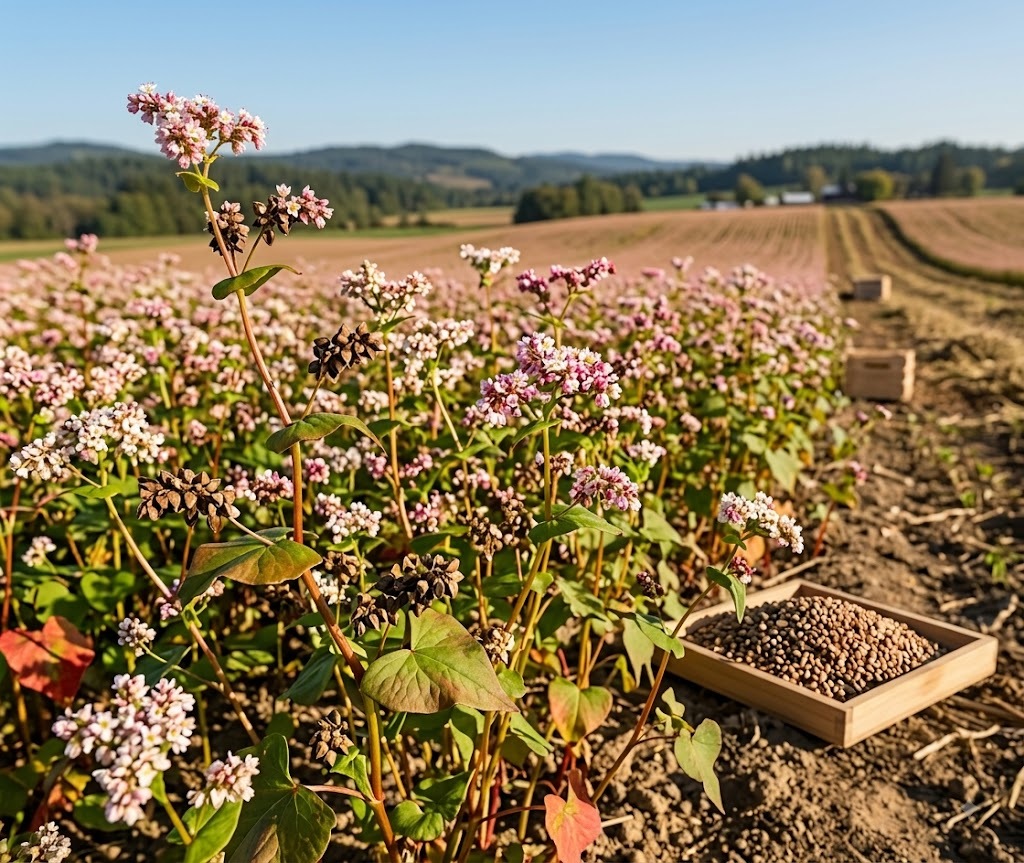
Nongsaroo describes buckwheat as a crop that can be cultivated as both summer and autumn varieties ; since autumn buckwheat often exhibits indeterminate growth, flowering and fruiting can occur simultaneously on a single plant, making it crucial to determine the optimal harvest time .
Nongsaroo's harvesting technique suggests harvesting general autumn buckwheat when approximately 75–80% of the seeds have matured and turned black . It explains that harvesting too early makes drying and storage difficult due to immature grains and high moisture content, and that heavy rainfall during the harvest season can increase the risk of pre-harvest sprouting and quality degradation. ( Nongsaroo )
Plant Identity
Basic fields | Buckwheat Registration Standards |
| Korean name | buckwheat |
| English name | Buckwheat / Common buckwheat |
| Representative scientific name | Fagopyrum esculentum Moench |
| classification | Polygonaceae · Fagopyrum |
| Edible parts | Mature fruit/seed |
| Non-edible · Separate management | Stems, leaves, roots, buckwheat hulls, and milling by-products. Young plants and sprouts are sold separately. |
| Major harvesting stages | Edible seed maturity / Seed maturity / Sprout/young plant stage |
| Basic product form | Raw grain · Selected grain · Dried grain · Buckwheat rice · Powder · Sprout · Processed raw material |
| Basic processing stage | Harvesting → Drying → Sorting → Peeling → Milling → Blending, Noodle Making, Manufacturing |
| Basic use | Noodles, Makguksu, Naengmyeon, Mixed Ingredients, Muk, Jeonbyeong, Tteok, Tea, Confectionery & Baking, Seonsik, Local Specialties |
| Similarity Principle | Other Fagopyrum species, such as bitter buckwheat, are separate Plant Entities. Summer and autumn cultivation types are separated as Production Attributes. |
Although Nongsaroo explains that young buckwheat plants can be edible, they must be managed as a separate Product Entity because they differ from mature seeds in terms of edible parts, harvest stage, and product form . ( Nongsaroo )
Product Master
Product ID | Product type | Key Management Standards |
| BKW-P01 | Buckwheat Original | Species · Variety · Origin · Cultivation Type · Harvest Date · Pollination · Lot |
| BKW-P02 | Jeongseon buckwheat | Foreign matter, immature grains, broken grains, or mixing with other grains |
| BKW-P03 | hulled buckwheat | Depilation rate · Damage · Shell residue · Yield |
| BKW-P04 | Buckwheat rice | Particle size, uniformity, cooking suitability, raw material lot |
| BKW-P05 | buckwheat flour | Particle size, milling rate, color, moisture, microorganisms |
| BKW-P06 | Ingredients for noodles and buckwheat noodles | Buckwheat content, particle size, dough, and noodle-making suitability |
| BKW-P07 | Ingredients for ink | Raw material specifications, powder characteristics, and processing suitability |
| BKW-P08 | Ingredients for Jeonbyeong and Tteok | Particle size, mixing, and processing suitability |
| BKW-P09 | Borrowed raw materials | Ingredient type, roasting, aroma, color |
| BKW-P10 | Confectionery and baking ingredients | Powder, Blending, Processing Suitability |
| BKW-P11 | Buckwheat sprouts | Seed Lot · Germination · Harvest Date · Hygiene |
| BKW-P12 | Bitter buckwheat products | Species, Variety, Raw Grain, Processing History Separate |
| BKW-P13 | semi-finished products | Blending · Heat Treatment · Raw Material Lot |
| BKW-P14 | finished product | Labeling · Raw Materials · Processing Lot · Use-by Date |
| BKW-P15 | Buckwheat hulls and by-products | Generation process · Foreign matter · Contamination · Application |
Classification criteria | Subdivision type | Management principles |
| Plant classification | Regular buckwheat / Bitter buckwheat, etc. | Plant Entity separate by Species |
| varieties | Breeding, native, and introduced varieties | Variety name and seed source are required. |
| Cultivation method | Summer buckwheat / Autumn buckwheat | Separation of sowing, flowering, and harvesting times |
| Growth type | Finite and infinite flesh characteristics | Connect with the Harvest Decision Dataset |
| Harvesting stage | Mature seeds / Seeds / Buckwheat sprouts | Product Separation |
| Distribution methods | Original Song · Selected Song · Hair-shed Song · Buckwheat Rice | Product ID Assignment |
| Processing form | Milling, Stir-frying, Noodle Making, Jelly, Pancakes, Confectionery | Create Process Lot |
| Final use | Noodles, Jelly, Tea, Rice Cakes, Pancakes, Baked Food, and Health Food | RFQ by Buyer |
| Transaction type | In-kind · Contract farming · Regular supply · OEM · PB | Price and contract are NDAs |
| origin | Domestic/Imported | Separation of origin and lot |
Since Nongsaroo explains that the growth types and harvest characteristics of autumn buckwheat and summer buckwheat may differ, cropping types and growth types are not combined into the same field. ( Nongsaroo )
The bitter buckwheat variety 'Hwanggeum Miso,' which was field-evaluated by the Rural Development Administration in 2026, manages data regarding raw materials, products, and processing suitability separately from regular buckwheat. In Rural Development Administration trials, this variety demonstrated diverse processing suitability for products such as tea, noodles, jelly, bread, and health food products. ( Rural Development Administration )
step | Essential Dataset | Management purpose |
| Cultivation plan | Species · Varieties · Summer/Autumn Crop Type · Area · Buyer | Final use determined |
| satellite | Variety · Germination · Seed Lot | Breed Traceability |
| sowing | Sowing date, sowing quantity, and plot | Cultivation type and ripening management |
| budding | Budding date and hair growth rate | Early growth |
| Growth management | Plant height, branching, flowering, and fruiting | Harvest forecasting |
| rising | Temperature, precipitation, sunshine, humidity | Flowering, fruiting, and pre-harvest sprouting risks |
| Watering | Record if necessary | Moisture stress management |
| dispute | Soil, fertilizer, timing, and amount | Growth and Lodging Management |
| weeds | Occurrence and Control | Productivity Management |
| pests | Occurrence, Monitoring, and Control | Quality and Safety |
| flowering | Flowering start and flowering period | Fruition and harvest prediction |
| Maturity assessment | Blackening rate, moisture, and vapor | Harvest decision |
| harvest | Harvest date, method, and loss | Original song Lot |
| threshing grain | Threshing day, equipment, damage, loss | Secure original song |
| dry | Moisture, Method, Time | Storage stability |
| Jeongseon | Foreign matter, immature grains, other grains | commercialization |
| ecdysis | Depilation rate, breakage, and yield | Buckwheat rice production |
| Milling | Particle size, yield, fractionation | Powder Product |
| stir-fry | Heat treatment, scent, color | Tea ingredients |
| noodle making | Mixing, dough, and noodle quality | Noodle Product |
| Jelly making | Raw materials, blending, heating | Muk Product |
| packaging | Packaging date/specifications | trading unit |
| save | Temperature, humidity, and period | Quality maintenance |
| shipment | Buyer · Lot · Shipment Date | Delivery Traceability |
Nongsaroo suggests that the general harvest criterion for autumn buckwheat is when 75–80% of the seeds have matured and turned black . Harvesting too early can cause problems with drying and storage due to immature grains and high moisture content, while heavy rain and humidity can lead to quality degradation caused by pre-harvest sprouting and delayed drying. ( Nongsaroo )
In addition, since cultivation management data from Nongsaroo indicates that excessive fertilizer application in fertile soil can actually lower buckwheat yields, fertilizer application rates are not simply applied at the level of general grains. ( Nongsaroo )
Quality items | raw materials | Pre-treated products | processed goods | finished product | Public rating |
| Species | essential | succession | succession | tracking | Public/Verified |
| mountainous district | essential | succession | succession | tracking | Public/Verified |
| Cultivation method | Summer and Autumn | succession | tracking | If necessary | Member |
| varieties | essential | essential | Raw material connection | tracking | Member/Verified |
| farmhouse | ID | succession | succession | tracking | Verified |
| Lot | essential | new | new | Manufacturing Lot | Verified/NDA |
| Sowing date | record | succession | tracking | - | Verified |
| Flowering day | record | succession | tracking | - | Verified |
| Harvest day | essential | succession | succession | tracking | Verified |
| Maturity | core | succession | Raw Material Indicators | tracking | Verified |
| appearance | check | check | Product specifications | Product specifications | Member |
| Color | check | Selection | Powder color, etc. | By product | Member |
| moisture | core | core | By product | By product | Verified |
| weight | record | record | record | mark | NDA |
| immature teeth | check | Selection | Raw Material Indicators | tracking | Verified |
| Damaged lip | check | eliminate | Raw Material Indicators | tracking | Verified |
| Germination of grains · Pre-germination | check | Selection | Raw material deemed unsuitable | tracking | Verified |
| alien substance | check | core | core | Compliance with standards | Verified |
| Mixing of other grains | check | core | Raw material traceability | Marking standards | Verified |
| pesticide residues | Required test | Linkage | Compliance with standards | Compliance with standards | Verified/NDA |
| microorganism | By product | If necessary | By product | legal standards | Verified/NDA |
| Allergy management | Separate management | Facility cross-contact | Check processing line | Display and Management | Verified/NDA |
| molting history | - | essential | succession | tracking | Verified |
| Milling history | - | The relevant city | essential | tracking | Verified |
| Processing history | - | record | essential | essential | Verified/NDA |
| packaging | Won-gok packaging | By product | Product packaging | Final packaging | Member |
| save | essential | essential | essential | By product | Verified |
| Expiration date | The relevant city | By product | By product | Labeling standards | Member |
| Shipment · Return · Claim | record | record | record | record | NDA |
| Repurchase | Buyer Connection | Buyer Connection | Buyer Connection | Buyer Connection | NDA |
Lot Master Required Field
Lot ID · Item/Product Type · Species/Scientific Name · Variety · Summer/Autumn Crop Type · Origin/Cultivation Area · Producer · Seed Lot · Sowing Date · Flowering Date · Harvest Date · Harvest Stage · Blackening/Maturity Status · Quality Indicators · Moisture · Weight/Specifications/Grade · Immature Grains/Pre-harvest Sprouting/Appearance · Pesticide Use History · Pesticide Residue/Microbiological Report · Threshing/Drying/Storage History · Raw Material Lot · Sorting/Dehulling/Milling History · Processing History · Packaging Date · Best Before Date · Shipper · Returns/Claims · Repurchase
Quantity, actual unit price, original test report, contract, and Lot details are managed as Verified/NDA .
Korean production
National buckwheat cultivation area: To be entered after verification of official raw data
National buckwheat production volume: To be entered after verification of official raw data
Nongsaroo's buckwheat cultivation data includes historical figures stating that the paddy field cultivation area in 2016 was **340 ha, accounting for approximately 10% of the total buckwheat cultivation area**; however, this data describes the structure from 2016 and is not used as the latest production scale for 2026. ( Nongsaroo )
The Rural Development Administration has promoted the dissemination of domestic varieties, cultivation techniques, the development of processed products, and the improvement of distribution conditions while fostering buckwheat as a regionally specialized crop in Jeju. ( Rural Development Administration )
Customers | Purchase criteria | Cooperation opportunities |
| Producer organizations and agricultural cooperatives | Variety, Cultivation Type, Pollination, Harvest Date, Quantity | Joint sorting and contract farming |
| Jeongseon and flour milling companies | Original grain uniformity, moisture, milling yield | Milling raw materials |
| Makguksu and buckwheat noodle businesses | Buckwheat content, powder specifications, and noodle-making suitability | Specialized varieties · Powder |
| cold noodle manufacturers | Mixing ratio and noodle properties | mixed ingredients |
| Muk manufacturers | Powder Specifications and Processing Suitability | Jelly-exclusive product |
| Jeonbyeong and Tteok companies | Grinding specifications, flavor, color | local products |
| Tea and beverage companies | Roasting characteristics, aroma, and origin | Buckwheat tea |
| Confectionery and bakery companies | Powder and mixing suitability | Processed raw materials |
| Sunsik and grain processing | Powder, heat treatment, variety | HMR · Health Foods |
| School and public meals | Country of origin, safety, and product specifications | local agricultural products |
| food service companies | Noodle making, cooking suitability, and supply stability | Regular supply |
| HMR · Meal Kit | Semi-finished product, sauce, and noodle specifications | Product development |
| PB | Domestic, Local, and Variety Stories | PB Noodles, Tea, Powder |
| local specialties | Regionality, Traditional Food, Tourism | local brand |
| Bitter buckwheat processing company | Species · Varieties · Processing Suitability | New Product |
| Research and technology institutions | Variety, Cultivation, Milling, and Product Data | PRP · Verification |
| exporters | HS · Quality · Origin · Certification | Export of processed products |
step | Key variables | Operational judgment |
| satellite | Species · Varieties · Germination · Seed Resources | Separation of regular and bitter buckwheat |
| Production in the producing area | Summer/Autumn crop type/area/expected harvest | Compared to buyer demand |
| contract farming | Variety, Processing Use, Estimated Quantity | Demand-based production |
| Harvesting and threshing | Maturity, sprouting, loss | Quality assurance |
| Drying and sorting | Moisture, immature grains, foreign matter | Storage stability |
| ecdysis | molting rate and yield | Buckwheat rice |
| Milling | Yield, particle size, and fractionation | Buyer Spec |
| Storage and shipment | Inventory · Quality · Lot | Annual procurement |
| Noodle making and processing | Blending and product yield | finished product |
| Distribution and supply | Delivery, Packaging, Logistics | Buyer SLA |
| RFQ · Repurchase | Quality, Delivery, Evaluation | Repeat trading |
Trade Management
Buckwheat is generally classified under the Buckwheat series of HS 1008 in the international HS system . In the analysis of actual Korean imports and exports, the current HSK detailed codes and product descriptions are reconfirmed with the Korea Customs Service.
item | Operating Principles |
| HS Major Classification | 1008 series |
| Buckwheat three times | Customs HSK verification at the time of transaction |
| Regular buckwheat | Management of Species, Origin, and Original Condition |
| bitter buckwheat | Review of Products and Statistics Separate from Regular Buckwheat |
| For seeds | Separation from edible grains |
| buckwheat flour | Review of HS separately from the original song |
| Noodles and processed products | Three separate items by degree of food processing |
| Import volume and value | Subsequent official verification of raw data by the Korea Customs Service |
| major countries | Enter after verifying the detailed HS and base year |
| Export volume and value | Further verification |
| Quarantine | Quarantine conditions by seed and grain status |
| FTA | Verification by tariff classification, origin, and agreement |
| Customs clearance unit price | Based on identical product, three-number, and quantity unit |
Latest buckwheat import, export, major countries, and customs clearance unit prices: To be entered later after verification of official raw data from the Korea Customs Service.
The figures for raw grain, buckwheat flour, buckwheat noodles, etc., are not aggregated into a single buckwheat import volume.
Products and processes | Key conditions | RFQ conversion |
| Original song | Species · Varieties · Cultivation Type · Origin · Pollination | Origin RFQ |
| Selected | Foreign matter, immaturity, premature sprouting | flour mill |
| Escape song | Depilation rate, breakage, and yield | Buckwheat rice |
| buckwheat flour | Particle size, color, milling rate, moisture | Noodles, Jelly, and Confectionery |
| noodle powder | Noodle suitability and mixing conditions | Makguksu · Noodles |
| Ingredients for ink | Powder characteristics and processing yield | Jelly making |
| Ingredients for Jeonbyeong | Particle size, aroma, and processability | Dining Out & Local Products |
| buckwheat for borrowing | Roasting conditions, aroma, color | Tea and Beverages |
| Confectionery and baking ingredients | Mixing and dough suitability | Bakery |
| Ingredients for health food | Heat treatment, powder, safety | Seonsik · HMR |
| Buckwheat sprouts | Seed Lot · Germination · Harvest · Hygiene | fresh food |
| bitter buckwheat | Species · Varieties · Processing Suitability | Tea, noodles, jelly, bread, etc. |
| semi-finished products | Blending · Process · Raw Material Lot | OEM |
| finished product | Labeling, Use-by Date, Manufacturing Lot | PB·Distribution |
| Buckwheat hulls | Foreign matter, dust, and contamination | Review of non-food utilization |
| Milling by-products | Food and feed suitability | Separate verification |
The Rural Development Administration proposed tea, noodles, jelly, bread, and health food products as processing applications for the bitter buckwheat variety 'Hwanggeum Miso' by 2026. A Product Research Profile will be established for this product group separately from that of regular buckwheat. ( Rural Development Administration )
Utilization of by-products
Review Area:
Food materials · Feed · Fermentation · Compost · Biomaterials · Buckwheat hull utilization · Waste reduction
However, the conversion of food, functional, pharmaceutical, or cosmetic materials shall be registered after verifying relevant safety, laws, and official research grounds.
PRP — Product Research Profile
PRP ID | Product Research Profile |
| PRP-BKW-01 | Comparison of Regular Buckwheat and Bitter Buckwheat Species |
| PRP-BKW-02 | Summer and Autumn Buckwheat Varieties, Maturity, and Productivity |
| PRP-BKW-03 | Relationship between maturity, shattering/pre-harvest sprouting, and yield loss |
| PRP-BKW-04 | Depilation rate and milling yield by variety |
| PRP-BKW-05 | Buckwheat powder particle size and noodle-making suitability |
| PRP-BKW-06 | Specifications exclusively for domestic buckwheat makguksu and noodles |
| PRP-BKW-07 | Processing suitability of buckwheat raw materials for making buckwheat |
| PRP-BKW-08 | Roasted Buckwheat Tea Product Manufacturing Process |
| PRP-BKW-09 | Buckwheat Applicability to Confectionery and Baking |
| PRP-BKW-10 | Bitter Buckwheat 'Golden Miso' Processed Product |
| PRP-BKW-11 | Comparison of specifications for domestic and imported raw materials |
| PRP-BKW-12 | Resource utilization of buckwheat hulls and milling by-products |
| PRP-BKW-13 | Linking local buckwheat tourism, dining, and private brands |
| PRP-BKW-14 | Buyer Spec–Species–Variety–Milling Process AI Match |
first of all | Execution item | Performance indicators |
| 1 | Species, Variety, Cultivation Type, Origin, Harvest Date, and Lot are mandatory. | Required field input rate |
| 2 | Separation of Raw Grain, Buckwheat Rice, Powder, Sprouts, and Bitter Buckwheat Products | Product identification rate |
| 3 | Connection between weather, flowering, fruiting, maturation, and harvest | Production Dataset Completion Rate |
| 4 | Datafication of sprouting, moisture, quality, test reports, and milling history | Lot tracking rate |
| 5 | Farm – Milling – Food Manufacturing – Buyer RFQ Connection | Match rate |
| 6 | Video AI maturity ratio determination | Harvest judgment accuracy |
| 7 | AI screening for sprouts and immature grains | Detection accuracy |
| 8 | Yield prediction based on flowering and fruiting | Prediction error |
| 9 | Weather-based harvest risk prediction | Harvest Delay and Rainfall Response Rate |
| 10 | Prediction of milling yield | Yield prediction error per lot |
| 11 | Smart Storage | Storage loss rate |
| 12 | Inventory and Supply Forecast | Supply Gap Forecast Rate |
| 13 | AI Buyer Match | Valid RFQ Recommendation Rate |
| 14 | Traceability | Finished Product → Species/Raw Material Lot Traceability |
| 15 | Repurchase Runtime | Buyer repurchase and claim rates |
Problem group | Problem Definition | Required data |
| Mixed regular and bitter buckwheat | Species/variety differences are not reflected in the Product | Scientific name and variety |
| Mixed summer and autumn cropping types | Differences in growth and harvest characteristics by cropping type | Sowing, flowering, and harvesting |
| Uneven flowering and maturation | Flowering and fruiting can continue on a single plant | Flowering and blackening rate |
| Determining the optimal harvest time | Both early and delayed harvesting may result in quality loss. | Maturity and moisture |
| Subara | Risk of quality degradation due to rainfall and high humidity during the harvest season | Precipitation, humidity, germination |
| Dropping/harvest loss | Possible losses if harvest is delayed after maturity | Harvest date and loss rate |
| immature teeth | Contamination when harvesting too early | Maturity and Selection |
| Delayed drying | High moisture affects storage and processing | Moisture and dryness |
| Mixing of varieties | Common and bitter buckwheat and variety mixing | Seed·Lot |
| Foreign matter contamination | Quality variation in production area and sorting stage | Jeongseon/Imul |
| Depilation yield variation | Yield difference based on raw material quality | Input and Output |
| Milling yield deviation | Differences in variety, raw grain, and milling conditions | Milling Dataset |
| Area deviation | Difference in Buyer Specifications for Noodles | Powder, dough, and noodle quality |
| Competition between domestic and imported products | Differences in price, specifications, and supply stability | Trade, Price, Origin |
| Dispersion of production scale | Difficulty in large-scale raw material procurement | Farms, Area, Region |
| Verification of the latest official statistics | Need to verify nationwide production scale for 2026 | KOSIS · Public Data |
| Lack of contract farming | Disconnection between demand from processors and production in producing regions | RFQ · Contract |
| Lack of information on flour milling facilities | Actual processing capacity and fractionation specifications are unclear | Facilities, Equipment, and Yield |
| Allergy and cross-contact | Safety management of buckwheat products is necessary | Process, Line, Display |
| Discontinuity of traceability from raw materials to finished products | Difficulty tracing ingredients in local products | Parent–Child Lot |
| Lack of inventory visibility | Difficulties in supply planning for seasonal ingredients | Stock/Expected Harvest |
| Buyer repurchase not reflected | Consumption and delivery evaluations not reflected in next cultivation | Reviews · Claims · Repurchase |
Given that Nongsaroo separately points out the risks of pre-harvest sprouting and quality degradation under rainfall and high humidity conditions during the harvest season, the connection between weather conditions → maturation → harvest determination → pre-harvest sprouting → quality grade is the core problem dataset for buckwheat. ( Nongsaroo )
RFQ Type | Public Registration | Verify/NDA |
| Original source procurement | Species · Varieties · Cultivation Type · Region | Farm · Quantity · Unit Price · Lot |
| sale | Origin · Product · Harvest Season | Stock, Price, Delivery Time |
| purchase | General/Bitter Buckwheat · Standards · Uses | Target Price · MOQ |
| Regular supply | Product · Supply Cycle | Quantity · Actual Unit Price |
| contract farming | Species · Varieties · Cultivation Type · Region | Area, Quantity, Price |
| Seed supply | Variety and Seed Use | Germination · Seed Lot |
| Jeongseonwon 곡 | Standard specifications | Lot · Facilities · Price |
| hulled buckwheat | Product form | Yield · Lot |
| buckwheat flour | Particle size and uses | Test Reports · MOQ |
| Noodle and buckwheat noodle ingredients | General specifications for noodle making | Sample and noodle making test |
| Ingredients for ink | Product Use | Processing test |
| Borrowed raw materials | Product for Stir-frying | Samples and quality |
| Confectionery and Baking | Powder Product | Mixing and Testing |
| Buckwheat sprouts | Production type and region | Hygiene · Lot · Delivery Time |
| bitter buckwheat | Species · Varieties | Test Reports and Processing Tests |
| Dining Out & School Meals | Product Type · Region | Delivery time, quantity, and price |
| HMR · Meal Kit | Noodles, powder, and semi-finished products | MOQ · Recipe |
| OEM·PB | Product concept | MOQ · Contract |
| local specialties | Origin · Product | Manufacturer/Contract |
| export | Product/Target Country | HS · Certification · Price |
| Technology demonstration | Cultivation, harvesting, milling, and processing | Exam materials |
| Research cooperation | Species · Product | Confidential results |
Verified/NDA: Producer · Growing Site Details · Facilities · Quantity · Estimated Production Quantity · Inventory · Unit Price · MOQ · Certificates · Lot · Samples · Contract Terms · Process Conditions · Delivery Date · Claims · Repurchase
RFQ Runtime:
RFQ Registration → Supplier Verification → AI Match → Sample → Inspection → Processability Test → Negotiation → Contract → Production/Securing → Lot → Delivery → Inspection → Performance Evaluation → Repurchase
① Need Products & Materials
Companies and institutions seeking necessary products, agricultural products, raw materials, and processed goods register purchasing demands. Registered requests are utilized to review cooperation with potential suppliers and producers based on the RFQ Intelligence Library.
Process:
RFQ Registration → Supplier/Product Review → Collaboration Connection → Future AI Matching
Register
② We are looking for production and manufacturing partners. (Need Suppliers & Manufacturers)
Register a request to find necessary production and supply partners, ranging from farms and producer organizations to processing companies, OEM, ODM, and private label manufacturers.
Process:
RFQ Registration → Review of Production & Manufacturing Capabilities → Collaboration Connection → Future AI Partner Matching
Register
③ We are looking for domestic and international buyers. (Need Buyers)
Farmers, producer organizations, and manufacturing companies are requesting cooperation with new buyers, such as domestic and international distributors, importers, brand companies, and food service and catering businesses.
Process:
RFQ Registration → Product & Supply Capability Review → Market & Buyer Connection → Future AI Buyer Matching
Register
Contact : mail@markethub.org
Version | Main contents | situation |
| v1.0 | Plant Identity · Species · Cultivation Type · Production · Milling · Product · RFQ Basic Structure Registration | complete |
| v1.1 | Verification of official raw data on production, region, market, supply and demand, and import/export | expected |
| v2.0 | Detailed quality standards by product type: regular buckwheat, bitter buckwheat, buckwheat rice, powder, noodles, jelly, and tea | expected |
| v3.0 | Producer – Sorting & Milling – Food Manufacturing – Food Service & Distribution – Buyer Verified Container Combination | expected |