

Judgment axis | Key judgment |
| Item Identity | Representative legumes centered on the mature seeds of the legume family Glycine max |
| Key role | Multilayer industrial raw materials such as edible grains, tofu, soy milk, fermented sauces, bean sprouts, edible oil, protein, food ingredients, and animal feed |
| Harvesting principle | Separation of harvesting into ripe seeds, immature seeds, and seeds according to final use and variety. |
| Product separation | Separate product management for raw soybeans, soybeans for rice, soybeans for tofu, soybeans for sauces, soybean sprouts, edamame, soybeans for oil extraction, and soybeans for processing materials. |
| Separation of similar items | Separation of Plant Entities from other legumes such as red beans, mung beans, and kidney beans. Separation of Products within the same soybean variety based on harvest stage, variety, and use. |
| Domestic statistics | Statistics on soybean production volume and cultivated area are available in the National Data Center's KOSIS Crop Production Survey. The final raw data figures for 2025 were entered after re-verification in v1.1. |
| Supply and demand risk | Discrepancies in varieties and specifications by intended use, weather, waterlogging, pests and diseases, harvest losses, price differences between domestic and imported products, differences in processing suitability, fluctuations in the import supply chain |
| Operating Principles | Connect Variety–Production–Harvest–Quality–Processing–Buyer Spec to Lot |
| Final goal | Connects soybeans produced by producers with Buyer Specs by intended use and feeds processing and delivery results back into the next cultivation plan. |
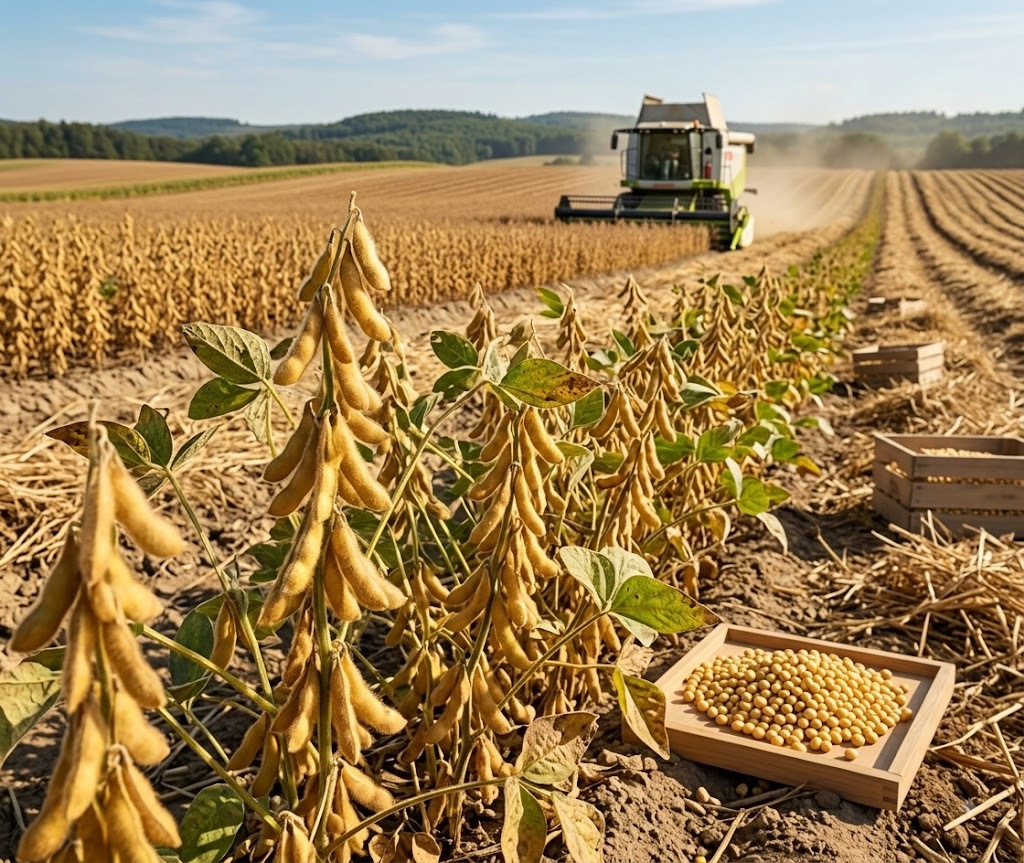
It is important to view soybeans as a representative multi-product crop, unlike other small-scale legumes, where multiple industrial supply chains branch out from a single raw material . This is because even with the same Glycine Max, the varieties, seed sizes, appearances, protein content, and processing suitability required by tofu manufacturers, soy sauce producers, bean sprout producers, the soybean market for rice dishes, and oil extraction and protein material companies are not the same.
Plant Identity
Basic fields | Soybean registration standards |
| Korean name | Soybeans |
| English name | Soybean |
| Representative scientific name | Glycine max (L.) Merr. |
| classification | Fabaceae · Glycine |
| Edible parts | Mainly royal family |
| Non-edible · Separate management | Stems, leaves, pod shells, roots, processed meal, etc. |
| Major harvesting stages | Immature seeds / Mature seeds / For seeds |
| Basic product form | Raw soybeans, sorted soybeans, washed soybeans, green soybeans, soybeans for bean sprouts, processed raw materials |
| Basic processing stage | Sorting, washing, soaking, germination, grinding, heating, coagulation, fermentation, extraction, degreasing |
| Basic use | Soybeans for rice, tofu, soy milk, fermented sauces, bean sprouts, cooking oil, protein sources, animal feed |
| Similarity Principle | Separation of plants from other legumes, and separation of soybeans into products based on variety, color, harvest stage, and use. |
Product Master
Product ID | Product type | Key Management Standards |
| SOY-P01 | Harvested soybean original grain | Variety · Origin · Harvest Date · Moisture · Lot |
| SOY-P02 | dried soybeans | Moisture, drying conditions, cracks |
| SOY-P03 | Jeongseon soybeans | Foreign matter, broken pellets, damaged pellets, uniformity |
| SOY-P04 | Beans under the rice | Breed, color, size, appearance, cooking suitability |
| SOY-P05 | Beans for tofu | Variety, Protein, Soaking, Tofu Processing Suitability |
| SOY-P06 | Soybeans for soy milk | Variety · Protein · Extract · Sensory |
| SOY-P07 | Soybeans for fermented sauces | Variety, Maturity, Fermentation Suitability |
| SOY-P08 | Beans for bean sprouts | Seed size, germination rate, and germination uniformity |
| SOY-P09 | Edamame | Immature Harvest · Pod · Seed Size · Refrigeration/Frozen |
| SOY-P10 | Black bean family | Verification of actual variety, color, and use |
| SOY-P11 | Soybeans for oil extraction | Fat content, moisture, foreign matter, milking yield |
| SOY-P12 | Soybean flour | Grinding, particle size, and heat treatment |
| SOY-P13 | defatted soybeans | Milking history, residual milk, protein |
| SOY-P14 | Soy protein raw material | Protein specifications, processing methods, and functionality |
| SOY-P15 | tofu | Raw Material Lot · Coagulation · Yield · Microorganisms |
| SOY-P16 | Soy milk | Extraction, heating, blending, and packaging |
| SOY-P17 | Sauce ingredients and semi-finished products | Steaming, fermentation, microorganisms, aging |
| SOY-P18 | bean sprout | Seed Lot · Germination · Cultivation · Washing |
| SOY-P19 | Soybean oil | Extraction, Refining, Raw Material Lot |
| SOY-P20 | Soybean meal | Milking by-products, uses, and safety |
| SOY-P21 | HMR·PB ingredients | Processing status, blending, and delivery specifications |
| SOY-P22 | Soybeans for seeds | Variety · Purity · Germination Rate · Seed Lot |
Classification criteria | Subdivision type | Management principles |
| Plant classification | Glycine max | Separation of other legumes and plants |
| varieties | Soy sauce, tofu, bean sprouts, rice garnish, and other varieties | Verification of variety name |
| Seed coat color | Yellow, green, black, etc. | Do not equate color with variety |
| Seed size | Small, neutral, confrontational, etc. | Actual specification values are recorded per lot |
| Harvesting stage | For immature, mature, and seeds | Product Separation |
| Cultivation method | Region, Sowing Season, Cultivation Method | Production Lot Connection |
| cultivation method | Practices, eco-friendly, etc. | Separate verification of certification status |
| Distribution methods | Raw grain, sorting, washing, refrigeration, freezing | Product ID |
| Processing form | Germination, grinding, coagulation, fermentation, extraction, and degreasing | Process Lot |
| Final use | Rice, tofu, soy milk, sauces, bean sprouts, oils and fats, protein | Buyer Spec |
| origin | Domestic/Imported | Origin Traceability |
| Transaction type | In-kind · Contract farming · Regular supply · Import · OEM · PB | Contract Connection |
In particular , black beans are not treated as a specific single variety. Seed coat color, actual variety name, region name, and market name are each managed as separate fields.
In addition, edamame may be the same species as soybeans, but since they are harvested when immature and distributed as fresh or frozen vegetable-type products, they are separated from mature soybean products.
step | Essential Dataset | Management purpose |
| Cultivation plan | Variety · Use · Buyer · Area | demand-based production |
| satellite | Variety · Purity · Germination Rate · Seed Lot | Breed Traceability |
| sowing | Sowing date, density, and method | Crop management |
| budding | Budding date and budding rate | Early growth |
| Growth management | Growth stage, plant height, flowering, and pod formation | Quantity forecasting |
| rising | Temperature, precipitation, sunshine, disasters | Production risk |
| Irrigation and drainage | Irrigation, soil moisture, and flooding | Moisture and humidity management |
| dispute | Fertilizer, Timing, and Amount | Growth and quality |
| weeds | Occurrence and Control | production loss |
| pests | Occurrence, Control, and Damage | Quality and quantity |
| Flowering and pod formation | Flowering date · Narrow | Quantity forecasting |
| enlargement of the royal family | Growth and seed status | Quality prediction |
| Maturity assessment | Leaves, pods, seeds, pollen | Harvest season |
| harvest | Date, Method, Loss | Harvest Lot |
| threshing grain | Equipment, Damage, Loss | Product yield |
| dry | Moisture, temperature, time | Storage stability |
| Jeongseon | Foreign matter, damaged granules, size | commercialization |
| Selection | Color, size, and appearance | Specs by Application |
| purifying | Required Product | food processing |
| Immersion | Tofu, soy milk, and fermented sauces | Processing |
| germination | bean sprout | Germination Lot |
| smash | Soy milk, tofu, powder | Processing yield |
| heating | food processing | Process Management |
| coagulation | tofu | Yield and quality |
| fermentation | Sauces | Fermentation Lot |
| milking | Soybean oil | Oil Yield |
| save | Temperature, humidity, and period | Quality maintenance |
| packaging | Specifications/Date | trading unit |
| shipment | Buyer · Lot · Delivery Date | Delivery |
Quality items | raw materials | Pre-treated products | processed goods | finished product | Public rating |
| mountainous district | essential | succession | tracking | mark | Public/Verified |
| Cultivation method | record | succession | tracking | - | Member |
| varieties | essential | essential | succession | tracking | Public/Verified |
| farmhouse | ID | succession | tracking | - | Verified |
| Lot | essential | new | new | Manufacturing Lot | Verified/NDA |
| Harvest day | essential | succession | tracking | - | Verified |
| Seed coat color | record | Selection | By product | If necessary | Member |
| appearance | core | core | Raw material specifications | Product specifications | Member |
| weight | By Lot | By Lot | By Batch | By product | Verified |
| size | core | Selection | By use | If necessary | Member |
| rating | Check application criteria | apply | Raw Material Spec | Product Spec | Member |
| Damaged lip | check | eliminate | tracking | - | Verified |
| Broken lip | check | Selection | By use | - | Verified |
| alien substance | core | core | Process inspection | Compliance with standards | Verified |
| moisture | core | core | By product | By product | Verified |
| germination rate | For seeds and bean sprouts | core | Germination Product | - | Verified |
| pesticide residues | test | succession | Standard verification | Compliance with standards | Verified/NDA |
| microorganism | By product | After washing | core | Food standards | Verified/NDA |
| protein | Measurement by Use | succession | Fabrication aptitude | Product specifications | Verified |
| maintain | Milking center | succession | Milking yield | Product specifications | Verified |
| purifying | - | record | succession | tracking | Verified |
| Immersion | - | process | essential | tracking | NDA |
| fermentation | - | - | The core of fermented sauces | tracking | NDA |
| milking | - | - | Maintenance products | tracking | NDA |
| packaging | Original song | Preprocessing | processed goods | finished product | Member |
| save | essential | essential | essential | Product Conditions | Verified |
| Expiration date | The relevant city | By product | essential | essential | Member |
| Shipment | record | record | record | record | NDA |
| Returns and Claims | record | record | record | record | NDA |
| Repurchase | Buyer Connection | connection | connection | connection | NDA |
Lot Master Required Field
Lot ID · Item/Product Type · Scientific Name/Variety · Seed Coat Color · Cultivation Type · Origin/Cultivation Area · Producer · Cultivation Method · Seed Lot · Sowing Date · Flowering Date · Harvest Date · Quality Indicators · Moisture · Indicators by Use (Protein, Oil, etc.) · Weight · Specifications · Grade · Damaged Grains · Broken Grains · Appearance · Pesticide Use Records · Pesticide Residue/Microbiological Test Reports · Drying/Sorting/Storage History · Raw Material Lot · Washing/Immersion/Sprouting/Grinding/Heating/Coagulation/Fermentation/Extraction History · Packaging Date · Best Before Date · Shipper · Returns/Claims · Repurchase
Soybeans are a key legume that must simultaneously connect the raw grain market and the processing industry in Korea .
Official production statistics are managed based on the soybean item of the National Data Office KOSIS Crop Production Survey.
Domestic soybean cultivation area: Entered after re-verification of official final raw data for 2025
Domestic soybean production volume: Entered after re-verification of official final raw data for 2025
MarketHub does not arbitrarily divide the volume of specific products such as green beans, soybean sprouts, black beans, and tofu beans within the range of soybeans in national statistics.
Customers | Purchase criteria | Cooperation opportunities |
| Agricultural Cooperatives and Production Area Distribution Organizations | Variety, Origin, Grade, Quantity | Joint screening and contract |
| Wholesale and grain distribution | Origin, variety, size | Regular supply |
| Tofu manufacturer | Variety, Protein, Processing Yield | contract farming |
| Soy milk manufacturer | Protein, Extraction Yield, Sensory | Exclusive type |
| Sauce manufacturers | Variety, Seed, Fermentation Suitability | Soybean contract |
| Bean sprout manufacturer | Small grains, germination rate, uniformity | Seed-to-Sprout |
| Rice-bean market | Color, size, appearance, and cooking ability | Premium domestic beans |
| edible oil production | Milking yield | Large-scale raw material procurement |
| protein material companies | Protein and processability | food materials |
| HMR · Meal Kit | Pre-processing and Cookability | Processed beans |
| School and public meals | Domestic, Safety, Delivery | Regional contract production |
| dining out | Tofu, soy milk, processed beans | Regular delivery |
| PB | Origin · Variety · Traceability | local brand |
| exporters | Varieties, processed products, HS | K-Food linkage |
| Research Institute | Variety, Protein, Processing Suitability | PRP |
| Seed company | Variety, Yield, Diseases, Uses | Variety development |
The key to soybeans is not just "buyers who need beans," but to subdivide the RFQ to the point of identifying which beans are needed for which specific use .
step | Key variables | Operational judgment |
| satellite | Variety, Use, Germination | production base |
| Production in the producing area | Area, Crop Condition, Expected Harvest | Supply forecast |
| contract farming | Buyer Spec · Variety · Area | Demand linkage |
| Harvesting and threshing | Moisture, loss, damage | Product yield |
| Drying and sorting | Moisture, foreign matter, grade | Food Grade |
| save | Inventory, Quality, and Time | Shipment control |
| Import procurement | Country · HS · Price · Freight | Supply Risk |
| Preprocessing | Washing, Soaking, Grinding | Processor |
| food processing | Tofu, soy milk, fermented sauces, bean sprouts | Product |
| industrial processing | Milking, Skimming, Protein | Ingredient |
| Distribution and supply | Specifications, Delivery Time, Packaging | Buyer SLA |
| RFQ · Repurchase | Evaluation, Price, Quality | Repeat trading |
HS·Trade Management
Since the HS code for soybeans can vary depending on their processing state and use, the HS code is managed by product.
Product | HS Management |
| Raw soybeans | Checking current HSK subdivisions based on the HS 1201 series |
| Soybeans for seeds | Check for subdivision for sowing |
| Soybean oil | HS 1507 Series Verification |
| Soybean meal | HS 2304 Series Verification |
| Tofu and soy milk | Verification of current HS by finished product |
| Soy protein | HS Verification by Manufacturing Form |
| Sauces | Separate HS codes for each product, such as soybean paste and soy sauce |
South Korea's Soybean Import Volume, Import Value, Major Supply Countries, and Customs Clearance Unit Prices:
Input of detailed HS 1201 raw data for 2025 from the Korea Customs Service's Import and Export Trade Statistics, re-verified by Product.
Since the supply chains for soybeans—whether for food, oil extraction, feed, or seeds—are significantly different, the total import volume under HS 1201 is not used as the market size for specific edible soybeans.
Products and processes | Key conditions | RFQ conversion |
| Original song | Variety, Origin, and Moisture | Raw Soybean RFQ |
| Jeongseon beans | Size, foreign matter, damaged granules | food companies |
| Washed beans | Hygiene and moisture | Food service and processing |
| Soaked beans | Immersion time and absorption rate | Tofu and soy milk |
| Ground beans | Particle size and extraction | Processed raw materials |
| tofu | Coagulation, Yield, Texture | OEM · Food Service |
| Soy milk | Extraction, heating, and sensory | OEM·PB |
| Fermented sauce ingredients | Suitable for steaming and fermentation | Soybean paste and soy sauce |
| bean sprout | Germination rate, yield, and hygiene | School meals and distribution |
| Soybean flour | Particle size and heat treatment | Confectionery and Food |
| Soybean oil | Extraction and refining | Food manufacturing |
| defatted soybeans | Residual oil and protein | Food and Feed |
| protein materials | Processes such as concentration and separation | food materials |
| Soybean | Moisture and hygiene | Review of food, feed, etc. |
| Soybean meal | Protein and safety | Feed and materials |
| testa | Amount and composition | Review of materials and feed |
| Non-commercial beans | Causes of damage and safety | Decision on conversion of use |
| finished product | Raw materials, processes, and packaging | PB·Export |
By-products, soybean meal, seed coats, and soybeans excluded from sorting are managed as independent By-product Entities.
The conversion into food, feed, fermentation, or biomaterials is registered after verifying the safety, laws, and official research grounds applicable to each use.
PRP — Product Research Profile
PRP ID | Product Research Profile |
| PRP-SOY-01 | Variety–End Use Mapping |
| PRP-SOY-02 | Variety–Protein–Tofu Yield |
| PRP-SOY-03 | Variety – Soy milk extraction · Sensory |
| PRP-SOY-04 | Soybeans for Soy Sauce – Fermentation Suitability |
| PRP-SOY-05 | Bean Sprout Seeds – Germination Rate · Yield |
| PRP-SOY-06 | Seed Size – Sorting · Buyer Spec |
| PRP-SOY-07 | Sowing period – Growth – Yield |
| PRP-SOY-08 | Weather–Constriction–Quantity |
| PRP-SOY-09 | Harvest time – Moisture – Damage |
| PRP-SOY-10 | Storage Conditions – Original Quality |
| PRP-SOY-11 | Comparison of Processing Suitability Between Domestic and Imported Soybeans |
| PRP-SOY-12 | Oil extraction yield – Soybean meal quality |
| PRP-SOY-13 | Soy protein food ingredient Product |
| PRP-SOY-14 | Utilization of soybean pulp and seed coat by-products |
| PRP-SOY-15 | Separation of Green Beans and Ripe Beans |
| PRP-SOY-16 | Local Varieties – PB Product |
| PRP-SOY-17 | Buyer Spec–Variety–Lot AI Match |
| PRP-SOY-18 | Contract Farming – Analysis of Actual Delivery Performance |
first of all | Execution item | Performance indicators |
| 1 | Make Variety, Crop Type, Origin, Harvest Date, and Lot mandatory values | Required input rate |
| 2 | Separation of Tofu, Fermented Sauces, Bean Sprouts, Rice Base, and Extracted Products | Usage identification rate |
| 3 | Connecting weather, growth, pod formation, harvest, and shipment | Production data connection rate |
| 4 | Data conversion of quality, certificates, storage, and processing history | Lot completion rate |
| 5 | Connecting Farms – Processing Companies – Distribution – Buyer RFQs | Match rate |
| 6 | Video AI Diagnosis of Growth and Pests | Judgment accuracy |
| 7 | AI harvest time prediction | yield forecast error |
| 8 | Production volume forecast | Error compared to actual yield |
| 9 | Optical color, size, and damaged grain sorting | Selection accuracy |
| 10 | Prediction of tofu and soy milk processing yields | Expected–Actual Yield Difference |
| 11 | Bean sprout germination and yield prediction | Production yield error |
| 12 | Stored Inventory Runtime | Inventory Renewal Rate |
| 13 | Domestic–Import Arbitrage | Comparable Lot Ratio |
| 14 | AI Buyer Match | Sample approval rate |
| 15 | Traceability | Finished product → Farm traceability |
| 16 | Repurchase learning | Buyer repurchase rate |
| 17 | Optimization of contract farming | Contract-Delivery Fulfillment Rate |
Problem group | Problem Definition | Required data |
| mismatch between variety and use | The product variety does not match the buyer's intended use. | Variety·Buyer Spec |
| Mixed market names | Confusion between market names and varieties such as Seoritae and black beans | Variety/Seed coat color |
| Green bean mixture | Mixture of unripe product and ripe soybeans | Harvest Stage |
| Changes in sowing season | Differences in growth depending on region and weather | Sowing·Climate |
| humid | Productivity decline due to excessive moisture and flooding | Soil, Rainfall, Drainage |
| pests | Damage by timing and region | Disease/Pest |
| weather disaster | Heatwaves, torrential rains, typhoons, etc. | Weather |
| Changes in pod formation and ripening | Weather and variety influence | Growth |
| Harvest season concentration | Labor, machinery, and drying facility burden | Harvest Schedule |
| Harvest loss | Detachment, mechanical loss, damage | Harvest Loss |
| Poor drying | Deterioration of shelf life and quality | Moisture |
| Quality deviation | Differences in size, color, and damaged granules | Quality |
| Bean sprout germination variation | Differences in germination and yield by Seed Lot | Germination |
| Tofu yield variation | Differences in variety, protein, and process | Processing |
| Processing suitability of fermented sauces | Differences in Fermentation and Steaming Characteristics by Variety | Fermentation |
| Differences in Specs Between Domestic and Imported Products | Cannot be replaced by price alone | Origin·Quality |
| Changes in import prices | International prices, exchange rates, and freight rates | Trade |
| Discrepancy in contract farming | Discrepancy between production volume and contract specifications | Contract·Lot |
| Dispersion of test reports | Quality data not linked to Lot | COA |
| Disconnection between raw materials and processing | Difficulty in tracing back production farms from finished products | Parent Lot |
| Low utilization of by-products | Lack of resource utilization of soybean pulp and seed coats | By-product |
| Disconnection of inventory information | Difficulty in tracking inventory at production sites and processing companies | Inventory |
| Buyer evaluation not reflected | Delivery performance is not fed back into variety selection | Evaluation |
| Insufficient repurchase data | Insufficient production planning based on recurring transactions | Repurchase |
| RFQ Type | Public Registration | Verify/NDA |
| Procurement of raw materials from the source | Variety, Region, Use | Farm, Volume, Unit Price |
| sale | Product · Variety · Origin | Stock and Price |
| purchase | Uses, varieties, and specifications | Target Price · MOQ |
| Regular supply | Product Cycle | Quantity, Unit Price, Delivery Time |
| contract farming | Variety, Use, Region | Area, Price, Contract Quantity |
| Tofu beans | Variety · General Spec | Protein and processing test |
| Soybeans for soy milk | Varieties and Uses | Extraction yield and sensory |
| Soybeans for fermented sauces | Variety/Origin | Fermentation test |
| mung beans | Size and variety | Germination rate and yield |
| Beans under the rice | Color, Size, Origin | Lot · Unit Price |
| edamame | Harvesting stage · Packaging | Volume and refrigeration conditions |
| milking | Origin and Use | Maintenance and price |
| Protein source | Processing form | Test Reports · MOQ |
| Dining Out & School Meals | Product · Origin | Delivery Date/Certification |
| HMR · Meal Kit | Preprocessing type | Sample·MOQ |
| OEM·PB | Product concept | Recipe · MOQ · Contract |
| local specialties | Region/Variety | Producer/Volume |
| export | Product · Target Country | HS · Certification · Price |
| Technology demonstration | Variety, Production, Processing | Test Dataset |
| Research cooperation | Variety, Ingredients, Processing | Research Data · NDA |
Only non-identifiable and general information is disclosed in the Public.
Verified/NDA: Actual Producer · Producer Organization · Processing Facility · Contract Area · Production Volume · Inventory · Actual Unit Price · MOQ · Quality Certificate · Lot · Sample · Tofu Yield · Germination Rate · Milk Extraction Yield · Contract Terms · Delivery Date · Claims · Repurchase
RFQ Operation:
RFQ Registration → Supplier Verification → Variety/Use Confirmation → AI Match → Sample → Quality/Processing Testing → Negotiation → Contract → Contract Farming/Procurement → Harvest Lot → Processing Lot → Delivery → Inspection → Buyer Evaluation → Repurchase
① Need Products & Materials
Companies and institutions seeking necessary products, agricultural products, raw materials, and processed goods register purchasing demands. Registered requests are utilized to review cooperation with potential suppliers and producers based on the RFQ Intelligence Library.
Process:
RFQ Registration → Supplier/Product Review → Collaboration Connection → Future AI Matching
Register
② We are looking for production and manufacturing partners. (Need Suppliers & Manufacturers)
Register a request to find necessary production and supply partners, ranging from farms and producer organizations to processing companies, OEM, ODM, and private label manufacturers.
Process:
RFQ Registration → Review of Production & Manufacturing Capabilities → Collaboration Connection → Future AI Partner Matching
Register
③ We are looking for domestic and international buyers. (Need Buyers)
Farmers, producer organizations, and manufacturing companies are requesting cooperation with new buyers, such as domestic and international distributors, importers, brand companies, and food service and catering businesses.
Process:
RFQ Registration → Product & Supply Capability Review → Market & Buyer Connection → Future AI Buyer Matching
Register
Contact : mail@markethub.org
Version | Main contents | situation |
| v1.0 | Registration of basic structure for Plant Identity, Variety, Production, Product, Processing, and RFQ by Use | complete |
| v1.1 | Verification of official production, region, market, HS, and import/export raw data | expected |
| v2.0 | Detailed quality and processing standards by tofu, soy milk, fermented pastes, bean sprouts, extracted milk, and protein | expected |
| v3.0 | Producer–Producer Organization–Processing Enterprise–Distribution–Buyer Verified Container Combination | expected |